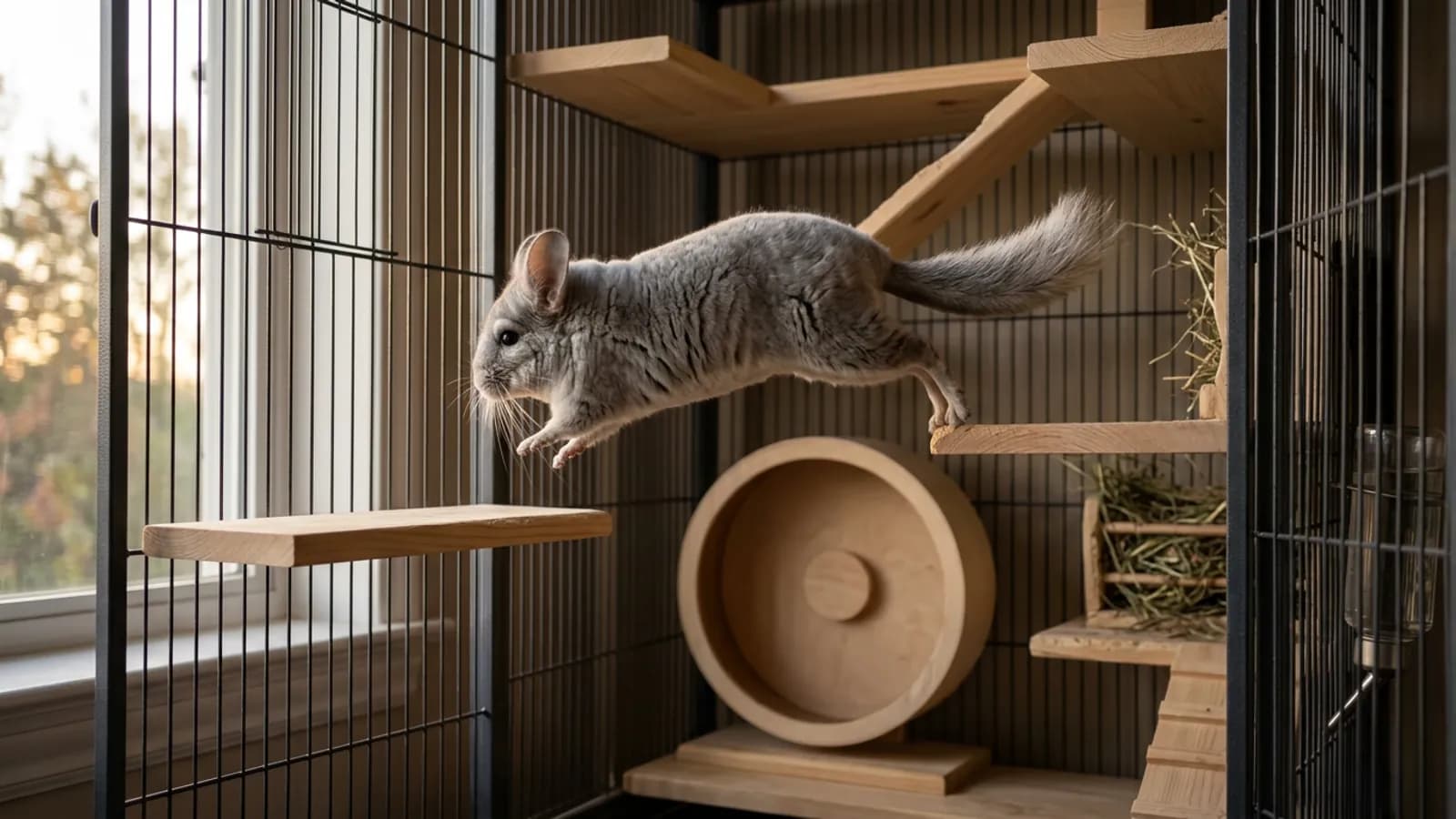
When someone asks me whether a huge chinchilla cage is overkill, I already know what they are really worried about: spending a lot of money on an animal the size of a squashed loaf of bread. I have kept chinchillas for about ten years, and I will say it plainly. The cage most people call generous is the one their chinchilla outgrows the first evening they sit and actually watch it move. Bigger is not indulgence here. It is the floor you build every other good decision on top of, and it is the single thing I would not compromise on if I were starting again from scratch.
Why a huge cage matches how a chinchilla actually moves
A chinchilla does not pace a floor the way a hamster does. Their ancestors live on the rocky slopes of the Andes, and the body reflects it: powerful back legs, a low center of gravity, and a reflex to go up and out when startled rather than along. Mine can clear a couple of feet from a standing start, land on a ledge the width of my hand, and turn around before I have finished blinking. That is not showing off. That is the normal, healthy way the animal is built to spend its energy, and a cage has to give it somewhere to go.
Give that body a small box and the cost is not just boredom. You get muscles that never really work, a chinchilla that starts barbering its own fur, and stereotyped bar-chewing and back-flipping that owners mistake for happy play. A big chinchilla cage is the baseline, not a luxury, and "huge" is simply that instinct followed all the way through instead of trimmed down to fit a shelf. When I moved Pebble from a starter cage into something she could truly launch around in, the change in her within a week told me everything about what the small one had been quietly costing her.
How big is huge, in real numbers
People want a number, so here is an honest one with its edges shown. A minimum that many keepers cite for a single chinchilla is roughly a 2 by 2 foot footprint and about 3 feet of height, and a bonded pair wants more than that. I treat those figures as the floor, the smallest I would call acceptable, not a target to aim at. "Huge" starts where you stop counting square inches and start handing over whole extra levels the chinchilla does not strictly need but will absolutely use. A double-height ferret-style unit, something in the region of 3 feet wide and 5 to 6 feet tall with several full levels, is the kind of space I mean, and mine use every inch of it every night. I would rather someone build up from the minimum toward that than buy exactly the minimum and call the job finished. If you are choosing between two cages, the taller one with more levels almost always wins.
Height beats floor space, every time
Here is the mistake I see most often: someone buys the widest cage on the shelf because wide looks roomy to a human standing in a shop. A chinchilla reads a space completely differently. They want up. A tall cage with several levels gives them far more usable territory than a long, low one with the same footprint, because they treat vertical distance as real, travelable distance. This is why height beats floor space is a rule I repeat until people are sick of hearing it from me.
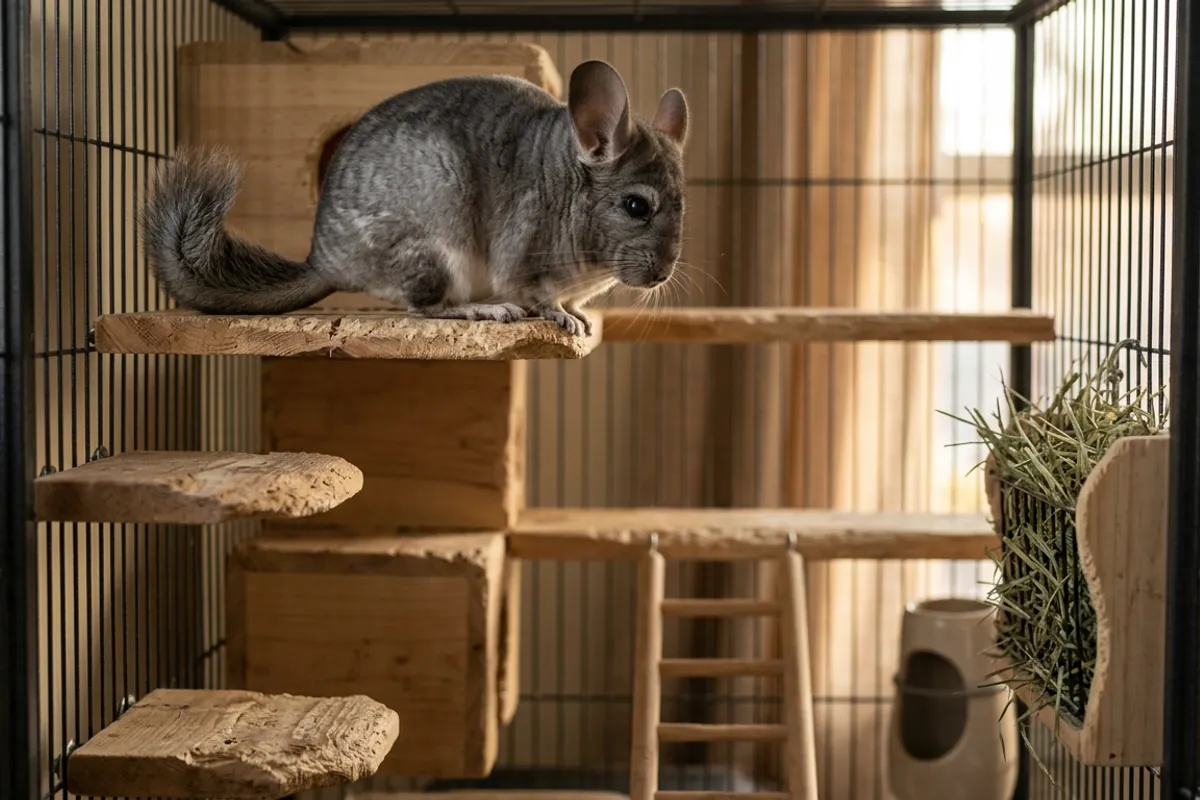
What "huge" should mean, then, is tall first and wide second. Staggered ledges at different heights so there is always a next jump waiting. A multi level chinchilla cage is built for how they move, and once you have watched a chinchilla actually use one, you cannot unsee how much of a single-story cage just sits there empty and wasted. If you only have room to grow in one direction, grow upward.
What a huge cage is actually made of
Size means nothing if the cage is made of the wrong stuff, and plenty of big cages are built badly. Two hard rules. First, metal and wood only. Chinchillas gnaw everything, constantly, because their teeth never stop growing, and plastic they chew comes off in shards that can block a gut. Any tray, ledge, or shelf that is plastic will eventually be eaten, so a real cage is a chinchilla cage that has to be metal with solid wood ledges you can unbolt and replace as they get chewed down.
Second, bar spacing. Keep it to about 1 inch (roughly 2.5 cm) or less. Wider than that and a young or slim chinchilla can squeeze through or get a head stuck, so a huge cage with wide aviary bars becomes a huge trap. The powder-coated wire and solid wood build that most experienced keepers land on is a proven, boring, reliable combination, and boring is exactly what you want in the thing that contains your animal. Critter Nation double unit small animal cage As an Amazon Associate I earn from qualifying purchases. The double-unit ferret-style cages get recommended constantly for a reason, and if that is the direction you are leaning, it is worth reading whether the Critter Nation is right for a chinchilla before you spend the money, because there are small fitting-out details that decide whether it works.
Filling all that space so it is not just empty
A huge cage you leave bare is a waste of the very thing you paid for. The point of the space is to fill it with reasons to move. I run ledges at staggered heights so every level connects by a jump the chinchilla chooses, not a ramp I forced on it. Wooden ledges double as chew surfaces, and I would far rather they wear my ledges down than leave their own incisors unworn.
This is Juniper's lesson, and I learned it the hard way. She came to me as a rescue with dental disease, and managing it day to day is exactly why I am uncompromising about giving them real variety to chew on. A pack of assorted safe woods keeps interest up and keeps teeth working the way constant grinding is supposed to. emours apple wood chew sticks, 40 count As an Amazon Associate I earn from qualifying purchases. Hay lives in the cage at all times, because unlimited grass hay is the whole meal and not a treat, and a good feeder keeps it up off the floor and clean. Oxbow Western Timothy Hay, 40 oz bag As an Amazon Associate I earn from qualifying purchases. If there is a wheel, and in a huge cage there is finally room for a proper one, it must have a solid running surface. A wire or mesh wheel catches toes and tails and breaks legs, full stop. A solid-surface wheel of a big enough diameter that the back does not arch when they run is the only kind I will put in a cage at all. 15 inch Chin Spin solid surface chinchilla wheel As an Amazon Associate I earn from qualifying purchases. They also bathe in dust, never water, so a huge cage has the room for a proper bath house they can roll in without flinging grit into every corner of the setup. Lixit Blue Beauty chinchilla dust, 3 lb As an Amazon Associate I earn from qualifying purchases. Beyond that, keep cage accessories honest: a few good chews, a hide or two, a spot for the dust bath, and plenty of open air to jump through. A huge cage does not need to be cluttered. It needs to be climbable.
A huge cage still has to stay cool
I will not soften this, because it is the part that nearly cost me Pebble. She came from a rehome out of an overheated attic, and her first summer with me brought a heatwave and a night at the emergency vet that I still think about. A big cage does not protect against heat on its own. If anything, a tall cage can trap the warmest air up high, exactly where a chinchilla likes to sit.
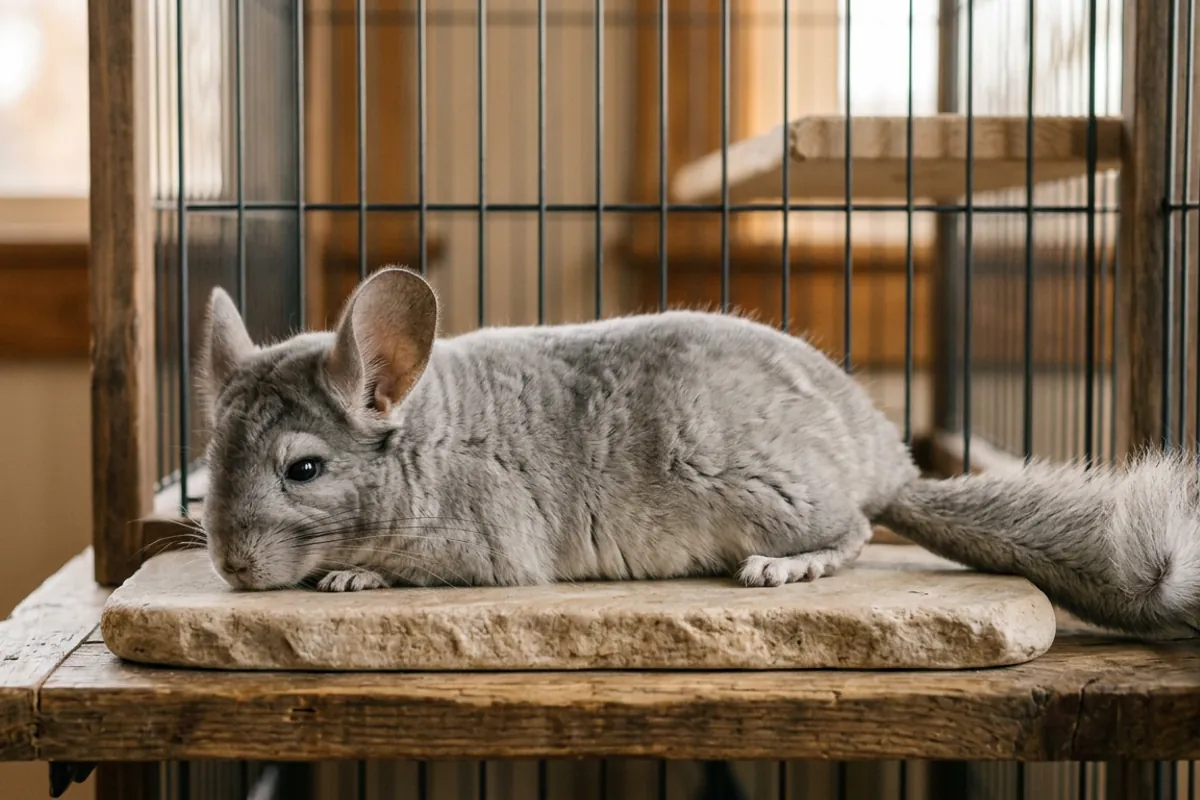
The numbers are not negotiable. Comfortable is 60 to 70°F (15 to 21°C). Above 75°F (24°C) starts to get risky, and 80°F (27°C) and up is an emergency, faster in humid air, because a chinchilla cannot dump heat through that dense fur the way we do by sweating. Put a thermometer on the cage at the height your chinchilla actually sits, not on the far wall of the room, and watch it through summer. digital thermometer and humidity gauge with remote probes As an Amazon Associate I earn from qualifying purchases. A smooth chewable stone slab gives them somewhere to lie and shed heat on a warm day, and it is one of the few passive helps I genuinely trust. Kaytee Chinchilla Chiller granite stone As an Amazon Associate I earn from qualifying purchases. None of that replaces cooling the room itself. If you want to know how close to the line your setup runs, the heat danger calculator is worth a minute, and everything about the temperature that keeps yours alive is worth reading before your first hot spell, not during it. If a chinchilla is already lying flat, ears red, breathing hard, that is a vet call, immediately, cage size be damned.
Cleaning a huge cage without it becoming a chore
The honest downside of huge is that there is more of it to clean, and people who do not plan for that end up resenting the cage they were so excited about. The trick is that metal makes it all manageable. Wipeable trays, a substrate you can scoop or a fleece liner you can wash, and a five-minute spot clean each day so nothing gets a chance to build up. Chinchillas are dry, tidy animals compared with most rodents, which helps a lot, but urine corners and scattered hay still gather.
I do a proper wipe-down once a week and a full strip-down less often than that. The thing that keeps it from becoming a real chore is layout: pull-out pans, ledges that lift out, and doors big enough to get both hands and a cloth inside without a fight. If a cage is a nightmare to reach into, you will clean it less, and a clean chinchilla cage is not optional for their health. Buy for access as much as you buy for size.
When huge is the wrong kind of huge
Bigger is better right up until it stops being safe, and there are versions of "huge" I would send straight back. Tall cages with long, open drops are the main one. A chinchilla that misses a landing and falls the full height of a big cage onto a hard pan can break a leg, and it does happen. The fix is not a shorter cage. It is ledges placed to break the fall, so there is never more than a modest drop between one surface and the next. Think of the levels as a staircase, not a cliff with a floor at the bottom.
The rest of the wrong-huge list: bar spacing wide enough to escape or get stuck in, ramps so steep they are useless, and wire anything underfoot. Older chinchillas need extra thought here too. As they age, joints stiffen and jumps that were once easy get risky, so an old chinchilla may need that same big cage rearranged with lower, closer ledges and softer landings. The space stays generous. You just lower the ceiling on how far they can fall. Get the size right, then get the inside right, and a huge chinchilla cage stops being an extravagance and becomes the plainest good decision you will make for the animal.