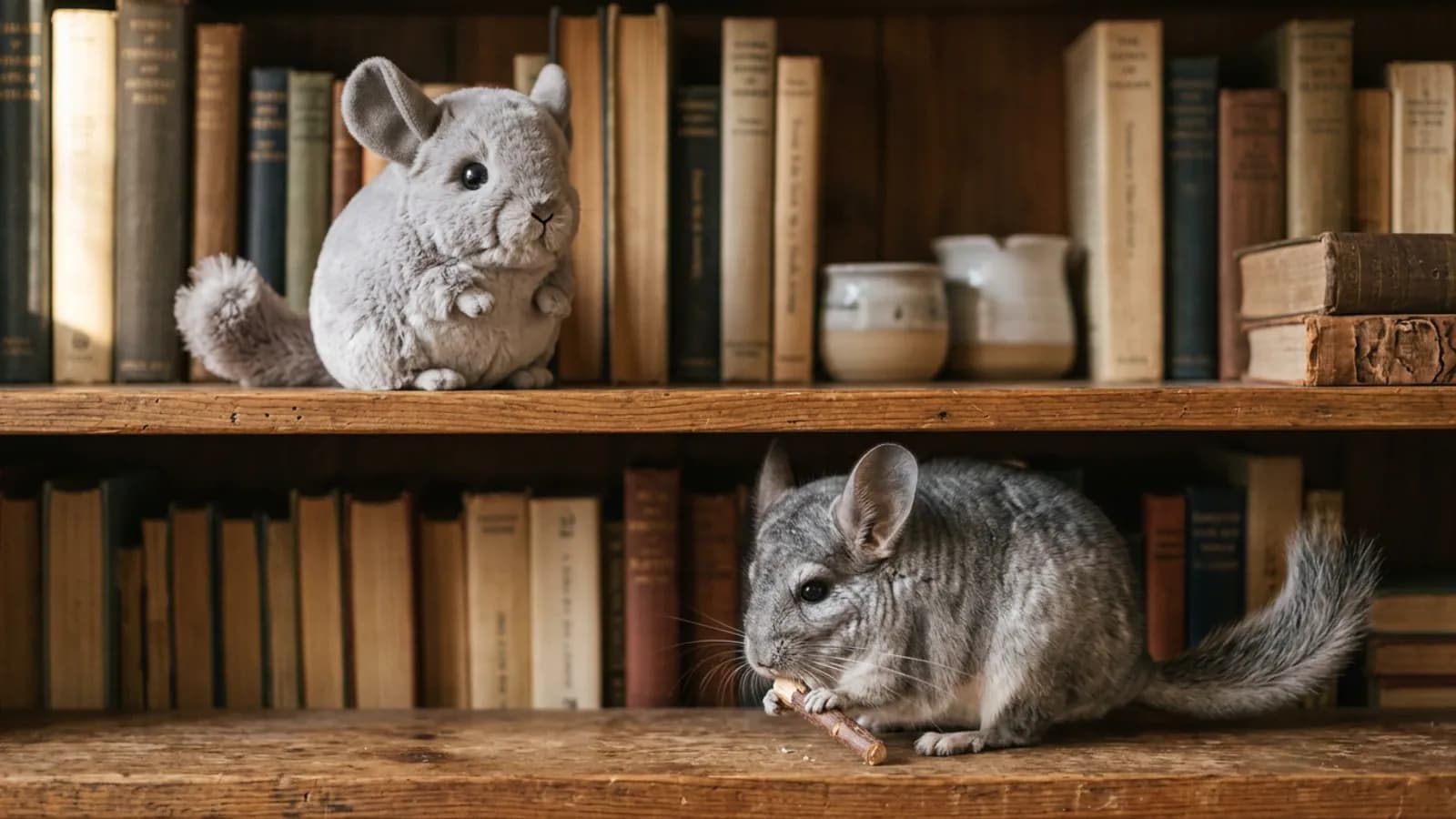
If you searched for a soft toy chinchilla, you probably meant one of two things. Either you want a plush, stuffed version to sit on a shelf, or you have a real chinchilla and you are wondering whether you can tuck something soft and cuddly into the cage so it has a friend to sleep against. The first is harmless and rather sweet. The second is where I need to stop you, because after about ten years of keeping these animals I have watched what a chinchilla does to anything soft, and it is not snuggle it. It shreds it, and then it eats the shreds. This article is about both meanings, and about the wide gap between what a soft toy seems to offer and what a chinchilla actually needs from the things in its cage.
What people mean by a soft toy chinchilla
The phrase covers a surprising range. Some people are shopping for a plush keepsake, the kind of chinchilla-shaped toy you find beside the teddy bears, and they just want one that looks like the real animal. Others already have a chinchilla and they are searching in good faith for cage enrichment, picturing the soft fleece hammocks and stuffed cuddle toys sold for rabbits and guinea pigs. And a third group is looking at the plush because they are deciding whether to get the living animal at all, and the toy is standing in for a decision they have not made yet.
Those are three different needs, and only one of them ends with fabric near a chinchilla. If you are in the first or third group, most of what follows is reassurance and a bit of honest planning. If you are in the second group, please read the next two sections slowly, because the friendly-looking answer is the dangerous one. I cover the pure keepsake angle in more depth in the honest truth about a chinchilla stuffed animal and chinchilla plushie, but the cage question is the one that actually hurts animals, so it goes first.
Why a soft toy does not belong in the cage
A chinchilla is a rodent whose front teeth never stop growing. Chewing is not a hobby for them, it is a biological requirement, the way they keep those teeth from overgrowing into their own jaw. That single fact rewrites how you have to think about everything you put in the enclosure. A guinea pig might sleep on a soft toy and leave it alone. A chinchilla will test it with its teeth within the hour, and once it has found that the thing comes apart, it will keep going.
What comes apart is the problem. Plush toys are fabric skins stuffed with polyester fibre, held together with thread, and finished with plastic eyes and noses glued or riveted on. Every one of those is a hazard to an animal that eats what it chews. Fibre fill and fabric threads are indigestible. A chinchilla's gut is a long, narrow, motion-dependent system built to move a steady stream of hay through it, and a wad of swallowed stuffing is exactly the kind of thing that stops that motion. When the gut stops, you get bloat and a genuine emergency, and there is no home remedy for it. That is an exotics vet visit, fast, and even then the outcome is not guaranteed.
Plastic eyes are worse in their own way, because they are small, hard, and the perfect size to be gnawed loose and swallowed or lodged. I will not put anything plastic in a chinchilla cage at all, toys included, and I am blunt about it because the failure mode is a choking animal at two in the morning. There is no soft toy chinchilla product on the market that is designed and tested to survive a chinchilla, because the animal that destroys it is not the animal it is sold for.
What a chinchilla actually does with fabric and stuffing
I want to be specific here rather than just waving the word "dangerous" around. When people picture a chinchilla with a soft toy, they picture cuddling. What actually happens is closer to demolition. The chinchilla grabs the fabric in its front paws, braces it, and works the seam with those constantly growing incisors until it opens. Then it pulls the stuffing out in tufts. Some of it becomes nesting material scattered around the cage, and some of it goes down the hatch, because chewing and tasting are the same investigation for a rodent.
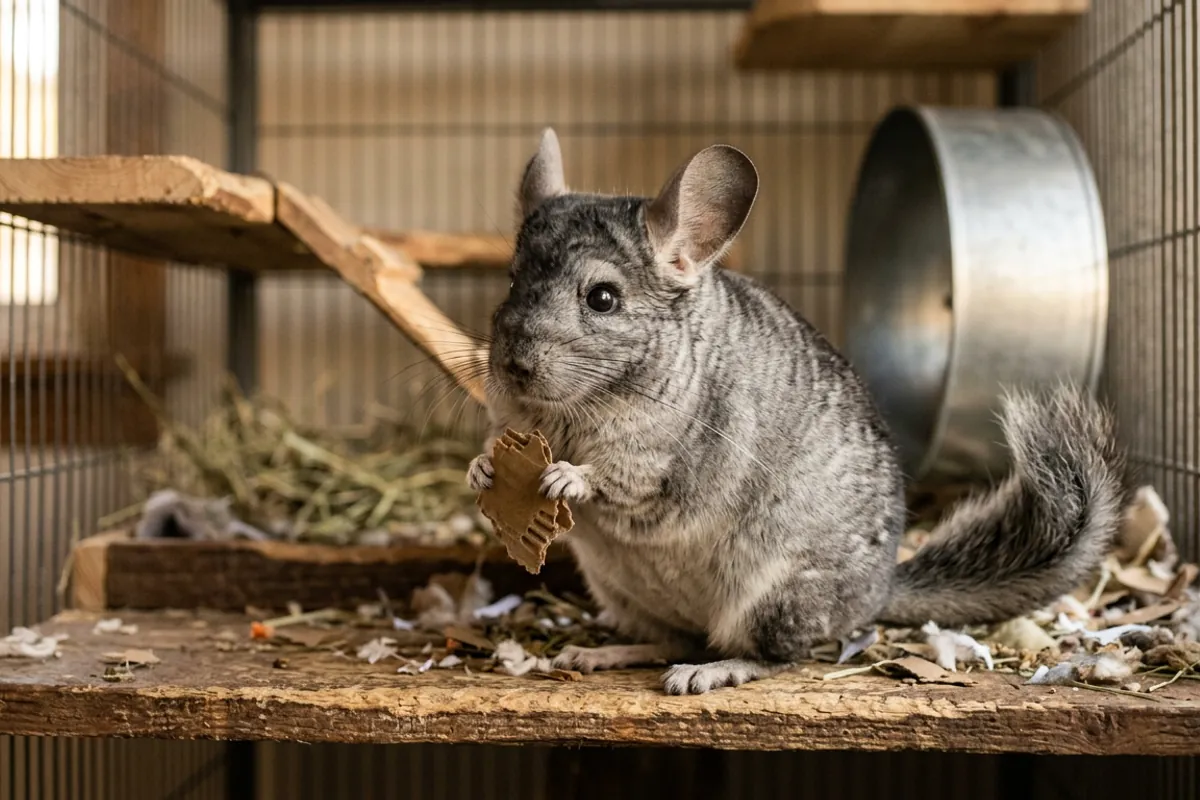
Fleece hammocks and fabric hideouts sold for other small pets fail the same way. I have seen fleece work for some keepers who supervise closely and pull it the moment there is a nibbled edge, but I do not recommend it as a default, and I would never leave a fabric item in overnight with an animal that chews when it is bored and bored when it is awake. If you have ever watched a chinchilla systematically dismantle a cardboard tube, you already know how a plush toy ends. The difference is that shredded cardboard is a normal, safe thing for them to play with, and shredded polyester is not.
There is also a heat angle that people never think about. A soft toy is an insulator. A chinchilla that curls against a warm, fibre-filled object on a hot day is trapping heat against a coat that is already the densest fur of any land mammal and cannot shed heat quickly. My Pebble came to me out of an overheated attic, and her first summer included a heatwave near-miss and a night at the emergency vet, so I am relentless about anything that makes it harder for a chinchilla to stay cool. A cuddly toy in a warm room is working against you. What you actually want in the cage in summer is the opposite of insulation, a cool hard surface the animal can stretch out on, which is why I keep a chilled stone in the enclosure instead. Kaytee Chinchilla Chiller granite stone As an Amazon Associate I earn from qualifying purchases.
For the full picture of why heat is the thing I never soften, read chinchilla heat safety, and if you want to know exactly how warm is too warm for your room, the chinchilla heat danger calculator turns the numbers into a plain answer. The short version stays the same: comfortable is 60 to 70°F (15 to 21°C), above 75°F (24°C) is getting risky, and 80°F (27°C) and up is an emergency, faster in humid air.
The enrichment a chinchilla genuinely needs instead
So if the cuddly toy is out, what goes in? The honest answer is that a chinchilla's idea of a good time is not a soft friend, it is things to chew, things to climb, and room to jump. Their enrichment is functional. It keeps the teeth worn down and the body moving, and it happens to be fun for them precisely because it satisfies those drives.
Wood is the centrepiece. Untreated, chinchilla-safe woods like apple, pear, willow, and kiln-dried pine give them something to gnaw that is meant to be destroyed, which is exactly the outcome a plush toy fails at safely. A variety of shapes and hardnesses keeps them interested and works the teeth from different angles. emours apple wood chew sticks, 40 count As an Amazon Associate I earn from qualifying purchases.
My Juniper is the reason I am uncompromising about this. She came to me as a neglected rescue with dental disease, and I manage her overgrown teeth day to day. Watching up close what happens when teeth do not get worn down turned chew variety from a nice-to-have into a rule in my house. If you want the reasoning laid out properly, chinchilla chew toys explains why I treat chews as dental care rather than decoration, and chinchilla teeth and health covers what dental trouble actually looks like before it turns serious.
Beyond wood, the good enrichment is structural. Wooden ledges at different heights turn a tall cage into a climbing gym. Loofah, plain seagrass mats, and cardboard tubes give them softer things to demolish that are safe to swallow in the small amounts they manage. None of it is cuddly, and none of it needs to be. A chinchilla is not looking for a security blanket. It is looking for a job.
Wood, wheels, and the things that are safe to chew
Since we are on cage contents, let me name the two pieces of gear people most often get wrong, because getting them wrong is as harmful as a soft toy and much more common.
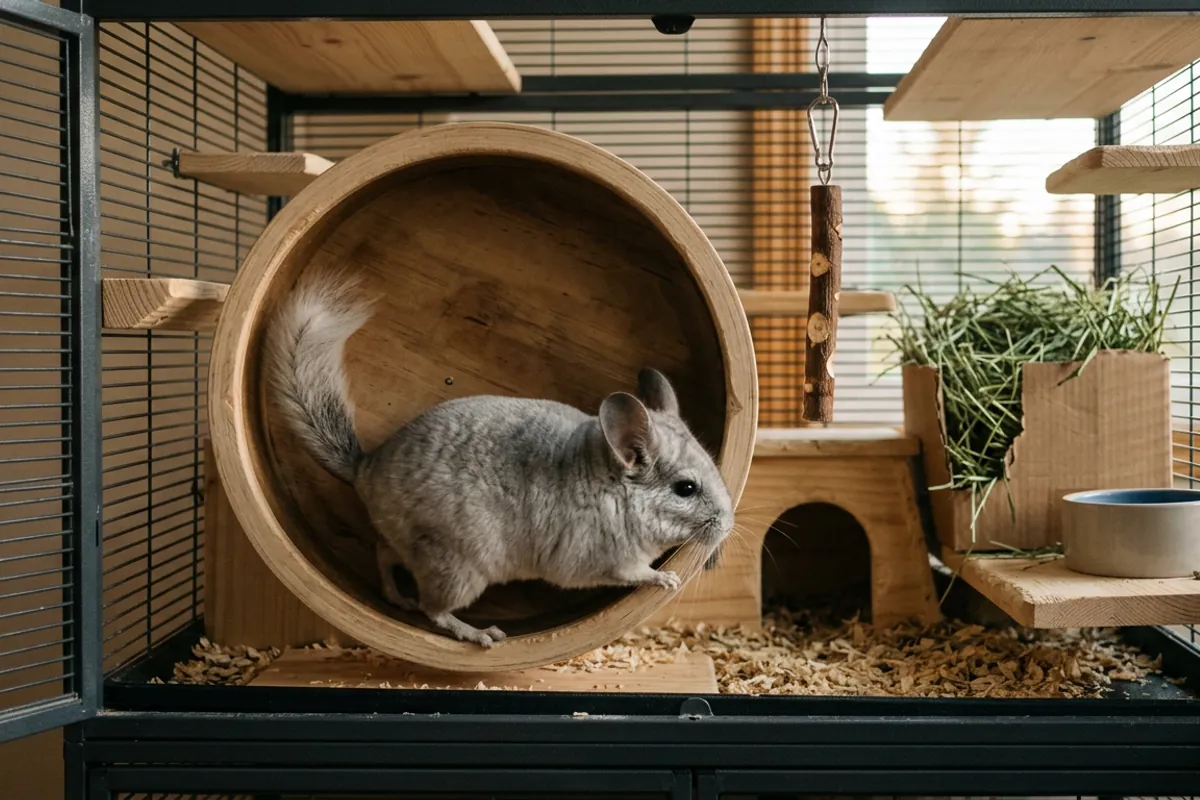
The wheel first. A chinchilla needs to run, and a good solid-surface wheel is one of the best things you can put in the enclosure. What matters is that the running surface is solid, not wire rungs and not a mesh. Wire wheels catch feet and tails and cause real injuries, and I will name them plainly as the wrong buy. A large solid wheel, sized so the animal runs with a straight back rather than an arched one, is the version that is safe to leave in around the clock. 15 inch Chin Spin solid surface chinchilla wheel As an Amazon Associate I earn from qualifying purchases.
The cage itself is the other one. A soft toy will not save a chinchilla that lives in a plastic-bottomed, too-small enclosure. What you want is tall, with a metal frame and wooden ledges and no plastic surfaces for the animal to chew, because plastic is both a chewing hazard and impossible to gnaw safely. Critter Nation double unit small animal cage As an Amazon Associate I earn from qualifying purchases.
If you are still setting up, I would rather you spend your money here than on anything cuddly. How to build a chinchilla cage setup that keeps the animal healthy and chinchilla cage setup walk through the whole layout, and is the Critter Nation cage right for a chinchilla covers the specific cage most keepers land on.
While we are listing what actually goes in a cage: the two things a chinchilla genuinely cannot do without are unlimited grass hay and a dust bath. Hay is the whole foundation of the diet, available at all times, with plain pellets as a measured supplement on top and treats kept rare. Oxbow Western Timothy Hay, 40 oz bag As an Amazon Associate I earn from qualifying purchases.
And the bath is dust, never water. A chinchilla rolls in fine volcanic pumice dust to keep that dense coat clean, and it must never be bathed in water, because that coat holds moisture against the skin and takes ages to dry. Lixit Blue Beauty chinchilla dust, 3 lb As an Amazon Associate I earn from qualifying purchases.
I put more detail into chinchilla diet, food, and hay and the chinchilla dust bath, done right from dust to schedule, but the pairing is the point: hay plus dust is the non-negotiable core, and a soft toy is nowhere on the list.
Buying the plush as a keepsake, not a cage item
Now the happy version. If what you want is a soft toy chinchilla for a shelf, a gift, or a child who loves the real animals, buy it and enjoy it. A plush chinchilla is a lovely thing, and there is nothing to warn you about as long as it stays out of a real chinchilla's cage. Keep it on the bookshelf, not the ledge.
A few honest notes if you want one that actually looks like the animal. Real chinchillas have very dense silver-gray fur in the standard coat, large rounded ears, a bushy tail, and a compact rounded body. Most plush versions get the ears and tail roughly right and the proportions a bit cartoonish, which is fine for a toy. If you care about the colours, the plush aisle will not teach you much, so what a brown chinchilla really is and what a white chinchilla actually is are better guides to what the real coats look like than any stuffed toy. And if the plush is a stand-in for a pet you are hoping to buy someday, the plush is the cheap part. The living animal is a decade-long commitment with real costs, which I lay out without sugar-coating in what a chinchilla really costs.
When the soft toy is the safer choice, for now
I will end on the honest thing, because I would rather say it than have you find out later. Sometimes the soft toy chinchilla is the right answer and the real one is not, at least not yet. A chinchilla is a crepuscular, long-lived, heat-sensitive animal that needs a cool room, a tall cage, unlimited hay, daily dust and out-of-cage time, and a chunk of savings set aside for an exotics vet who sees exotics. It is not a cuddly pet in the way a plush toy promises. They do not generally love being held, they are most active when you are winding down for the night, and they will not curl up in your lap like the toy suggests.
If you read that and the living animal still sounds right, wonderful, and chinchilla as pets, the honest version after ten years is where I would send you next. But if you read it and realise the timing is wrong, or the house runs too warm, or the budget is not there, then the plush on the shelf is not a consolation prize. It is you making a responsible call for an animal you have not brought home yet. That is a good decision, not a failed one.
The through-line across all three meanings is the same. A soft toy is soft because it is meant to be held. A chinchilla's cage is full of hard, chewable, functional things because the animal in it has teeth that never stop growing and a gut that cannot handle stuffing. Keep the two apart, give the real animal wood and hay and dust and a solid wheel, and let the cuddly one live where it belongs, safely out of reach of the only creature that would ever try to eat it.