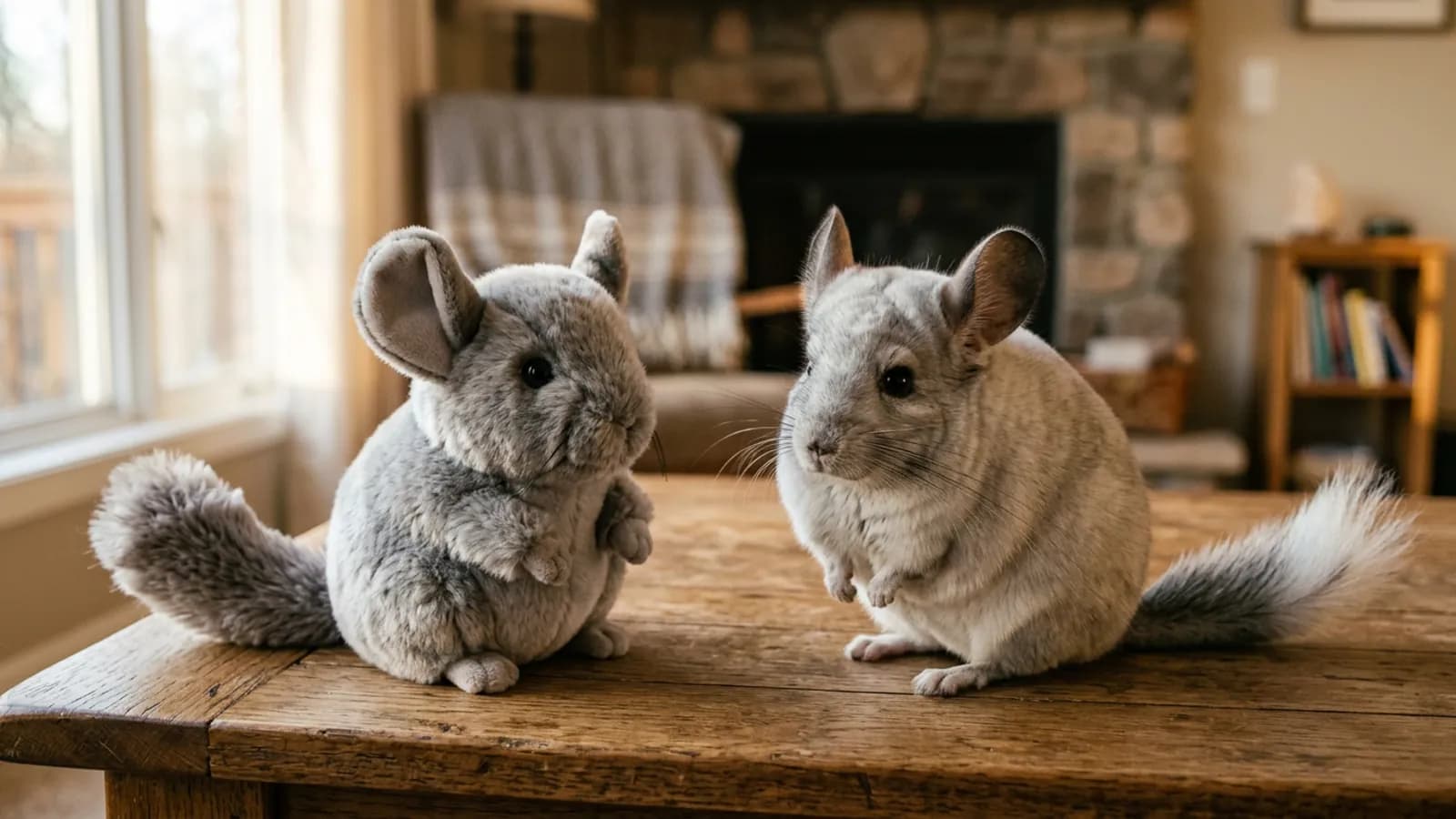
A chinchilla plushie is one of the few chinchilla things you can buy that asks nothing of a living animal, and that is exactly why I like it and exactly why I worry about it. A soft toy shaped like a chinchilla is a gift, a comfort object, a way for a kid to love the idea of the animal before anyone signs up for the real one. I have no problem with that. What I have watched happen, over about ten years of keeping these animals, is people meeting the plushie first and quietly deciding that the real thing is a slightly warmer, slightly wigglier version of it. It is not. So this is a piece about the plushie itself, and about the exact places where the plush version and the real animal pull apart, because the gap between them is where real chinchillas get hurt.
What the plushie gets right, and what it quietly gets wrong
A good chinchilla plushie captures the silhouette well. The round body, the oversized head, the big rounded ears, the bottlebrush tail that is genuinely that bushy in life. Toy makers exaggerate the ears and the eyes, but honestly not by much, because a real chinchilla already looks like a cartoon of a rodent. If you have only ever seen the plushie, the live animal will not shock you on shape.
Two things the plushie almost always gets wrong. The first is size. Plushies come in every scale, from keychain to body pillow, and none of them tell you that an adult chinchilla is a small animal, roughly the length of your forearm with the tail, light in the hand, mostly fur. People who grew up hugging a big plushie are sometimes surprised by how little there is to actually hold.
The second is the fur, and this one matters more than it sounds. Plush fabric is soft in a slick, matted, brush-it-flat way. Real chinchilla fur is not like that at all. It is the densest fur of any land mammal, something like fifty to eighty hairs growing from a single follicle, and the effect in your hand is less like petting a cat and more like pressing into a cloud that pushes back. That density is also the whole reason for the strangest rule in chinchilla care, and the plushie erases it completely.
Why the fur means never water, only dust
Here is the fact the plushie will never teach a child, and the one I most want people to carry out of this article. That incredibly dense coat cannot get wet and dry properly. Water soaks down to the skin, the fur mats, it stays damp against the body for a long time, and damp fur against skin grows fungus. A wet chinchilla is not a cute bath scene, it is a health problem. If you ever see a real chinchilla with a soaked coat or a wet chin, that is a reason to slow down and figure out why, and I wrote out both meanings in chinchilla wet.
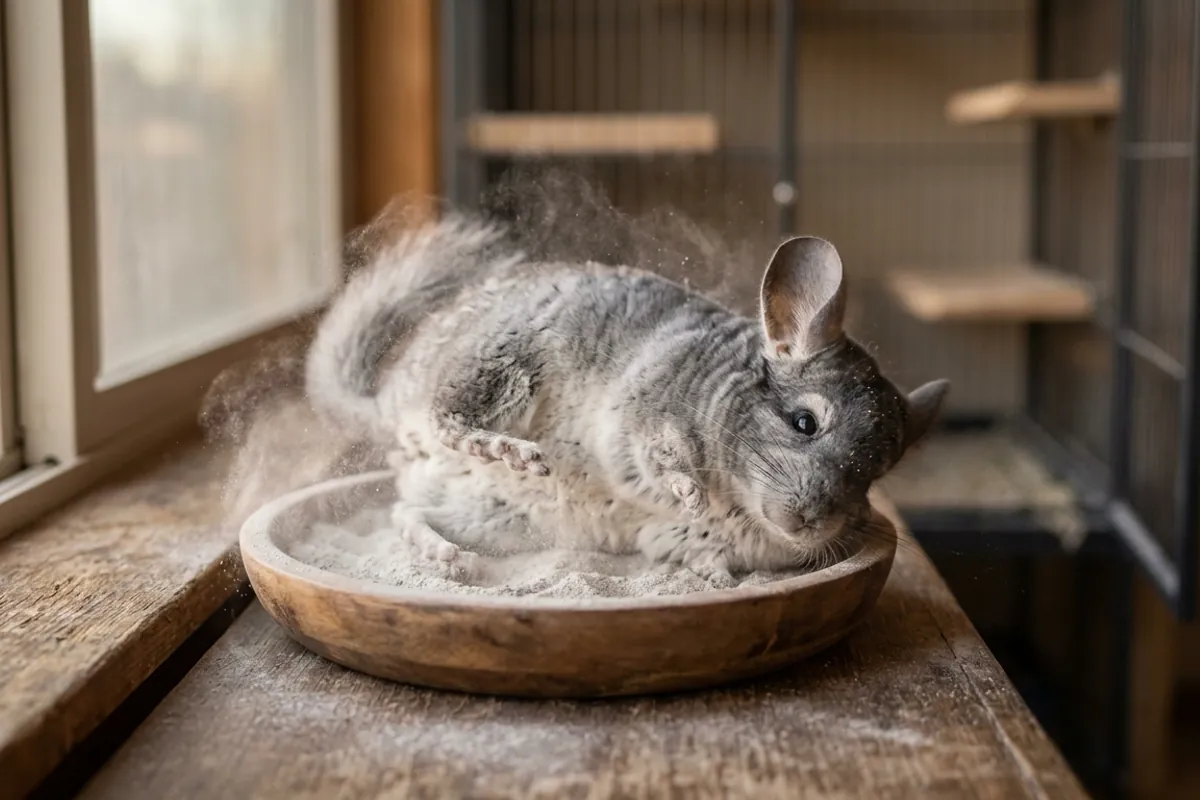
So chinchillas clean themselves in dust, not water. Not dirt from the garden, but a fine volcanic pumice dust that slides down into the coat, absorbs oil and moisture, and gets shaken back out. You give them a bowl or a house of it a few times a week and they roll in it, and it is genuinely one of the funniest things they do. A tub of the proper dust is cheap and lasts a long time.
Lixit Blue Beauty chinchilla dust, 3 lb As an Amazon Associate I earn from qualifying purchases.
If you want the actual how of it, the frequency, the depth of dust, when to take the bath away in humidity, I put it all in the chinchilla dust bath, done right. The short version for a plushie owner thinking about the real thing: the animal you saw as a squeezable toy is one you must never wash, and getting that backwards is a common, avoidable mistake.
The plushie invites cuddling, the real one usually does not
This is the expectation gap that does the most quiet damage. A plushie exists to be squeezed, held to a chest, slept on, dragged around. Every design cue says hug me. A real chinchilla, on the whole, does not want to be hugged.
They are prey animals built to explode out of a predator's grip, and being scooped up, held tight, and cuddled against a body reads to them as being caught. Some chinchillas, with patient handling from young, will tolerate short holds and sit on a shoulder. Plenty never fully love it. What they generally do enjoy is being near you, coming to the bars for a treat, taking food from your fingers, doing zoomies around a room you are sitting in. The relationship is real, but it is on their terms, and it looks nothing like cuddling a plushie.
Where this turns dangerous is with a child who has bonded with the toy and expects the live animal to behave the same way. A gripped, frightened chinchilla can slip a patch of fur on purpose, a defense called fur slip that leaves a bald spot for weeks, or it can be dropped and injured because it kicked free. If a plushie is a step toward a real animal for a kid, the honest framing is not "you get a soft thing to hold." It is "you get a fast, delicate wild-tempered animal you earn the trust of slowly." I laid out that whole reality in chinchillas as pets, the honest version.
Everything the plushie can never show you
A plushie is a chinchilla with the entire care load deleted. It never eats, never chews, never overheats, and that is precisely the information a first-time owner needs and a toy cannot give. Three of those deletions are the ones that kill real animals.
Food. A chinchilla's gut is built to process grass all day. The base of the diet is unlimited grass hay, timothy or a similar meadow hay, in front of them constantly, not as a snack but as the main event. A measured amount of plain pellets rounds it out, and treats are tiny and rare. That is the whole honest diet, and I keep good hay stocked in bulk because the animals go through a surprising amount of it.
Oxbow Western Timothy Hay, 40 oz bag As an Amazon Associate I earn from qualifying purchases.
Teeth. This is the one I am least willing to soften, because I live with it. My Juniper came to me as a neglected rescue with dental disease, and I manage her teeth every single day. Chinchilla teeth never stop growing, and the only thing that keeps them worn down to a safe length is constant chewing, mostly on that hay and on safe wood. Give them a real variety of chews, plain untreated apple or willow wood and the like, because the grinding is doing dental work, not decorating the cage.
emours apple wood chew sticks, 40 count As an Amazon Associate I earn from qualifying purchases.
When the wear fails, the teeth overgrow into the jaw and the cheeks, the animal drools, stops eating, and drops weight fast, and that is a vet visit, not something you fix at home. If you want to know what you are watching for, I wrote it plainly in chinchilla teeth problems and spotting malocclusion. A plushie has a permanent, painless smile. A real chinchilla's mouth is the single most important thing to get right.
Heat. This is Pebble's story, and it is why I am relentless about it. I adopted her out of an overheated attic, and her first summer brought a heatwave that nearly killed her and put us in an emergency vet's office overnight. That night is why the heat rules on this whole site are as hard as they are. A plushie is comfortable at any temperature. A real chinchilla is not, and the margins are narrow.
The heat rules a plushie will never warn you about
A chinchilla carries that record-breaking coat with no way to shed it and a very poor ability to cool itself. Comfortable for them is 60 to 70°F, which is 15 to 21°C. Above 75°F, or 24°C, you are into risky territory. At 80°F, 27°C, and up you are in an emergency, and it comes faster in humid air because they cannot dump heat efficiently when the air is already wet.
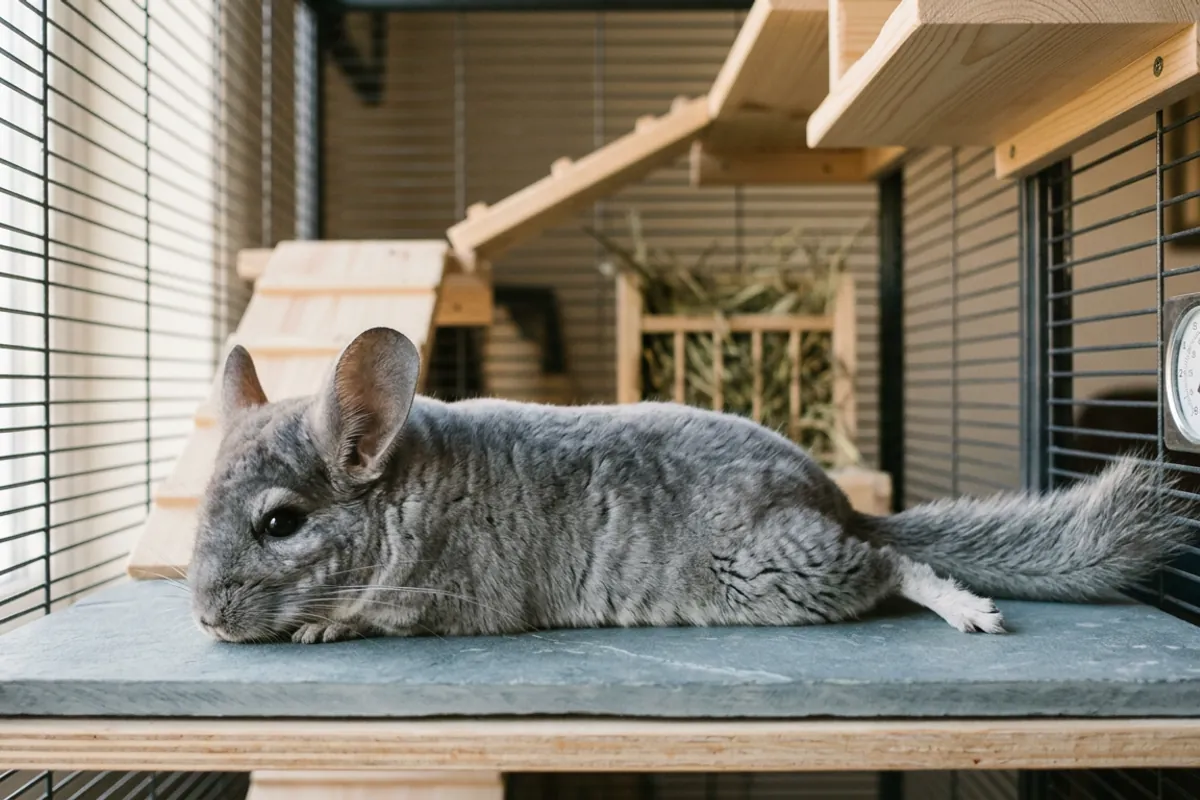
Nothing about a plushie tells a new owner that the animal they want to bring home needs a room kept genuinely cool, watched with a thermometer, not guessed at. I keep a simple thermometer and humidity gauge right on the cage so I am reading the animal's actual air, not the thermostat across the house.
digital thermometer and humidity gauge with remote probes As an Amazon Associate I earn from qualifying purchases.
A cooling stone gives them a cold surface to stretch out on and pull heat off their belly, and it helps, but it is a comfort measure, not a rescue.
Kaytee Chinchilla Chiller granite stone As an Amazon Associate I earn from qualifying purchases.
None of it replaces keeping the room cold in the first place. If you take one number away from a plushie into real ownership, take the ceiling. Above 75°F is a problem, and you can run the specifics through the heat danger calculator or read the warning signs in chinchilla heat stroke. This is the part I refuse to make friendlier than it is.
Choosing a plushie that is actually safe
So let us say you just want the plushie, as a toy, which is a completely good thing to want. There are still a couple of things worth checking, mostly if a young child or a real chinchilla is going to be near it.
For a child's toy, look at the small parts. Cheap plushies use glued-on plastic eyes and noses that pop off and become a choking hazard, so for a small kid I lean toward toys with embroidered features. Check the seams and the stuffing quality if it is going to be dragged and slept on for years, because a burst seam spills fill.
If you keep a real chinchilla, keep the plushie away from the cage. This sounds obvious and I have still seen it go wrong. A chinchilla will chew anything within reach, and plush fabric, polyester fill, plastic eyes, and glue are exactly the things that cause a gut blockage if swallowed. Their whole world is safe untreated wood and hay for a reason. A plushie is a human's toy, not an enrichment item for the animal, and it should never go in the enclosure. Real cage enrichment is a different list entirely, and I walk through it in chinchilla chew toys as dental care.
If the plushie is a step toward the real animal
A lot of chinchilla plushies get bought for a kid who is asking for the real thing, and the toy becomes a stand-in while everyone decides. Used that way, it is genuinely useful, as long as the adults are honest about the distance between the two.
Before a live animal comes home, the real setup has to exist first, and it is more than most people expect from something this small. A tall metal-and-wood cage with wooden ledges, no plastic and no wire floors, because wire ruins feet and plastic gets eaten.
Critter Nation double unit small animal cage As an Amazon Associate I earn from qualifying purchases.
A solid-surface running wheel, never the wire or rung kind that traps and breaks legs.
15 inch Chin Spin solid surface chinchilla wheel As an Amazon Associate I earn from qualifying purchases.
Unlimited hay, the dust bath, the cool room, the vet fund for the exotics vet you will eventually need. The real number on all of this surprises people, so I broke down what a chinchilla actually costs, and I would rather someone read that with the plushie still in the box than find out afterward.
Chinchillas also live a long time, commonly ten to twenty years with good care, which I covered in how long chinchillas really live. A plushie is a moment's gift. A real chinchilla is a decade-and-then-some commitment to an animal that needs specific food, careful teeth, and a cold room to stay alive. Both are fine choices. They are just not the same choice, and the plushie's job, when it is doing its best work, is to hold the love while the adults find out whether they are ready for the second one.
The honest place a plushie has
I am not down on the chinchilla plushie at all. It is a lovely thing to own. It comforts kids, it makes a good gift, it lets someone who cannot keep the real animal, because of a warm apartment or a busy life or an allergy, still have a chinchilla on the shelf. Used as what it is, a toy, it is entirely good.
The only failure mode is quiet and it is this: letting the plushie set the expectations for the living animal. The soft squeezable toy is the opposite of the real chinchilla in almost every way that matters. The real one must never get wet, mostly does not want to be cuddled, needs hay in front of it every hour of every day, needs its teeth worn down constantly, and will die in a room a plushie would sit in happily. Love the plushie for being simple. Just do not let its simplicity write the care manual for something alive. If you want the real manual, plainly and without the marketing, start with what a chinchilla really is and let the biology set the rules.