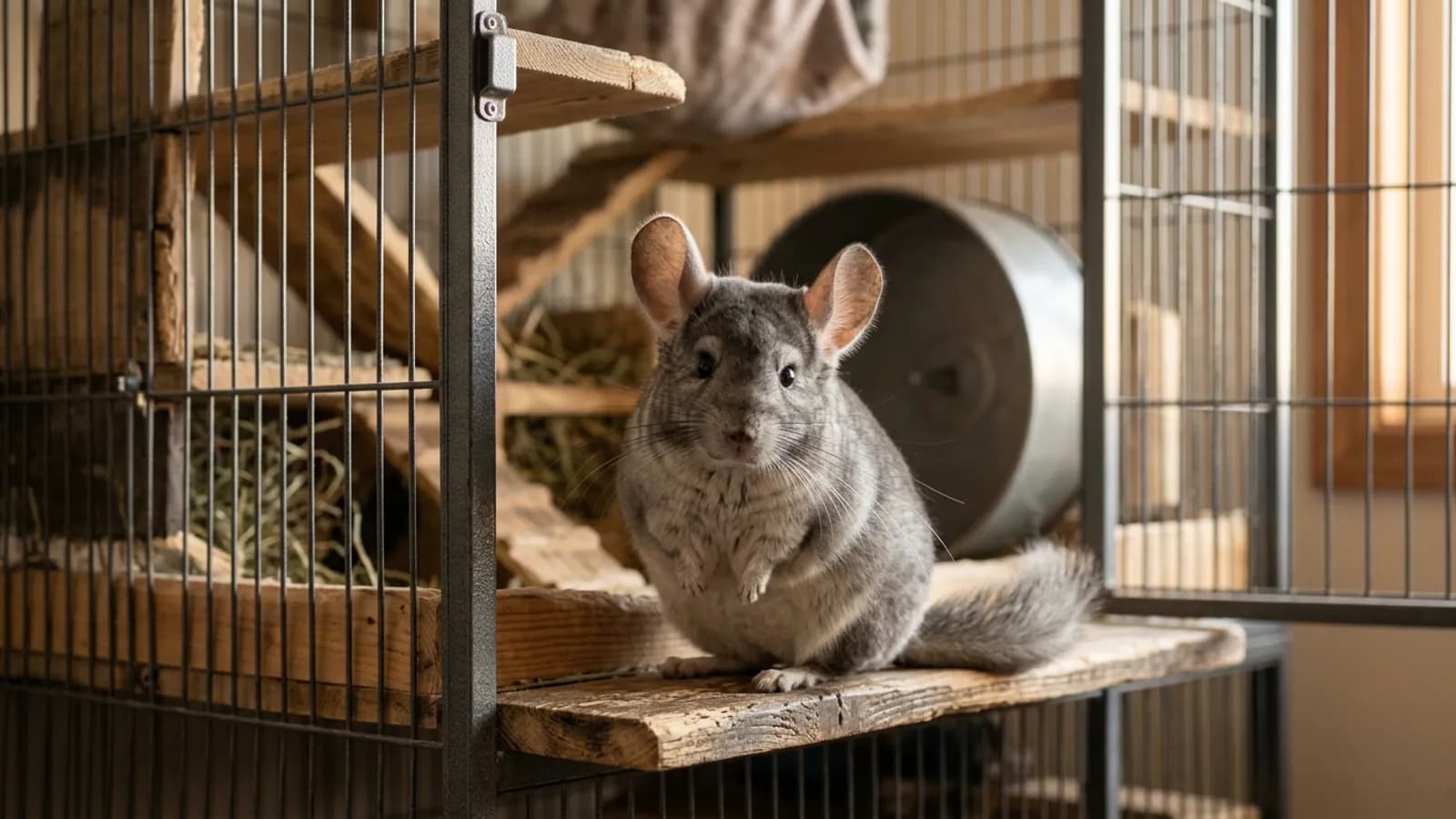
If you have ever typed "bunny chinchilla" into a search bar, you are probably one of two people. Either you saw a rabbit labeled a "chinchilla" at a shelter or a show and wondered what on earth that meant, or you are trying to decide between a bunny and a chinchilla as your next pet and the two keep blurring together in your head. Both are fair questions, and the honest answer clears up a lot at once: there is a rabbit breed called the Chinchilla, and there is the animal I actually keep, the chinchilla, a South American rodent that is not a rabbit at all. I have lived with chinchillas for about ten years, and I want to untangle the two for you plainly, because the care rules for one will hurt the other.
Why "bunny chinchilla" is really two different animals
The confusion is not your fault. Breeders in the early twentieth century developed a rabbit whose coat, when you blow into it, ripples in bands of slate gray, pearl, and dark tips, exactly the way a real chinchilla's fur does. They named the rabbit for that resemblance. So the "Chinchilla rabbit" is a bunny, full stop. It hops, it has the long upright ears and the split lip of a rabbit, and it lives and eats like a rabbit.
The chinchilla I keep is a different creature entirely. It is a rodent from the high, dry Andes, closer on the family tree to a guinea pig than to any rabbit. It does not hop like a bunny; it springs and climbs vertically, off walls and ledges, because in the wild it lives among rocks. Its fur is the densest of almost any land mammal, which is beautiful and also the single fact that governs everything about its care. So when someone says "bunny chinchilla," they have usually collided two animals that only share a coat pattern and a name. If you want the full picture of the rodent itself, I keep a plain-language rundown in what a chinchilla really is and across the broader chinchilla care pages.
Chinchilla types, and the "king chinchilla" myth
Because the rabbit muddies the water, people reach for search terms that make it worse. Let me clear a few of them.
There is no "king chinchilla" or "chinchilla king" as a species or a breed. If you see that phrase, it is almost always a shop name, a cattery brand, or a rabbit-show designation, not a kind of animal you can go buy. The real chinchilla types are simpler than the internet suggests. In the wild there are two species: the long-tailed chinchilla and the short-tailed chinchilla. Nearly every pet chinchilla alive today descends from the long-tailed line. What varies among pets is color, not species: the standard gray you picture, plus color mutations like beige, ebony, white, violet, and sapphire that breeders have selected over decades. Those are coat colors, not separate animals, and none of them changes how you care for the chinchilla.
The other phrase worth killing is "miniature chinchilla." There is no dwarf or teacup chinchilla. Adults land in a fairly narrow size band regardless of color, roughly a pound to a pound and a half, with females usually a touch larger than males. If a seller is advertising a "mini" or "miniature" chinchilla, treat it as marketing at best and a warning sign at worst. A too-small youngster is more likely underage, underweight, or unwell than a special breed. When you go looking, my guide to buying a chinchilla for sale without getting hurt or ripped off walks through the red flags.
Bunny and chinchilla: how the care actually diverges
If you are genuinely choosing between a bunny and a chinchilla, know that the day-to-day work is not the same, and the mistakes are not interchangeable. This is where treating them as one "bunny chinchilla" concept gets an animal hurt.
Rabbits tolerate a wide range of household temperatures and can, with care, live at least partly outdoors in many climates. A chinchilla cannot. That thick coat that earned the rabbit its name is a liability indoors: a chinchilla carries a built-in winter parka it can never take off, so it overheats fast and cannot sweat its way out of trouble. Rabbits will happily take a gentle bath in water if they get truly filthy; a chinchilla must never, ever touch water for grooming, because that dense fur soaks like a sponge, will not dry to the skin, and grows fungus. A bunny grooms by licking and the occasional water clean; a chinchilla grooms by rolling in dust. These are opposite instructions for the same job.
Both animals do share one thing, and it is the most important thing: both are hindgut fermenters that need unlimited grass hay as the foundation of the diet, and both have teeth that never stop growing. But even there the details differ, and feeding a chinchilla a rabbit's diet, or vice versa, is a slow way to make an animal sick. So no, you cannot simply apply what you read on a rabbit forum to a chinchilla, and that is exactly why generic "bunny chinchilla" advice is dangerous.
What a chinchilla really needs, and the number that matters most
If you take one piece of chinchilla info from this whole article, take the temperature. A comfortable chinchilla lives at 60 to 70°F (15 to 21°C). Above 75°F (24°C) you are into risky territory, and 80°F (27°C) and up is an emergency, faster and deadlier when the air is humid, because humidity strips away what little cooling that fur can manage.
I am relentless about this for a reason. My Pebble came to me as a rehome out of an overheated attic, and her first summer with me brought a heatwave that ended in a night at the emergency vet. That scare is why the heat guidance on this site reads like law rather than suggestion. Do not put the cage in a sunny window, do not rely on a fan alone (a fan moves hot air past an animal that cannot sweat, which does far less than people assume), and in summer run air conditioning or move the chinchilla to the coolest room in the house. Learn the early warning signs before you need them, and when in doubt, cool the animal and call an exotics vet. I keep the full playbook in chinchilla heat safety and a specific list of symptoms in heat stroke warning signs every owner should know. There is even a heat danger calculator if you want to check your own room against the humidity.
The diet is the second pillar, and it is refreshingly boring. Unlimited grass hay, always available, is the whole foundation, timothy or orchard or another quality grass hay. On top of that, a measured amount of plain chinchilla pellets, not a colorful muesli mix full of seeds and dried fruit, which chinchillas pick through and which wreck the diet. Fresh water always. Treats are rare and simple, and most "chinchilla treats" on shelves are sugar the animal cannot process. My rescue Juniper came to me with dental disease I manage every single day, and watching her is what made me uncompromising about unlimited hay and a real variety of chews: teeth that do not get worn down keep growing into the jaw. The details live in chinchilla diet, food, and hay, and the reason it matters so much is spelled out in chinchilla teeth and health.
Chinchilla grooming: dust, never water
Grooming a chinchilla is the point where the bunny comparison breaks completely, so it deserves its own space. A chinchilla grooms in a dust bath. The "dust" is a fine volcanic pumice powder that slips down through the coat to the skin, lifts oil and moisture, and gets shaken back out. Watching it is one of the joys of keeping them: they flip and roll like they are having the time of their lives, and honestly they are.
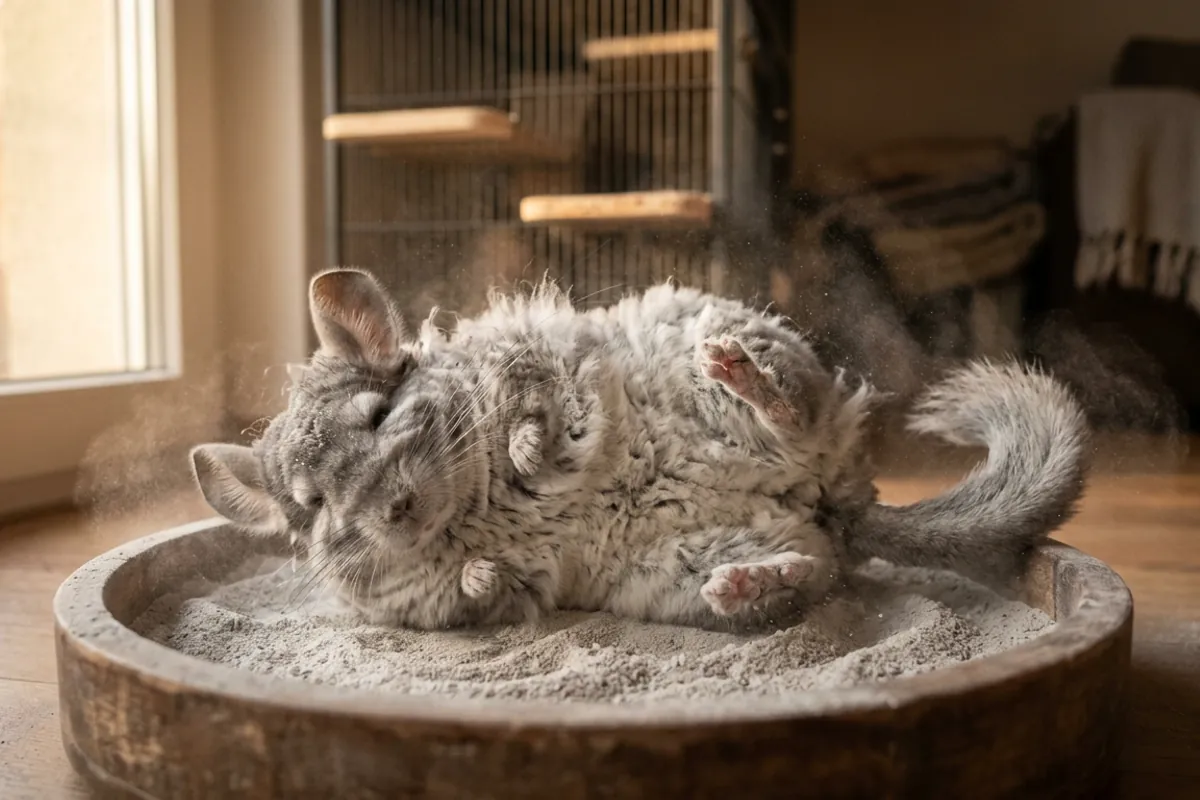
Give the dust bath a few times a week, ten to fifteen minutes at a time, then take it out. Leaving the bath in the cage sounds kind but is not: the chinchilla will use it as a litter box and sit in soiled dust, and constant bathing dries the skin. In humid weather they may need it a little more often to stay dry; in a damp climate this is not optional, because a chinchilla that cannot dry its coat is a chinchilla growing fungus. Use a proper chinchilla dust, not sand, and not a substitute someone recommends to save money.
Lixit Blue Beauty chinchilla dust, 3 lb As an Amazon Associate I earn from qualifying purchases.
The rest of chinchilla grooming is mostly hands-off, which surprises people coming from rabbits. You do not bathe them in water, you do not routinely brush them the way you might a long-haired rabbit, and you certainly do not trim that fur. What you do instead is watch: watch for mats, for wet patches, for fur that looks greasy or clumped, and for fur slip, the way a stressed chinchilla can release a patch of coat when grabbed. If the coat is going wrong, the answer is almost never water and almost always a check on humidity, dust frequency, and whether the animal is stressed or unwell.
Housing: a proper cage, a real hideout, and no plastic
A chinchilla needs a tall cage, because it climbs and jumps rather than roams a floor. Metal bars and solid wooden ledges, plenty of vertical space, and multiple levels so it can move the way its body is built to. Skip anything plastic on the inside: chinchillas gnaw constantly, plastic gets swallowed and can block a gut, and a chewed plastic shelf is a vet bill waiting to happen. If a cage came with a wire exercise wheel, replace it, a wire or mesh running surface catches toes and legs and causes real injuries. Use a solid-surface wheel sized for a chinchilla.
15 inch Chin Spin solid surface chinchilla wheel As an Amazon Associate I earn from qualifying purchases.
Every chinchilla needs a hideout, a snug enclosed spot where it can retreat and feel safe. A wooden chinchilla hideout doubles as something to chew, which is exactly what you want, since chewing is how those ever-growing teeth stay in check. Give it more than one hiding place if you can, and load the cage with safe wood chews and a bit of variety so no single texture gets boring. I rotate chews for Juniper specifically because her teeth need the work, and variety keeps her actually using them.
I will not pretend a good setup is cheap or that you can improvise it from a rabbit hutch. The proportions are different, the materials matter more, and the wrong cage is a mistake you pay for twice. If you are building one from scratch, I wrote how to choose a chinchilla cage without buying the wrong one twice and a fuller chinchilla cage setup guide so you get it right the first time.
How much money are chinchillas, really
People ask how much money chinchillas cost as if the answer is the price on the animal, and that is the trap. The purchase price, whether from a breeder or a rescue, is genuinely the smallest number you will pay. The real cost is the setup and the ongoing care: a tall proper cage, a solid wheel, dust and a dust house, an ongoing supply of quality hay and plain pellets, safe chews you replace as they get gnawed, and, in most homes, the air conditioning or cooling that keeps that dangerous fur from becoming fatal in summer.
Then there is the part people skip: a vet fund. Chinchillas need an exotics vet, not a general small-animal clinic, and exotics care is not cheap. Dental problems like Juniper's, or a heat episode like Pebble's, do not wait for payday. A chinchilla can live into its late teens, sometimes past twenty, which is wonderful and also a decade-and-a-half financial commitment most people underestimate. I lay the whole thing out honestly in what a chinchilla really costs, and the lifespan side, which drives the total, in how long chinchillas really live.
If you take one habit from the chinchilla community, whether it is chinchilla Reddit threads or a keeper's site like this one, make it this: read widely, then check every number against the animal in front of you. Good chinchilla info agrees on the fundamentals, unlimited hay, dust not water, a cool room, no plastic, and a real hideout. Get those right and you are most of the way to a healthy chinchilla, whatever the search bar first tangled you up with.