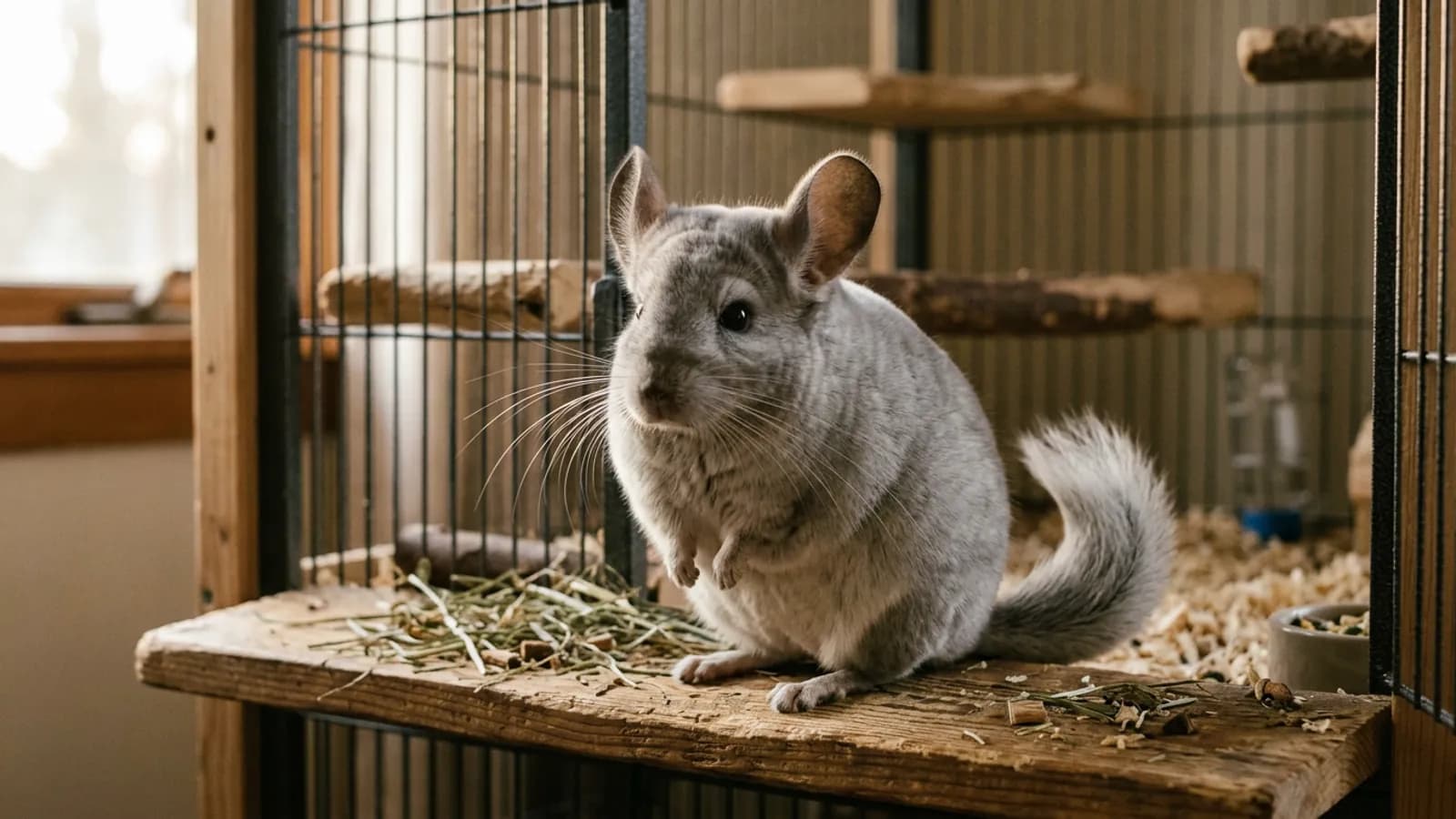
Most chinchilla fun facts get passed around as trivia, the kind of line you read once and forget by lunch. After about ten years of keeping these animals, I have come to see it the other way round. Almost every genuinely surprising thing about a chinchilla is also the reason behind a rule that keeps it alive. The absurdly thick fur is why you never put one in water. The mountain homeland is why a warm afternoon can kill it. So yes, this is a list of facts, but it is really an argument that the facts and the care are the same subject. You will find no shortage of chinchilla pictures and facts online, pages promising 10 fun facts about chinchillas, or even 50 fun facts about chinchillas, and most of them are true. These are the ones I wish someone had handed me, with the reason attached, before I brought Pebble home.
The fur is the fact everything else hangs on
If you keep only one chinchilla fun fact, make it this one: a chinchilla has the densest fur of any land mammal. Where you or I grow a single hair from each follicle, a chinchilla grows a whole bundle, more than fifty hairs from one point in the skin, and some sources put it closer to eighty. Spread that across the body and you get a coat so tight that fleas cannot actually live in it. There is nowhere for them to reach the skin and they suffocate. It is a strange, genuine fact, and it is the reason the animal feels like holding a cloud. In the wild that coat is a smoky gray that hides them against Andean rock. The whites, blacks, and beiges you see online all came later from breeders, and the color never changes the care, as I explain in rare chinchilla colors.
It is also the most important thing to understand about a chinchilla, because it explains the rule new owners break most often. That coat traps air, which is what makes it so warm and so soft. It also traps water. A soaked chinchilla coat does not shed water the way a dog's does. It holds the moisture down against the skin, and damp skin under dense fur invites fungus and chills the animal to the bone. This is why a chinchilla never bathes in water, only in dust. It rolls in fine volcanic dust that slips through the fur and pulls oil and moisture out with it, exactly what they do in the wild, rolling in ash and pumice on the mountainside. All you supply at home is a shallow tub of proper chinchilla dust bath. Lixit Blue Beauty chinchilla dust, 3 lb As an Amazon Associate I earn from qualifying purchases. Offered two or three times a week it is not a novelty, it is the whole of their skin care. If you want the detail on how often and how much, I wrote it all out in the chinchilla dust bath guide.
They are mountain animals, and that runs the thermostat
Here is the chinchilla fact you need to know above all others. Chinchillas come from the high Andes of South America, a cold, dry, thin-aired world where the sun is fierce but the air never holds much heat. Everything about their body is built to keep warmth in, not to shed it. They cannot sweat to cool down, and they cannot pant efficiently the way a dog can. The main radiator they have is their ears, and those large rounded ears you find so charming are packed with blood vessels and dump heat into the air. When a chinchilla is too hot, its ears flush red.
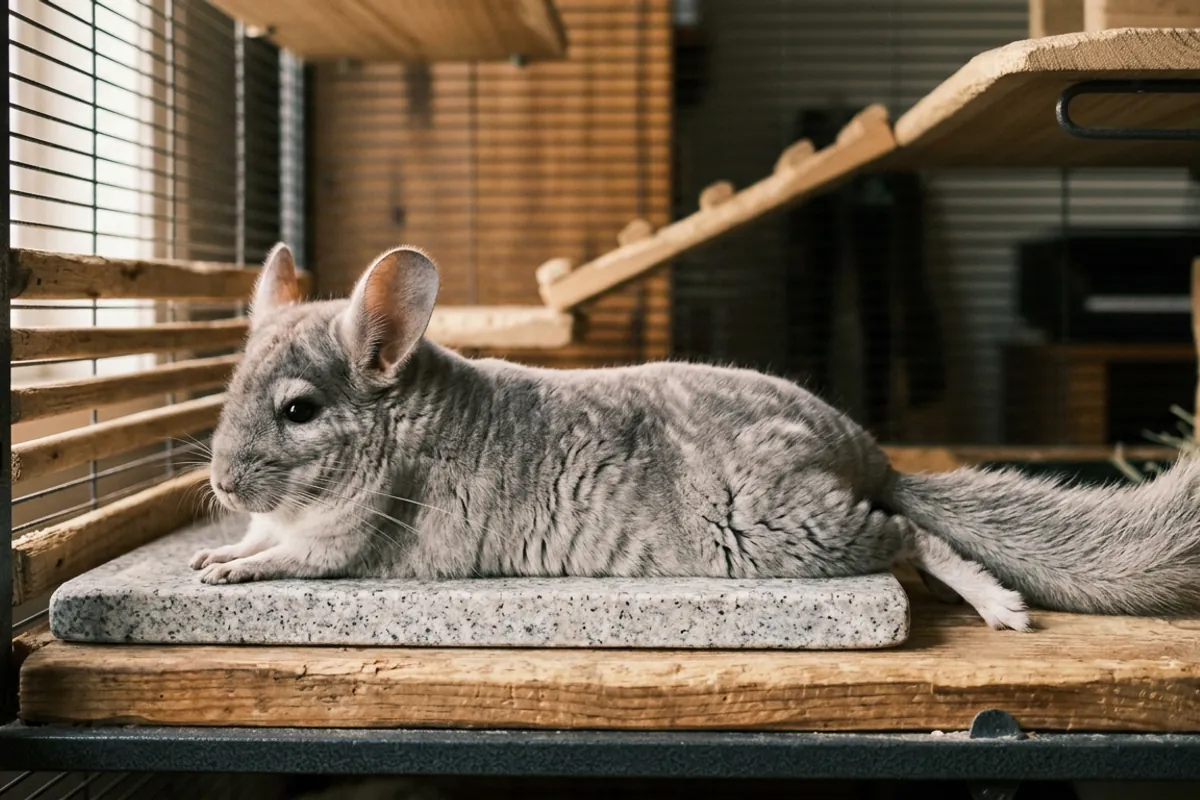
That thick coat, so perfect for a freezing mountain night, becomes a liability in a warm room. The comfortable range is 60 to 70°F (15 to 21°C). Above 75°F (24°C) you are into risky territory, and 80°F (27°C) and up is a genuine emergency, faster still when the air is humid, because humidity strips away what little cooling they can manage. I am relentless about this because Pebble's first summer brought a heatwave and a night at the emergency vet that I will not repeat. Heatstroke in a chinchilla moves quickly and it is often not survivable.
So I keep a plain thermometer and humidity gauge on the cage itself, not across the room, because the number that matters is the one where the animal actually sits. digital thermometer and humidity gauge with remote probes As an Amazon Associate I earn from qualifying purchases. On the edge of warm days a chilled cooling stone gives them somewhere to lie and offload heat. Kaytee Chinchilla Chiller granite stone As an Amazon Associate I earn from qualifying purchases. It buys minutes, not hours, and it is no substitute for keeping the room cool. If your summers are hot, air conditioning is not a luxury for this pet, it is the price of entry. I keep a fuller version of all this in the heat safety guide, and there is a heat danger calculator if you want to check your own room.
The teeth never stop growing
A chinchilla has twenty teeth, and every one of them grows continuously for its entire life. These are open-rooted teeth, with no final length, and they push out at a steady clip, commonly put at around two to three inches a year for the whole set. In the wild, coarse mountain grasses grind them back down to match. In your home, that job falls to what you feed.
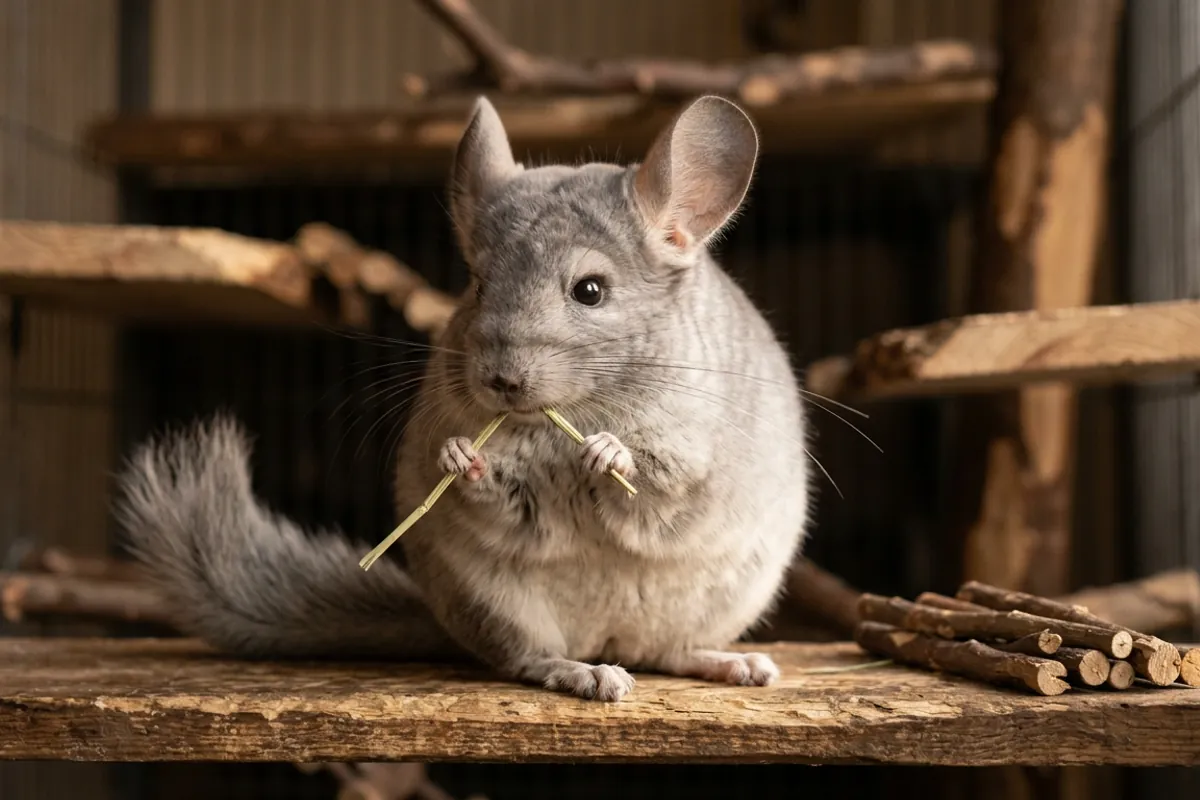
Here is a fun fact that doubles as a health check: healthy chinchilla teeth are not white, they are yellow to orange. That colour comes from iron pigment in the enamel and it is a sign of strength. Pale, chalky white teeth can actually signal a problem. You mostly see the front teeth, but it is the back teeth, the molars, that do the grinding and cause the worst trouble when they overgrow.
This is not abstract for me. Juniper came to me as a neglected rescue with dental disease, and I manage the fallout of it every single day, so I am uncompromising here. The teeth are worn down by chewing, and chewing means unlimited grass hay, all day, every day, not as a side dish but as the main meal. Good grass hay like a fresh box of timothy should be in front of them at all times. Oxbow Western Timothy Hay, 40 oz bag As an Amazon Associate I earn from qualifying purchases. It does far more grinding work than pellets ever will. Alongside it, a rotation of safe wooden chews gives the front teeth something to work on, and variety matters more than owners expect. An apple wood chew variety pack keeps them interested instead of ignoring the one stick they have grown bored of. emours apple wood chew sticks, 40 count As an Amazon Associate I earn from qualifying purchases. Overgrown molars are not something you can fix at home. If your chinchilla drools, drops food, paws at its mouth, or loses weight, that is an exotics vet visit, not a wait-and-see. I lay out the warning signs in the teeth and health guide.
Built to leap, and wired for dawn and dusk
Chinchillas are crepuscular, which means they are at their liveliest at dawn and dusk and sleep through the bright middle of the day. It is worth knowing before you buy one, because a chinchilla that bangs around the cage at eleven at night is not misbehaving, it is doing exactly what it is built to do. Plan the cage away from your bedroom and you will both be happier.
And they can move. A healthy chinchilla can leap something like six feet straight up, clearing shelves and ledges that look impossible for so small a body. That single fact should decide the cage you buy. Height matters more than floor space, because a chinchilla uses the vertical, jumping between levels the way it would work a rock face. A tall metal cage with solid wooden ledges gives them room to actually do what their legs are for. Critter Nation double unit small animal cage As an Amazon Associate I earn from qualifying purchases. I go into why height wins in the piece on the biggest chinchilla cage. If you add a wheel, and I think you should, it must have a solid running surface. 15 inch Chin Spin solid surface chinchilla wheel As an Amazon Associate I earn from qualifying purchases. Wire rungs and mesh catch those long back feet and break legs, and a wire wheel is one of the few pieces of gear I will tell you to never buy.
While we are on their anatomy, look at the whiskers. They are enormous, roughly a third of the body length, and a chinchilla uses them to judge gaps in the dark of a rocky burrow. Nothing about this animal is accidental.
A surprisingly long life for such a small animal
People expect a small rodent to be a short commitment, the way a hamster or a mouse is. A chinchilla is not. With good care they commonly live 10 to 15 years, and it is not rare for one to reach close to 20. That is a genuinely long time, longer than many dogs, and it is the fact I most want new owners to sit with before they fall for the fur. You are signing up for a decade or more of daily hay, cool rooms, weekly dust, and a vet fund for an exotic animal.
That long life also has a price attached. An exotics vet costs more than a cat or dog vet, and a chinchilla hides illness until it is well advanced, so an emergency fund is part of the deal, not an optional extra. I broke the real numbers down in what a chinchilla costs.
None of that should scare you off. It should just be honest. A chinchilla is not a low-effort starter pet, and the length of its life is exactly why the care rules are worth getting right from day one. Small mistakes that a shorter-lived animal never has time to pay for will catch up with a chinchilla. If you want the plain version of what a decade of this actually asks, I wrote chinchillas as pets, the honest version.
The facts new owners get wrong
The most useful chinchilla facts for new owners are often the corrections. A chinchilla is not a big hamster. It does not want to be scooped and squeezed, it needs space, height, and cool air far more than it needs cuddling, and it lives many times longer. I sort out the differences in chinchilla and hamster.
A few more that catch people out. Chinchillas are nearly odorless, which surprises people who expect a rodent smell, and it is down to the dry diet and the dust instead of water. Females are usually the larger sex, not the males. And a chinchilla can shed a clean patch of fur on purpose when it is grabbed too hard or startled, leaving a smooth bald spot and a tuft in your hand. It is called fur slip, it is a real escape trick from a predator's grip, and it grows back, but it is a plain signal that you handled the animal too roughly. I explain it in fur slip. These are the chinchilla pet facts that save a new owner a lot of worry and a few mistakes.
They are chattier than people expect, too. A chinchilla has a real vocabulary of squeaks, chirps, barks, and a sharp alarm call, and each sound means something specific. They also come to recognize the people who feed them and settle into routines, which is why a real bond is built with patience and hay, not by grabbing. I go through what they are telling you in chinchilla sounds.
Where the name comes from, and the wild cousins
The name itself is a fact worth knowing. Chinchillas are named for the Chincha people of the Andes, and the word carries the sense of the little one of the Chincha. There are two species, the long-tailed chinchilla and the short-tailed chinchilla, and both were hunted to the edge of extinction for that remarkable fur. Wild populations are now protected and still endangered, which is a sobering footnote to how soft the coat is.
Two last facts that always land with people. A chinchilla pregnancy runs about 111 days, which is enormously long for so small an animal, and the kits are born fully furred with their eyes open, ready to move almost at once, nothing like the naked, blind pups of most rodents. And like rabbits, chinchillas re-eat certain soft droppings to pull a second round of nutrients from their food, which sounds grim but is a normal, healthy part of how a hindgut fermenter gets the most out of a poor mountain diet. That is the thread running through every one of these chinchilla facts and care notes: this is an animal shaped hard by a cold, dry, sparse place, and the closer your home honors that, the longer and better it lives.