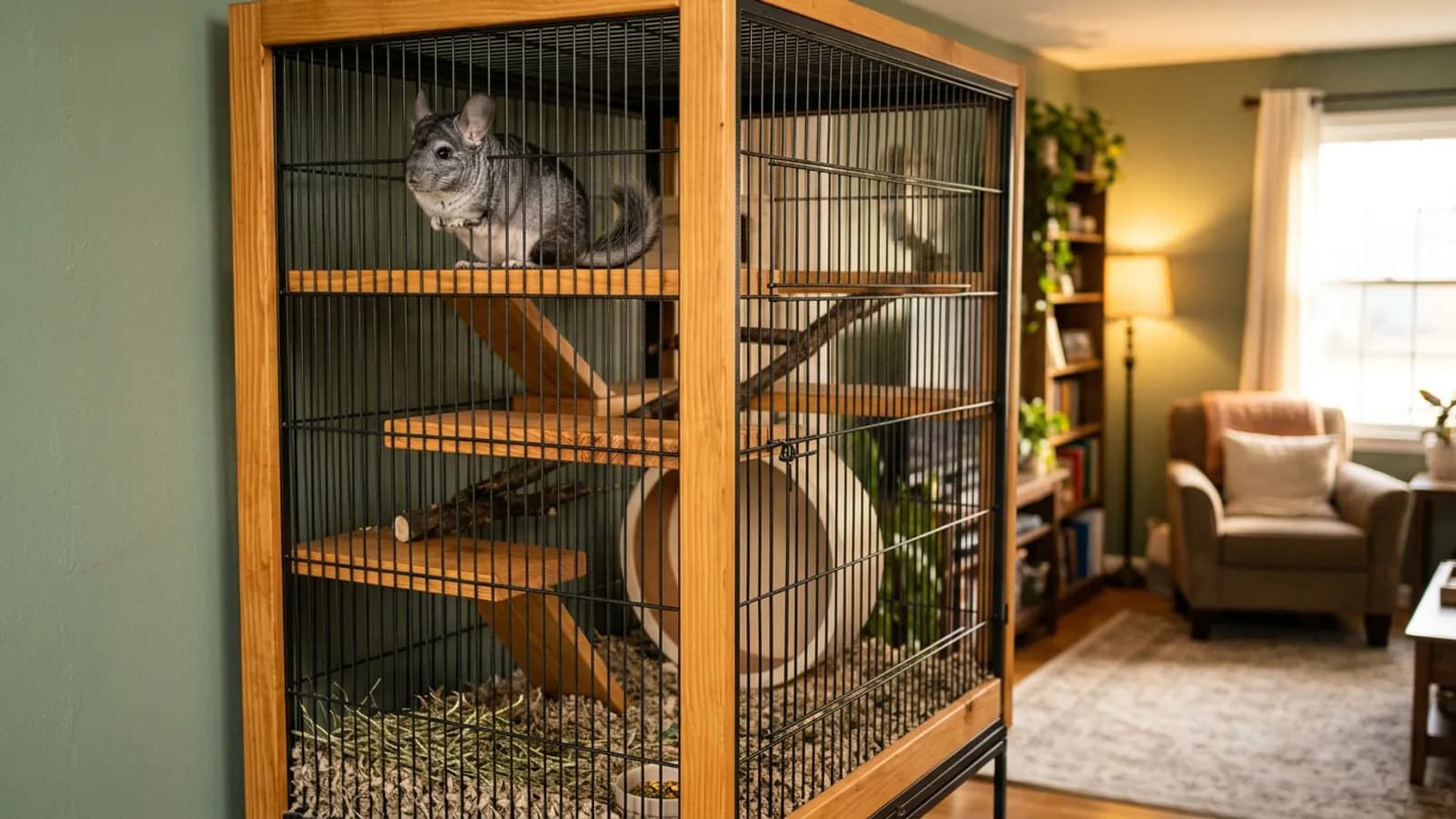
When people go hunting for the biggest chinchilla cage they can find, they almost always picture floor space: a wide, low, sprawling enclosure, the kind you would set up for a rabbit. That is the wrong picture, and buying on it wastes money. Chinchillas are climbers and jumpers, not floor-cruisers, so the dimension that matters most is height, and the second is how the space inside is stacked. I have spent about ten years keeping these animals, and the cages that actually served Pebble and Juniper well were never the ones with the most square footage printed on the box. They were the tall ones I could fill top to bottom with ledges. Before you chase the largest number you can find, it helps to know what biggest is really buying you.
What "biggest" actually buys a chinchilla
A chinchilla in the wild lives on rocky Andean slopes, moving up and down over boulders far more than it travels flat distance. That vertical instinct does not switch off in a living room. Give a chinchilla a tall cage with ledges at different heights and it will spend the evening bouncing between them, which is exactly the exercise its body is built for. Give it the same volume spread out low and wide, and most of that floor sits unused.
So when I judge the biggest chinchilla cage, I am not counting the footprint first. I am counting usable vertical levels. A cage that is 3 feet wide but only 2 feet tall is smaller, in the way that matters, than one that is 2 feet wide and 5 feet tall. The tall one gives you room for four or five ledge heights and a real jump between them. The wide one gives you a lot of floor a chinchilla walks past.
It is worth knowing why so many cages are built wide and short anyway. That shape stacks and ships flat, it fits under a shelf in a pet store, and it photographs as roomy. None of those reasons have anything to do with what a chinchilla uses. A cage marketed as large because it covers a big footprint can still be a poor cage for this species, which is the whole problem with a small chinchilla cage dressed up as adequate.
This is also why biggest has a ceiling of usefulness. Past a point, extra width does not add anything a chinchilla actually uses. Height keeps paying off much longer, right up until a fall from the very top onto a hard pan gets dangerous. More on that limit later.
The size numbers I actually use
For a single chinchilla I treat roughly 2 feet by 2 feet of floor and at least 3 feet of height as a floor, not a target. Bigger is better as long as you fill it. For two chinchillas, or if you simply want a cage you will never second-guess, a double-height unit around 3 feet wide and 5 to 6 feet tall is the honest sweet spot for the biggest bracket most keepers can house indoors.
The best-known cage in this class is the double-unit style sold under the Critter Nation and Ferret Nation names. Two stacked units give you a tall metal box with a full-width door on each level, which makes cleaning and rearranging genuinely easy. I am not sponsored by anyone and earn nothing by naming it, but it has become the default big cage for a reason: the bar spacing is right, the frame is solid, and the horizontal-bar fronts double as a climbing surface. I lay out the reasoning in full in the Critter Nation guide and in the broader large chinchilla cage piece.
If you are handy, a DIY build gives you the most usable space for the money, and I have seen keepers convert a metal shelving frame or a closet into a superb enclosure. The rule that cannot bend is materials: the whole thing has to be safe to chew, which in practice means metal and untreated wood and nothing else. Skip melamine, skip particle board, skip any coating you are not certain is safe.
The one number I will not let slide is bar spacing. Whatever the overall size, the bars need to sit no more than about 1 inch apart, and closer for a young kit. A huge cage with wide-set bars is not a big win, it is an escape route and a leg trap. A big cage earns its size only when the small numbers are right too.
Bar spacing and materials come first
I said it in passing, but it deserves its own space, because a giant cage built wrong is worse than a smaller cage built right. The material has to be metal, full stop. A chinchilla's teeth grow continuously for its whole life, and it will chew anything it can get purchase on. Plastic pans, plastic shelves, plastic connectors: all of it gets gnawed, and swallowed plastic can cause a fatal gut blockage. I will not put a plastic-based enclosure in the house no matter how large it is, and I go through the whole argument in why a chinchilla cage has to be metal.
Powder-coated metal or unpainted metal bars, a metal frame, and a pan you can protect: that is the spec. Many big cages ship with a plastic base pan, and that is not automatically a dealbreaker as long as you cover it so your chinchilla cannot reach the plastic. Fleece liners or a wood or metal false floor over the pan solve it. What you cannot do is leave that plastic exposed and hope.
If you would rather buy something built to this spec from the start than modify it, a tall enclosure framed in metal with solid wood ledges does the job. A metal-and-wood cage sidesteps the plastic problem because the surfaces a chinchilla actually stands and chews on are safe by design. Critter Nation double unit small animal cage As an Amazon Associate I earn from qualifying purchases.
Fitting out a big cage so the space counts
An empty big cage is just a tall empty box, and a chinchilla will use very little of it. The size only turns into exercise when you stage the interior into a climbing route. This is the part people skip, and it is the part that decides whether the money on a big cage was worth spending.
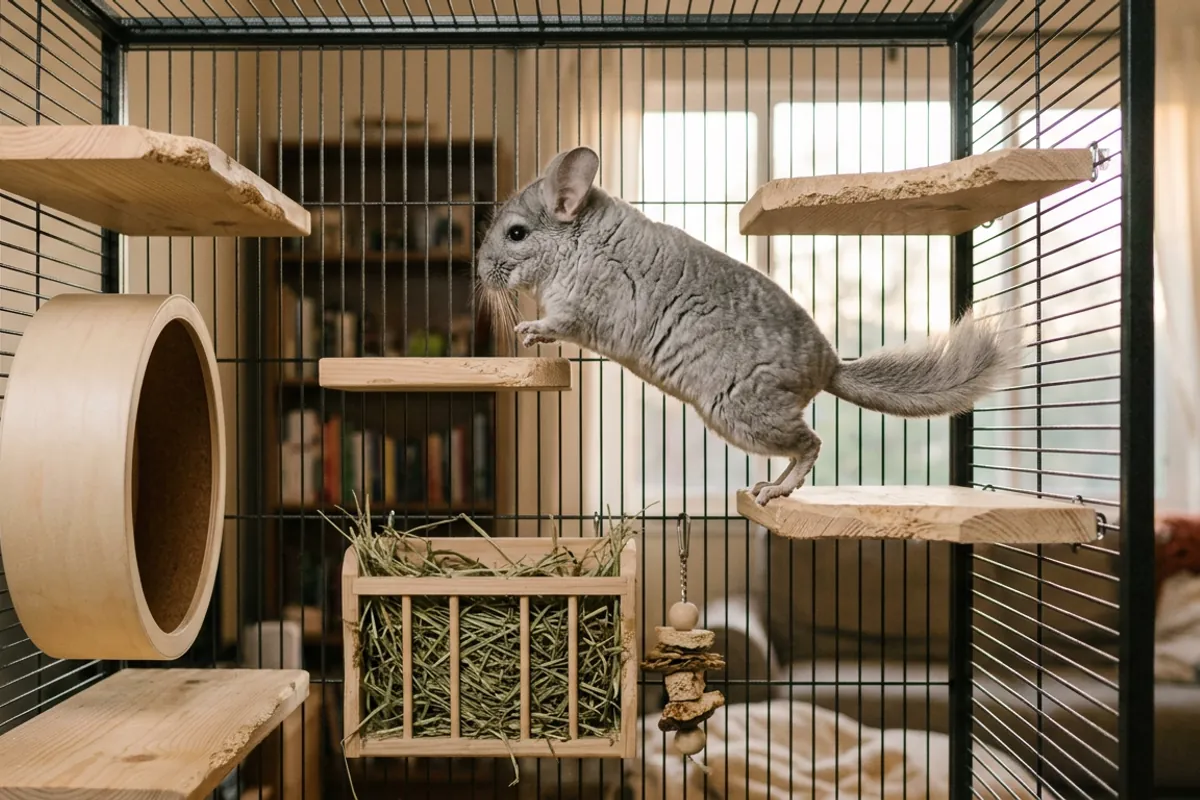
Ledges are the backbone. I run kiln-dried pine or apple-wood ledges at staggered heights so there is a real jump of 8 to 12 inches or so between each one, arranged so no single fall drops the animal the full height of the cage onto the pan. Stagger them, do not stack them straight up like a ladder, because a straight vertical drop is how a chinchilla gets hurt. Wooden ledges also give the teeth something to work on, which matters more than most new keepers realize. Juniper came to me with dental disease, and watching up close what unmanaged teeth do to an animal is why I am relentless about chewable surfaces everywhere, not just a token chew or two.
A solid-surface wheel belongs in a cage this tall, and only a solid-surface one. A solid running wheel lets a chinchilla sprint without risking a limb. 15 inch Chin Spin solid surface chinchilla wheel As an Amazon Associate I earn from qualifying purchases. Wire-rung and mesh wheels catch feet and tails and cause fractures, and I would never hang one; the full reasoning is in what a chinchilla on a wheel really needs.
Then the chew load and the food. A variety of untreated wood chews scattered across the levels keeps teeth worn and keeps a bored chinchilla off the bars. emours apple wood chew sticks, 40 count As an Amazon Associate I earn from qualifying purchases. Hay goes in at an accessible height too, because hay is the whole meal, not a garnish. I keep a hay feeder filled with grass hay at all times. Oxbow Western Timothy Hay, 40 oz bag As an Amazon Associate I earn from qualifying purchases. I buy that hay in bulk so it never runs low, since unlimited grass hay is the single most important thing in the diet, with plain pellets as a small measured supplement on top. Oxbow Western Timothy Hay, 9 lb box As an Amazon Associate I earn from qualifying purchases. For how the whole interior comes together I lay it out in chinchilla cage setup, and the extras worth their place are in cage accessories for chinchillas.
Where you put the cage matters as much as its size
Here is the hard truth no cage dimension can fix: a big cage in a hot room is a big death trap. Chinchillas carry one of the densest coats of any mammal, and they cannot shed heat the way we do. The comfortable range is 60 to 70°F (15 to 21°C). Above 75°F (24°C) you are in risky territory, and 80°F (27°C) and up is an emergency, faster still when the air is humid.
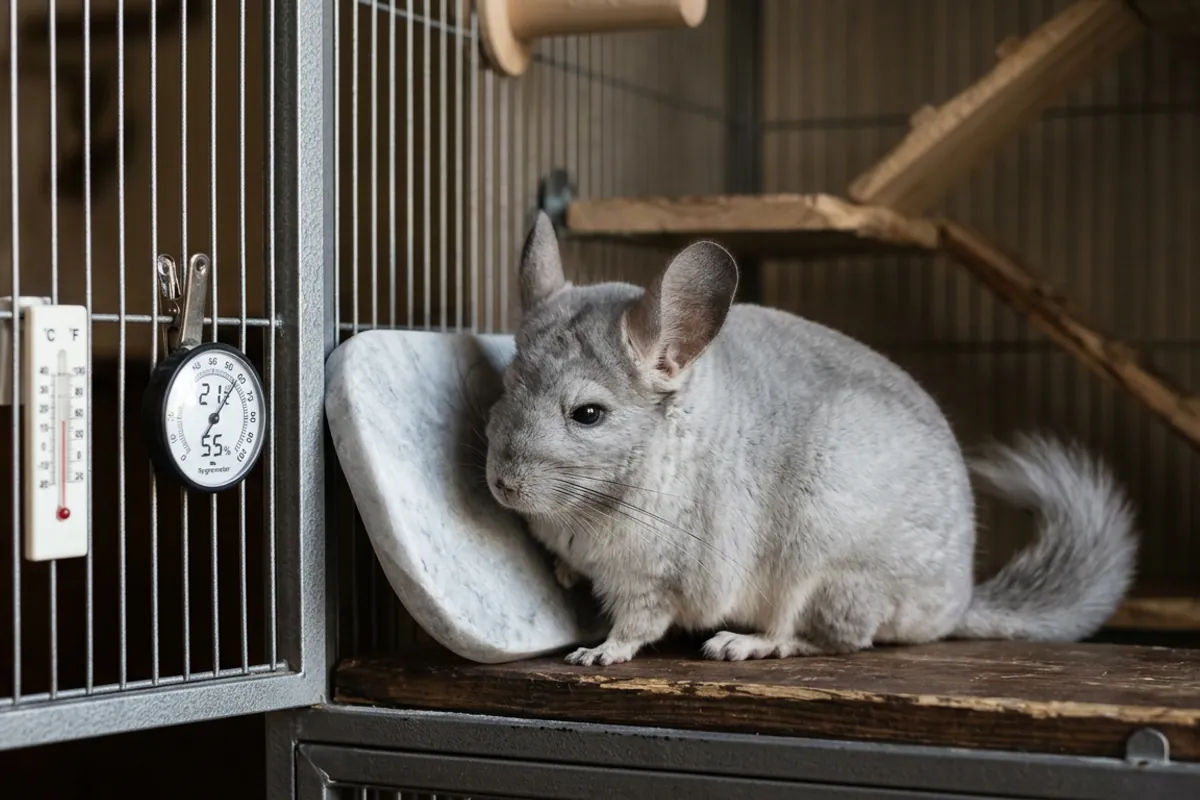
I learned this the way I never want anyone else to. Pebble came out of an overheated attic, and her first summer brought a heatwave that put us at the emergency vet overnight. That night is why the biggest cage in the world means nothing to me if it stands in the wrong spot. Keep it out of direct sun, away from radiators and sunny windows, in the coolest and most stable room you have. Put a thermometer and hygrometer right on the cage so you read the air the chinchilla actually breathes, not the far side of the room. digital thermometer and humidity gauge with remote probes As an Amazon Associate I earn from qualifying purchases. A cooling stone gives a spot to lie against on a warm afternoon, though it is a comfort aid and never a substitute for a genuinely cool room. Kaytee Chinchilla Chiller granite stone As an Amazon Associate I earn from qualifying purchases. To check your own room against the danger line, the heat danger calculator does the math, and I go deeper in chinchilla temperature.
A bigger cage does buy one small heat advantage: more air volume and more height means a chinchilla can pick the coolest layer, since warm air rises and the lower ledges sit cooler. That is a nice margin, not a rescue. It does not license a warm room.
When bigger becomes a problem
I am the last person to talk anyone out of space, but there are real limits, and pretending otherwise is not honest.
The first is fall height. A cage so tall that a chinchilla can climb to the top and fall the whole way to a bare pan is a fracture waiting to happen. The fix is not a shorter cage, it is staged ledges and hammocks that break any drop, plus deep bedding or fleece over the pan. Never leave a tall open shaft with nothing in it.
The second is bonding. If you are housing two chinchillas that are not yet bonded, a vast cage makes a fight harder to manage and easier to hide from you. New pairs get introduced slowly in controlled space, not turned loose together in a cavern. Size comes after the relationship is settled.
The third is plain practicality. A 6-foot cage has to be cleaned, and the top ledges have to be reachable. If you cannot comfortably get your arm to the highest ledge, that ledge will not get cleaned, and a chinchilla's respiratory system does not forgive ammonia buildup from stale soiled bedding. Buy the biggest cage you will actually maintain, not the biggest one that exists.
How I would buy the biggest cage without wasting money
If I were buying today I would work in this order. First, decide the room, and confirm it holds 60 to 70°F (15 to 21°C) through your worst week of summer. A cage you cannot keep cool is the wrong cage at any size. Second, buy the tallest all-metal or metal-and-wood cage that fits that room and that you can reach into, with bar spacing around 1 inch. Third, budget nearly as much again for the fit-out, because a bare big cage is not finished: ledges, a solid wheel, chews, a hay feeder, and a dust bath.
On that last one, the biggest cage still needs a bath the chinchilla can climb into, because chinchillas clean themselves in fine volcanic dust and never in water. A dust bath house offered two or three times a week keeps the coat right. Lixit Blue Beauty chinchilla dust, 3 lb As an Amazon Associate I earn from qualifying purchases. I cover the how and how-often in the chinchilla dust bath.
I would resist the urge to buy purely on advertised square footage. A tall cage you can fill and reach beats a wider one you cannot, every time. If you want a clear-eyed walk through the whole buying decision, including the traps in cheap listings, I put it all in how to pick the best chinchilla cage. Buy once, buy tall, fill it properly, and stand it in a cool room. Do that and the size stops being a number on a box and becomes what it is meant to be: room for an animal built to climb.