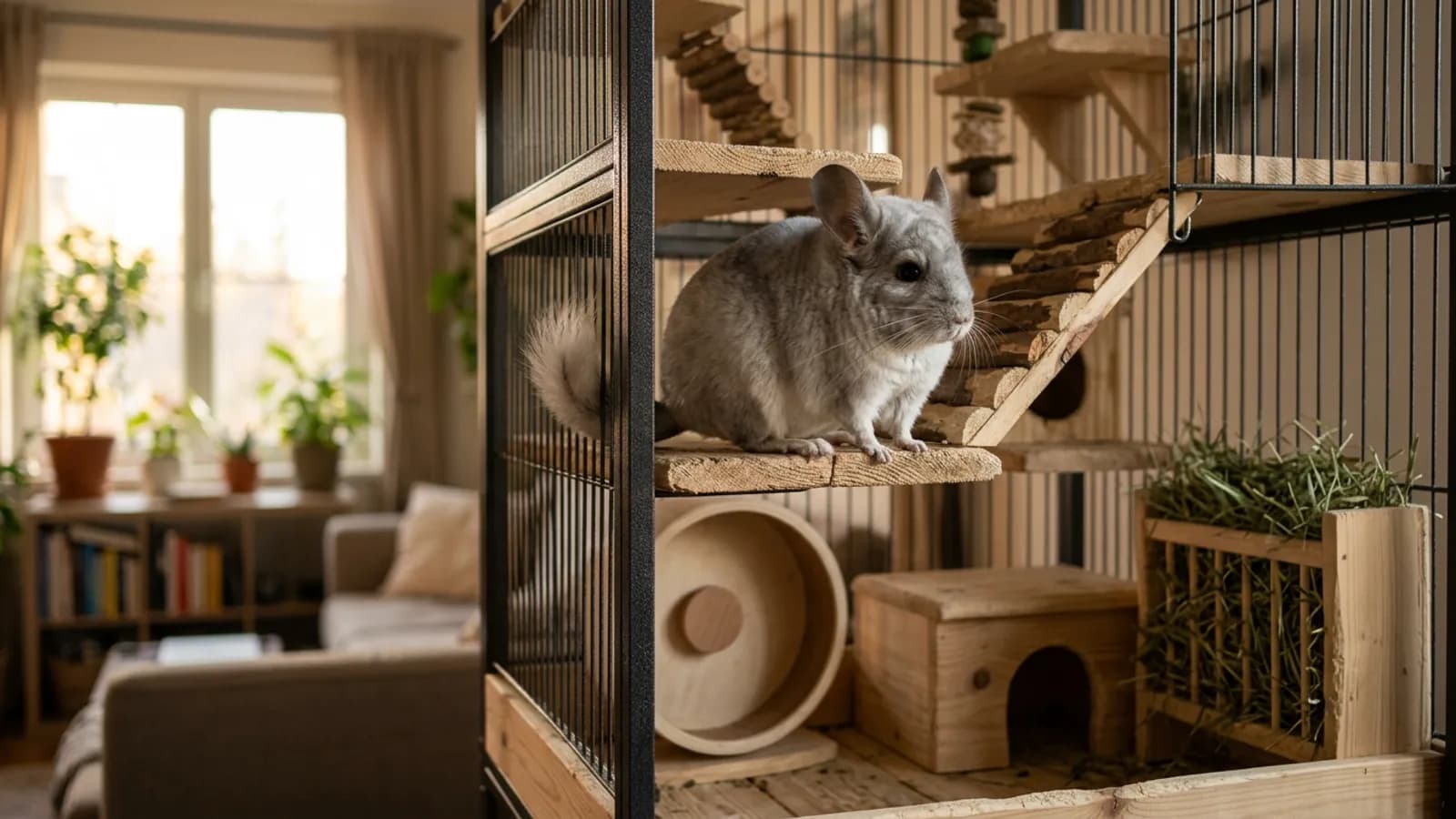
A large chinchilla cage is not the upgrade you get around to eventually. It is the floor you start from. Chinchillas are built to leap, and in the wild they cross rocky, broken ground in fast vertical bursts that a small box can never allow. When I brought Pebble home from a rehome out of an overheated attic, the first thing I sorted after the heat was her space, because a cramped chinchilla is a bored chinchilla, and a bored chinchilla chews bars, paces, and quietly loses condition. This is the guide I wish someone had handed me before I bought the wrong cage twice: what "large" actually means in inches, why metal and wood are the only materials that survive this animal, and how to fill all that room so the space does real work instead of just sitting there.
Why bigger is the whole point
A chinchilla is a small animal with an enormous need to move. They do not amble the way a guinea pig does. They spring off a ledge, ricochet off a wall, and land three levels up, and they want to do it many times a night. Floor space alone does not satisfy that. What they are really asking for is room to launch and land without hitting the far wall a heartbeat later.
Give them too little and you see it fast. Bar chewing at the same spot every night. Restless pacing along one edge. Fur that starts to look flat and unkempt because the animal is stressed rather than exercised. I have watched Juniper, who came to me as a neglected rescue, unwind over weeks simply because she finally had somewhere to go. None of that is a personality quirk you can train away. It is an animal telling you the enclosure is wrong.
There is a welfare argument and there is a plain practical one, and they point the same direction. A large chinchilla cage gives the animal enough to do that it stops inventing destructive hobbies, and it gives you enough room to fit hay, a wheel, chews, hides, and a dust bath without turning the whole thing into a cluttered obstacle course. Small cages force you to choose which essentials to leave out. Large cages let you keep all of them, spaced properly, which is exactly how a chinchilla wants to live.
What large actually means in inches
"Large" gets thrown around loosely on product listings, so let me anchor it. The floor most experienced keepers agree on for a single chinchilla is roughly 24 by 24 by 24 inches, about two feet in every direction, and honestly that is a floor, not a target. It is the smallest I would ever call acceptable, and I would not be happy at it. For a genuinely large chinchilla enclosure you want to be well past that, especially in height.
A common and well regarded reference point is a single-unit cage around 36 inches wide, 24 inches deep, and 24 inches or more tall, with a taller double unit stacking two of those levels. That extra footprint is what most people mean when they search for an extra large chinchilla cage, and for two chinchillas or one very active one, that is where I would aim rather than the bare minimum.
I want to be honest that the exact minimum is debated. You will find keepers who insist on more and a few who get by with less. What is not debated is the direction: within reason, bigger is always safer and more enriching, and nobody has ever regretted too much space. If you are weighing specific models and sizes against each other, I go through that decision in detail in how to pick the best chinchilla cage without buying the wrong one twice, and the case against going small is laid out in the honest truth about a small chinchilla cage.
Metal and wood, never plastic
Here is the rule that saves you money and possibly your animal's life: the cage frame and bars must be metal, and the surfaces inside it must be metal or safe untreated wood. No plastic. A chinchilla will gnaw plastic to pieces, and the pieces they swallow can block a gut that is not built to pass them. A plastic-bottomed cage, a plastic shelf, a plastic ramp: all of it becomes chew fodder, and none of it lasts. I go deeper on this in why a chinchilla cage has to be metal, because it is the single most common mistake I see new owners make.
Bar spacing matters as much as the material. You want the bars close enough that a chinchilla cannot force its head through and cannot get a leg trapped. Half an inch to one inch is the range I trust, and I lean toward the tighter end. If you have a young kit, be aware that wider spacing that holds an adult fine can still let a baby squeeze out, so err small.
A powder-coated metal frame with solid wooden ledges is the combination that survives years of use. A cage built on that principle, like this metal and wood setup, is worth the higher upfront cost because you buy it once instead of replacing chewed plastic every season. Critter Nation double unit small animal cage As an Amazon Associate I earn from qualifying purchases. When you are comparing listings, read the material description closely, not the marketing word "chewproof." Metal bars and a metal or deep-pan base are what chewproof actually means for this animal.
Height is where the space matters
If you only have room to grow the cage in one direction, grow it up. Chinchillas use vertical space more than horizontal, and a tall cage with well placed ledges gives them the jumping and climbing they crave far better than a long, low one of the same volume. This is why the tall metal cages tend to suit chinchillas so well, and why height keeps showing up in the good product names.
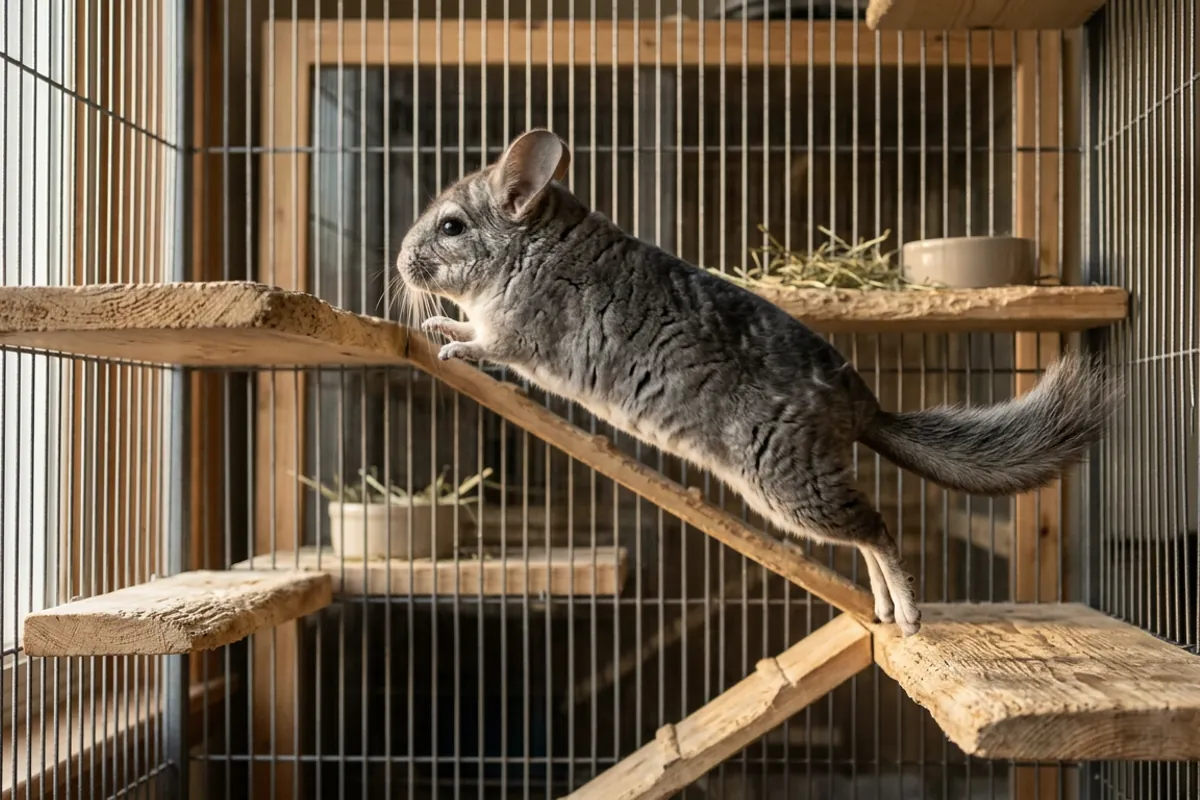
Wooden ledges are the working parts of that height. Space them so the animal can hop up and down in comfortable stages rather than one long drop, and stagger them left and right so there is always a landing pad below. Kiln-dried pine or another safe untreated wood works well and gives the teeth something to wear against. Lava ledges add grip and a bit of nail filing, and I cover where they earn their place in lava ledges for chinchillas.
One caution that comes with height: a fall onto a hard base from the top of a tall cage can hurt a chinchilla, particularly an older or heavier one. The fix is not a shorter cage, it is thoughtful ledge placement so there is never a long unbroken drop, plus a base that is not bare metal or hard plastic. Break the vertical distance into steps and the height becomes an asset instead of a hazard.
Fitting out all that room
A large cage rewards you with space to include every essential without crowding. Start with the wheel. It has to have a solid running surface, never wire or mesh rungs, because a wire wheel catches toes and tails and causes real injuries. A solid-surface wheel of adequate diameter lets a chinchilla run with a straight back instead of an arched one. 15 inch Chin Spin solid surface chinchilla wheel As an Amazon Associate I earn from qualifying purchases. I go through wheel sizing and safety in what a chinchilla on a wheel really needs to run safely.
Hay is the whole meal, not a garnish, so it needs a permanent home in the cage. Chinchillas eat unlimited grass hay, and a good hay holder keeps it clean and always available. I keep a rack topped up with timothy hay at all times. Oxbow Western Timothy Hay, 9 lb box As an Amazon Associate I earn from qualifying purchases. If you want the reasoning behind hay first, Juniper's dental disease is the whole story in timothy hay for chinchillas is the whole meal, not a side dish.
Then the dust bath. Chinchillas never bathe in water, only in fine dust, and a roomy cage means you can offer a bath house a few times a week without it living permanently underfoot. A proper chinchilla dust bath with the right pumice dust keeps the coat in condition. Lixit Blue Beauty chinchilla dust, 3 lb As an Amazon Associate I earn from qualifying purchases. The how and how often is in the chinchilla dust bath, done right from dust to schedule.
Finish with chews and a hide. Teeth grow continuously, so a rotating variety of safe wood chews is dental care, not decoration, and an apple wood chew pack gives that variety. emours apple wood chew sticks, 40 count As an Amazon Associate I earn from qualifying purchases. Add a wooden hide so the animal can retreat and feel safe. For the full layout logic of putting it all together, see how to build a chinchilla cage setup that keeps the animal healthy.
Where a large cage goes in your home
A big cage is heavy and hard to move once it is loaded, so decide placement before you build it, and decide it around heat. This is the part I will not soften, because it is the reason Pebble spent a night at the emergency vet in her first summer. Chinchillas carry one of the densest coats of any mammal and they cannot shed heat well, so temperature is the number that keeps yours alive.
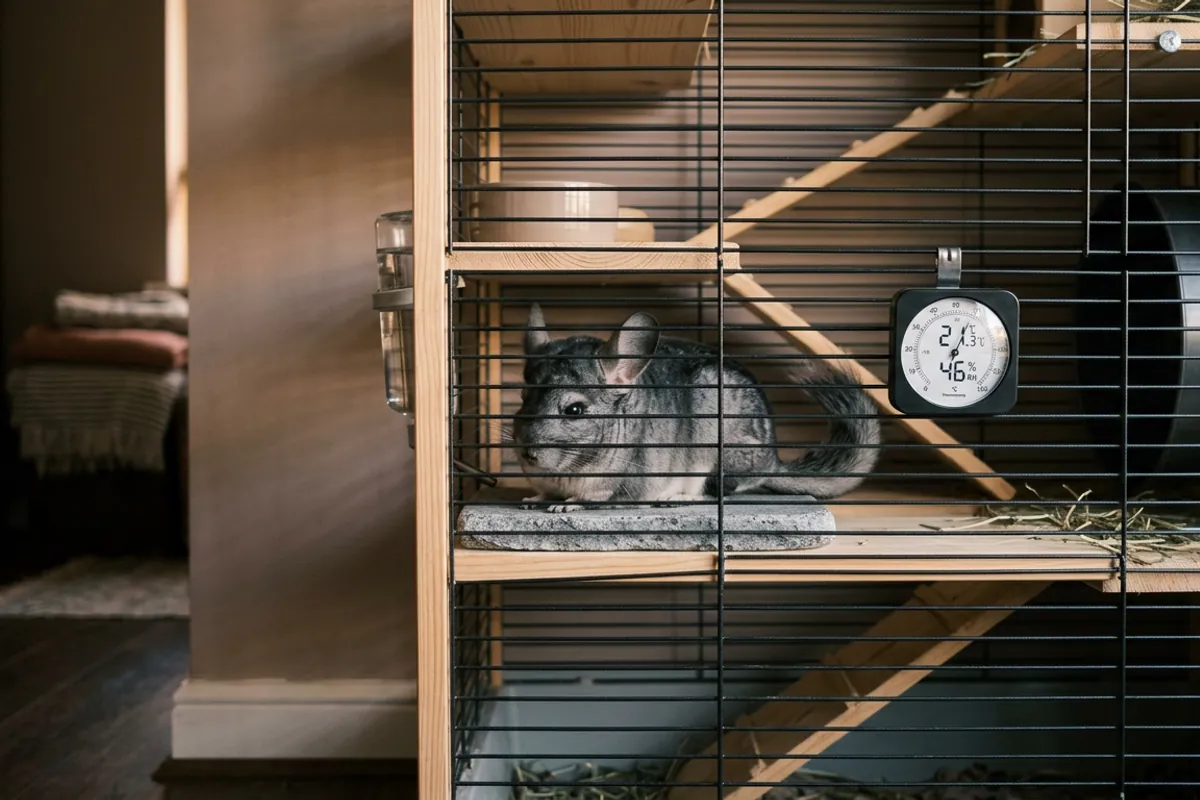
The comfortable range is 60 to 70°F, which is 15 to 21°C. Above 75°F, or 24°C, you are into risky territory, and 80°F, 27°C, and up is an emergency, faster in humid air because they lose heat through panting and humidity cripples that. So put the cage on an interior wall, out of direct sun, away from radiators and heat vents, and never in a conservatory or an attic. Keep a thermometer and humidity gauge right on the cage so you are reading the animal's actual conditions, not the far side of the room. digital thermometer and humidity gauge with remote probes As an Amazon Associate I earn from qualifying purchases.
For warm spells, a chilled solid stone gives the animal a cool surface to stretch out on, and it belongs in the cage before the heat arrives, not after. Kaytee Chinchilla Chiller granite stone As an Amazon Associate I earn from qualifying purchases. A cooling stone is a comfort aid, though, not a rescue for a room that is genuinely too hot; the real fix is keeping the room in range. If you want the full heat playbook, it lives in chinchilla heat safety and you can pressure-test your own room with the chinchilla heat danger calculator.
The cages people actually ask about
Two names come up constantly when people search for a large cage, and both are worth an honest word. The Little Friends large chewproof tall chinchilla metal cage is popular for good reasons: it is tall, the frame is metal, and the height suits how chinchillas move. As with any cage, check the ledge material and swap out anything plastic for wood, and confirm the bar spacing suits your animal, especially if you have a kit. The tall footprint is the real selling point.
The other perennial is the Critter Nation, and it earns its reputation. The double unit gives you a genuinely large chinchilla enclosure with two full levels, a metal frame, and enough room to fit every essential I listed above with space to spare. The stock shelves are usually plastic, so most keepers, me included, replace them with wood or fleece-covered wood before the chinchilla ever moves in. I weigh it up properly in is the Critter Nation cage right for a chinchilla.
Whatever name is on the box, judge it against the same short checklist rather than the marketing. Is the structure metal with bar spacing of about an inch or less. Is it tall, with room for staggered wooden ledges. Can it hold a solid wheel, unlimited hay, a dust bath, chews, and a hide without crowding. Can you site it somewhere that stays in the safe temperature range year round. A cage that passes all five is the one you buy once. That is the whole reason to go large from the start: you spend more today and you never have to have this conversation with yourself again, because the animal has, finally, enough.