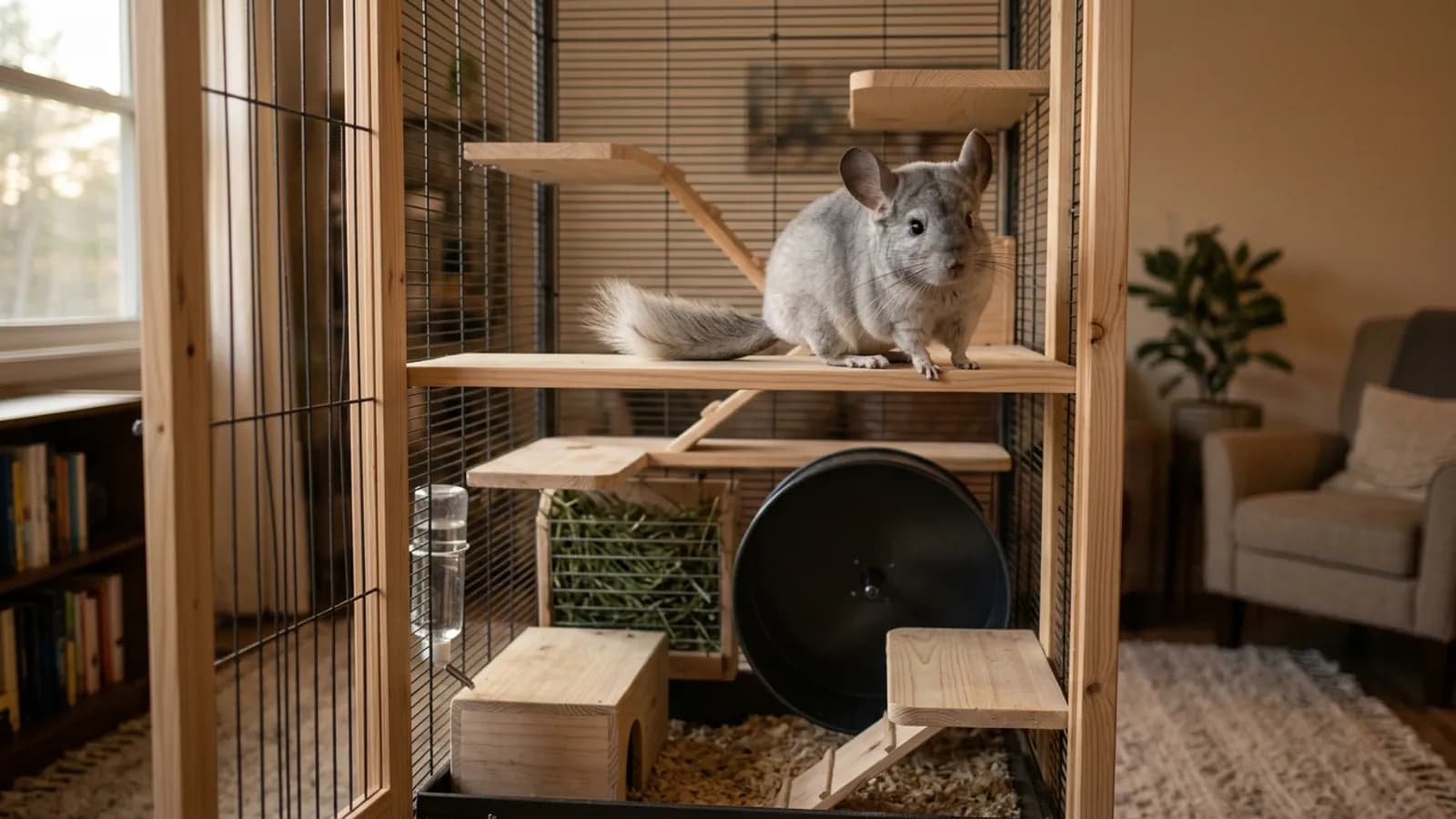
Ask me for the best chinchilla cage and my honest answer starts with a shrug, because "best" only means anything once you say best for what. There is no single model that wins every home. There is a set of things a cage has to get right for an animal that jumps, climbs, chews everything it touches, and cooks to death in a warm room, and once you know those things the field narrows fast. I have kept chinchillas for about ten years, I have bought the wrong cage and paid to replace it, and I would rather you buy once. So this is less a ranking and more a way to look at any cage on the shelf and know inside a minute whether it deserves your chinchilla.
What "best" actually means for a chinchilla cage
A chinchilla is a small animal with big requirements. In the wild it lives on rock faces in the Andes, moving vertically, dust bathing, chewing coarse plants down to nothing. None of that switches off in your living room. So the best chinchilla cage is the one that lets a caged animal do the things its body is built to do: climb, leap between levels, gnaw safely, and stay cool.
That gives you a short, unglamorous checklist. Enough height for real vertical movement. Metal and wood construction, no plastic anywhere the animal can reach. Bar spacing tight enough that a head cannot pass through. A door big enough that you can lift the animal out without a wrestling match. Solid or wood ledges to break up the climb. And a shape that fits the spot in your home that stays coolest, because placement is part of the cage decision whether the box admits it or not.
Notice what is not on that list: color, "starter kit" bundles, cute branding, or the picture on the box of a hamster in a plastic tube. If you want the longer walk through choosing without buying the wrong one twice, I wrote a full guide to choosing a chinchilla cage. Here I want to go product by product, honestly.
Why the material matters more than the brand
Chinchillas chew. Not occasionally, not when bored, but constantly, because their teeth grow for their whole life and chewing is how they keep the growth in check. That single fact rules out most of what gets sold as small pet housing. Plastic bases, plastic ramps, plastic shelves, plastic igloos: a chinchilla will gnaw them, swallow fragments, and you end up at an exotics vet with a gut blockage that did not have to happen. Juniper, one of my two, came to me with dental disease, and living with that day to day has made me flatly unwilling to keep anything chewable-and-toxic in a chinchilla's reach.
So the cage frame should be metal, powder coated steel is standard and fine, with ledges and shelves in untreated kiln-dried pine or another safe wood the animal is meant to chew. A tall wire cage with wooden ledges is the honest baseline, and a good one lasts years. A well built metal and wood chinchilla cage is the shape you are looking for. Critter Nation double unit small animal cage As an Amazon Associate I earn from qualifying purchases.
One caution on wire. The bars are fine, but a wire floor and wire shelving are not: they cause bumblefoot and caught legs. You want solid resting surfaces, which is why wood ledges matter. If a cage comes with wire shelves, plan to cover them with wood or fleece from day one. And skip anything with a wire exercise wheel entirely, but that belongs in the accessories section below.
Getting the size and height right
Bigger is genuinely better here, and height beats floor area because chinchillas use vertical space the way a squirrel does. For a single chinchilla, a common floor guideline is somewhere around 24 by 24 inches at the base with real height above it, and honestly I would treat that as a floor, not a target. More room, more ledges, more chances to jump: all of it goes straight into a healthier, less frustrated animal.
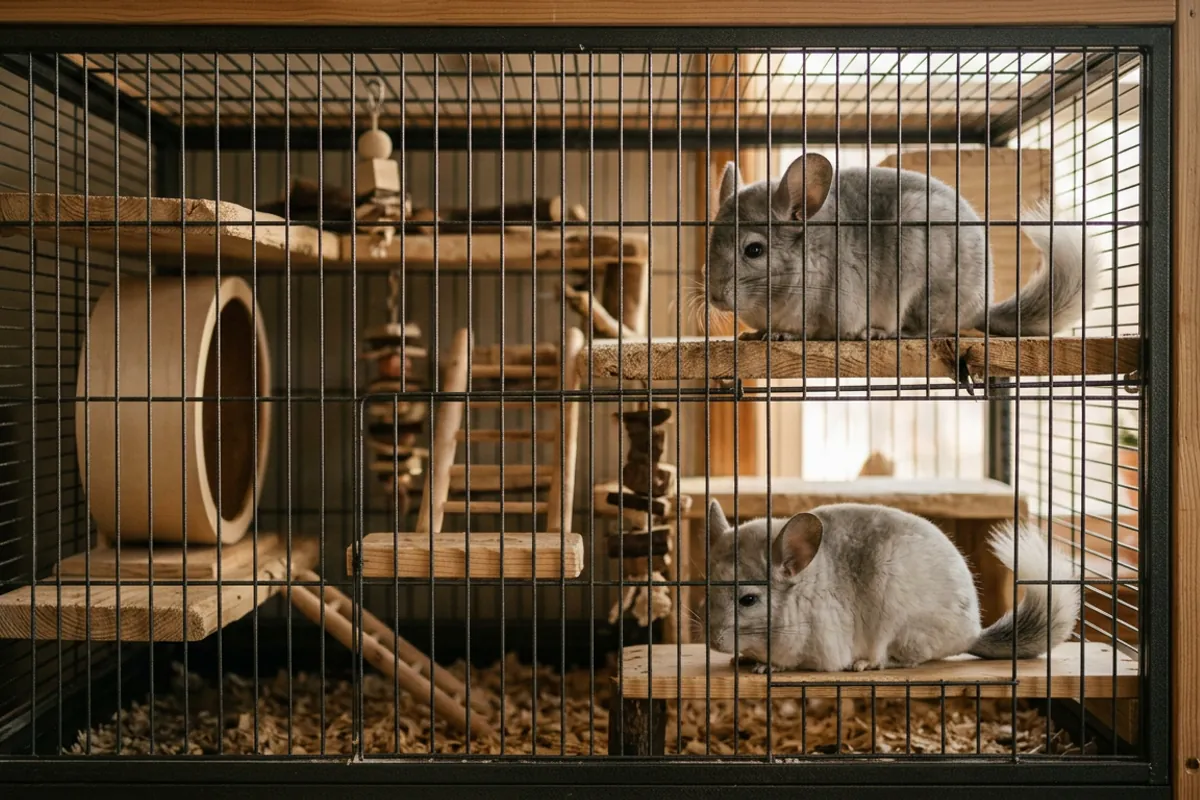
The best cage for 2 chinchillas is not "the single-animal cage but they will manage." It is a genuinely larger enclosure with multiple levels so two animals can hold separate territory, rest apart, and get out of each other's way. Two chinchillas that cannot escape each other will squabble, and a cramped cage turns normal friction into real fighting. If you are housing a pair, buy up a size and add a second set of ledges and a second hideout so nobody is ever cornered.
This is where the double-unit modular cages earn their reputation. Many keepers build out a two-tier setup because the height and the shelving suit chinchillas so well; I walk through whether that specific style fits in my piece on the Critter Nation cage for chinchillas. Whatever you choose, once it is home the arrangement inside matters as much as the box, and setting up the cage the right way, once will save you rearranging it three times. If the one you are looking at is the Ferret Nation, I wrote up what has to come out of a Ferret Nation cage before a chinchilla moves in.
Check the bar spacing before anything else. Roughly half an inch to five eighths is the usual safe range; wider than that and a young or small chinchilla can push its head through and get stuck or hurt. Measure it, do not trust the listing.
Bedding and the cage floor
The best bedding for a chinchilla cage is the one that stays dry, is not toxic when chewed, and does not fool you into thinking a dirty cage is clean. You have two mainstream choices, and I have used both.
Kiln-dried pine or aspen shavings are the classic loose bedding. They absorb well and control odor. The hard rule is that the pine must be kiln-dried; aromatic softwoods like cedar and untreated pine give off oils that irritate a chinchilla's airways, so those are off the table. Aspen is the safe default if you want to skip the pine question entirely.
Fleece liners are the other route, and they are what I mostly use now. Fleece over an absorbent layer, washed regularly, keeps the cage tidy and gives soft footing on ledges. The catch is that fleece hides nothing and absorbs everything, so it has to be changed on a real schedule or it turns into a damp mat, and damp is the enemy. A chinchilla's coat must stay dry, which is the whole reason they bathe in dust and never in water; a soggy cage floor works against that. If you want the biology behind the dry-coat rule, the dust bath done right covers it.
Whichever you pick, the litter tray underneath the cage is where most of the waste should end up, and spot cleaning daily plus a full change weekly is the rhythm that keeps ammonia down and lungs healthy. Deep bedding is not the point with chinchillas; dry and frequently changed is.
The accessories that earn their place
Best chinchilla accessories is a phrase that sells a lot of junk, so here is my filter: does it help the animal chew, climb, cool down, hide, or eat correctly? If yes, it earns a spot. If it is a plastic novelty, it goes in the bin.
Chewing comes first, because it is dental care, not decoration. An assortment of safe woods and pumice gives the teeth different textures to work against, and variety matters more than any single "best" chew. A mixed pack of apple wood and other safe chews covers it. emours apple wood chew sticks, 40 count As an Amazon Associate I earn from qualifying purchases. Juniper's dental disease is the reason I never let the chew supply run thin; I go deeper on why in chinchilla chew toys as dental care.
The exercise wheel is where people get hurt, so I will be blunt. A wire or mesh running wheel catches feet and tails and breaks legs. The only wheel worth buying has a solid running surface and is large enough that the animal is not arching its spine to run. A solid-surface wheel is the one accessory I would not cage a chinchilla without. 15 inch Chin Spin solid surface chinchilla wheel As an Amazon Associate I earn from qualifying purchases.
Hay has to be constant, and how you present it matters. Chinchillas eat unlimited grass hay first, all day, every day, with plain pellets as a small measured supplement on the side, never the main course. A hay feeder that keeps the hay off the cage floor and reasonably clean means the animal actually eats it instead of soiling it. Timothy is the standard grass hay, and buying it in a proper box or in bulk keeps you from ever running out. Oxbow Western Timothy Hay, 40 oz bag As an Amazon Associate I earn from qualifying purchases. If you go through a lot, bulk is cheaper per pound. Oxbow Western Timothy Hay, 9 lb box As an Amazon Associate I earn from qualifying purchases.
Then the dust bath, which is not optional and not water. Chinchillas clean their coats by rolling in fine volcanic pumice dust, two or three times a week for a few minutes, and that is the only bath they get. A sturdy container and the right dust are the whole kit. Lixit Blue Beauty chinchilla dust, 3 lb As an Amazon Associate I earn from qualifying purchases. Leaving the bath in the cage full time invites eye irritation and overbathing, so it goes in for a session and comes back out. What bathing dust actually is explains the rest.
A hide or house gives the animal somewhere to feel safe, and in wood it doubles as a chew. Skip the plastic igloos for the reasons already covered. And a couple of wood ledges at varied heights turn a plain box into something worth climbing. If you want the full layout, how to set up a chinchilla enclosure that fits the animal lays it out level by level.
Out of the cage: playpens and floor time
Even a large cage is not a substitute for real exercise, so the best chinchilla playpen is part of the housing decision, not an afterthought. Daily out-of-cage time in a safe, chinchilla-proofed space lets them run and jump in a way no cage allows, and it is good for their heads as much as their legs.
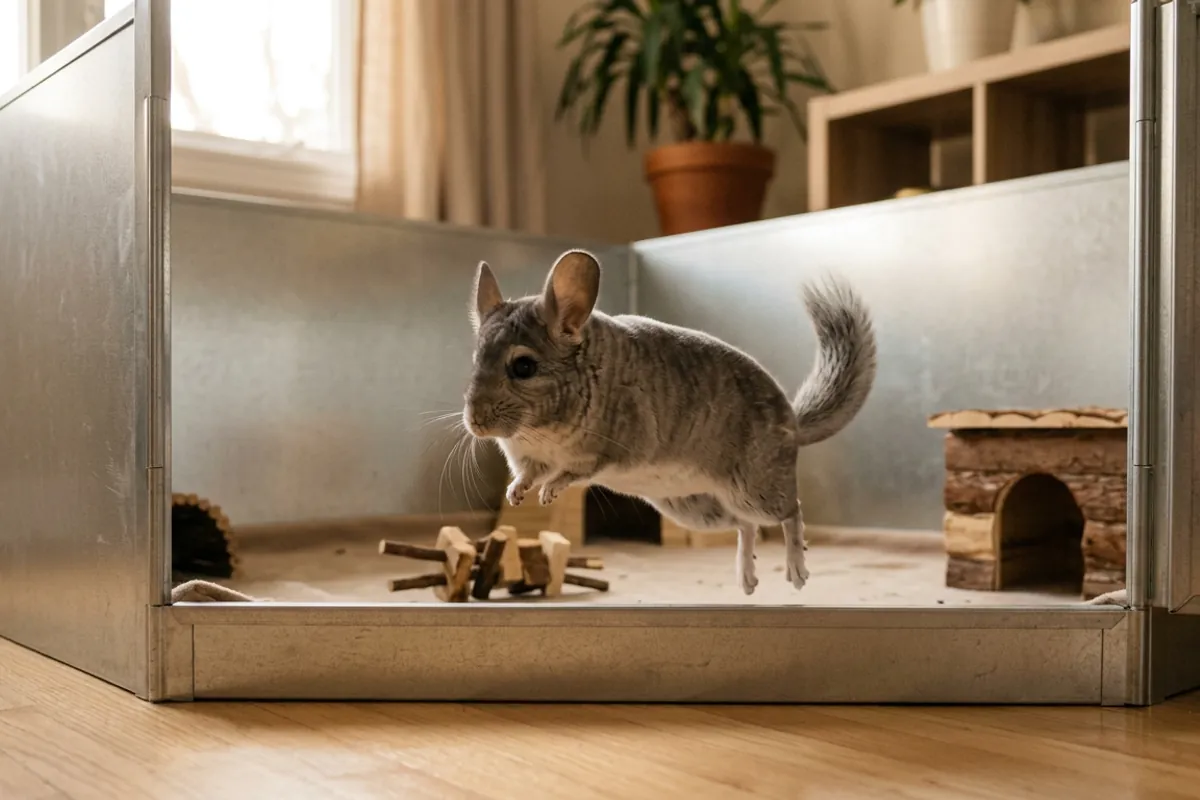
The best playpen for a chinchilla is tall and solid-sided, because these animals jump far higher than people expect and will clear a short panel without trying. Metal panel pens meant for small animals work if they are high enough; anything knee-height is decorative, not containing. Whatever you use, the floor inside it has to be genuinely chinchilla-proof: no exposed cords, no accessible baseboards or furniture legs, nothing plastic they can reach and chew. I supervise every playpen session, every time. A chinchilla can find and gnaw a hazard faster than you can cross the room.
A word on where the pen goes: the same cool-room rule that governs the cage governs floor time. A playpen in a bright, warm sunroom is a heat trap, however fun it looks.
Placement, heat, and getting them there safely
The best chinchilla cage in the world kills the animal if you put it in a hot room, so placement is not a footnote. Chinchillas are dense-furred animals built for cold mountain air, and they do not shed heat well. The comfortable range is 60 to 70°F (15 to 21°C). Above 75°F (24°C) you are into risky territory, and at 80°F (27°C) and up it is an emergency, faster still if the air is humid.
My whole approach to heat comes from Pebble, my other chinchilla, whose first summer brought a heatwave and a night at the emergency vet that I do not intend to repeat. So the cage goes in the coolest, most stable room you have, away from direct sun, radiators, and afternoon window glare, with air actually moving. Put a thermometer and hygrometer on the cage and read it, do not guess. digital thermometer and humidity gauge with remote probes As an Amazon Associate I earn from qualifying purchases. A chilled stone gives the animal a cool surface to lie against on a warm day, which helps but does not replace keeping the room itself cool. Kaytee Chinchilla Chiller granite stone As an Amazon Associate I earn from qualifying purchases. If you want to know how close to the line your room actually runs, I built a chinchilla heat danger calculator, and the full heat-safety guide sits behind it. This is the one thing on the whole page I will not soften.
Last, getting them home and to the vet. The best chinchilla carrier is small, hard-sided, well ventilated, and metal or a tough chew-resistant body, because a chinchilla in a soft fabric carrier will chew out or overheat. Small is a feature, not a limitation: a huge carrier lets the animal get thrown around, while a snug one keeps it steady. Line it with fleece, add a little hay, keep the trip short and the car cool, and never leave the carrier in a parked car for even a few minutes in warm weather. You want it bought and ready before you need it, not the day of an emergency.
Buy the cage that gets the boring things right, put it in the coolest room you have, fill it with wood and hay and a solid wheel, and give the animal real time out of it. That is the whole answer. The best chinchilla cage is not a brand you can point at; it is a set of decisions you make correctly and then rarely have to make again.