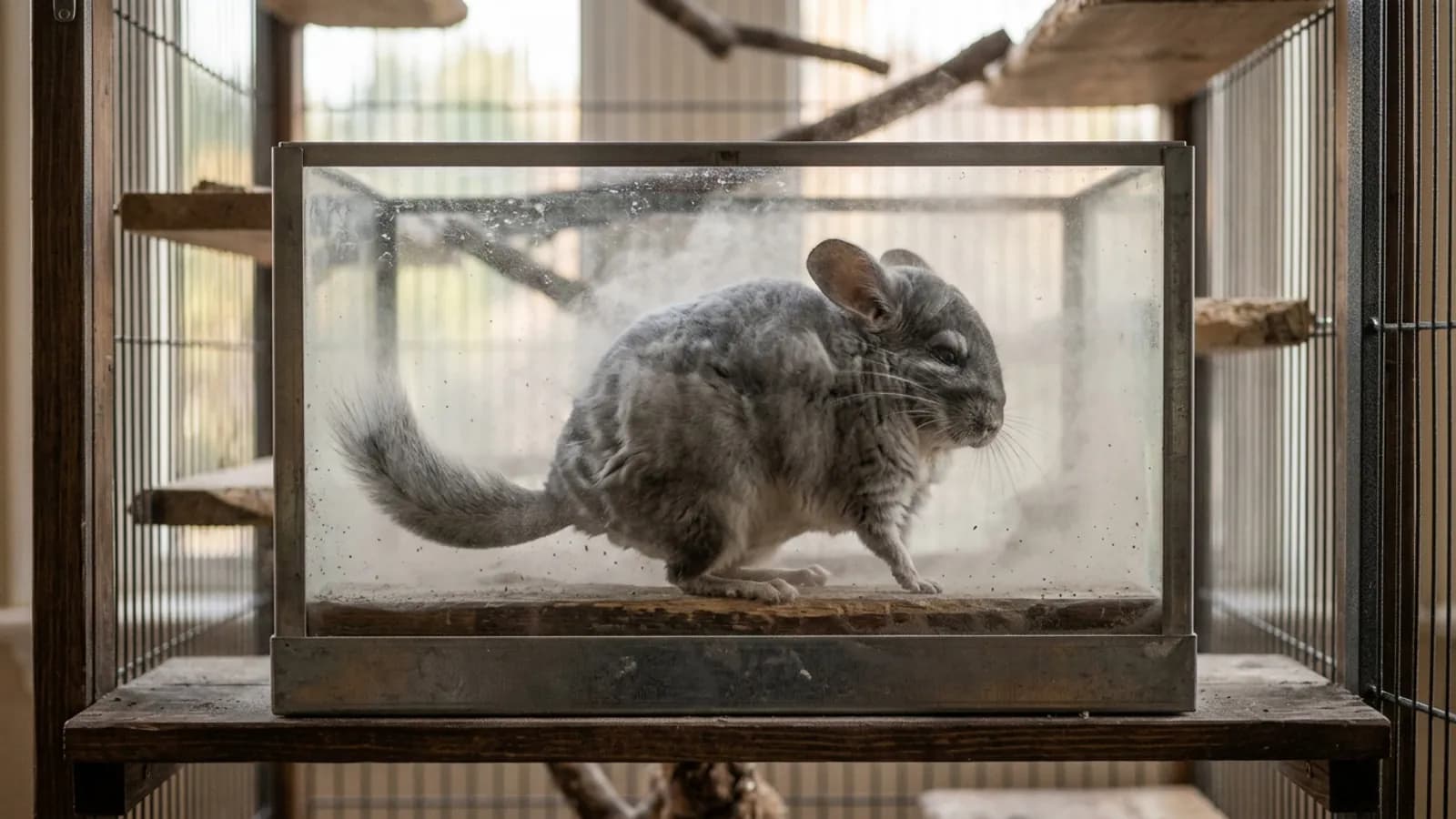
Bathing dust for chinchillas is the one supply I never let run low in my house. Hay matters more to long term health, and a decent cage matters more to daily happiness, but dust is what keeps the coat doing its job, and a chinchilla whose coat stops working is a chinchilla heading for skin trouble, matting, or worse. It is also the supply people get wrong most often, because a fair share of the bags on a pet shop shelf are the wrong material entirely and the front of the packet will not tell you. I have kept chinchillas for about ten years, and in that time I have bought good dust, mediocre dust, and one bag that was honestly just sand with a chinchilla printed on the front. Here is what the stuff actually is, how to spot the imposters, and how to use it without irritating eyes, lungs, or skin.
What bathing dust for chinchillas actually is
Proper chinchilla dust is ground volcanic pumice, milled to a powder finer than flour. Pinch a little between your fingers and it should feel silky, almost slippery, and leave a pale film on your skin. If you can feel individual grains rolling under your fingertips, you are holding the wrong product.
The reason it has to be that fine comes down to the coat. Chinchilla fur is extraordinarily dense: more than fifty hairs grow out of a single follicle, and figures in the range of sixty to eighty per follicle get quoted regularly. Exact counts vary between sources and between animals, so I would not treat any single number as gospel, but the practical point is not in dispute. That fur is packed so tightly that nothing much gets down to the skin and nothing much gets back out, including moisture and skin oils.
Fine pumice powder is light enough to slide between individual hairs, all the way down to the skin. It absorbs oil, lifts loose dander, and then leaves again when the chinchilla shakes, taking the grease with it. That is the whole mechanism. In the wild, chinchillas in the South American mountains roll in fine volcanic ash and dry soil for exactly the same reason, and the commercial product is an attempt to bottle that.
You will also see dusts based on sepiolite clay rather than pumice, especially in some European markets. Keepers argue about whether clay based products are as good, and I do not think the case is settled either way. Pumice is the default, it is what I use, and if you want the safe answer, that is it.
Why water is never an option
I want this said plainly, because new owners ask it every week: chinchillas never bathe in water. Not a quick rinse, not a shallow tub, not a wet cloth run over the body. The same fur density that makes dust necessary makes water dangerous. Water soaks straight into the undercoat and then sits there, because there is no airflow to the skin. A chinchilla can stay damp at skin level for many hours after it looks dry to you.
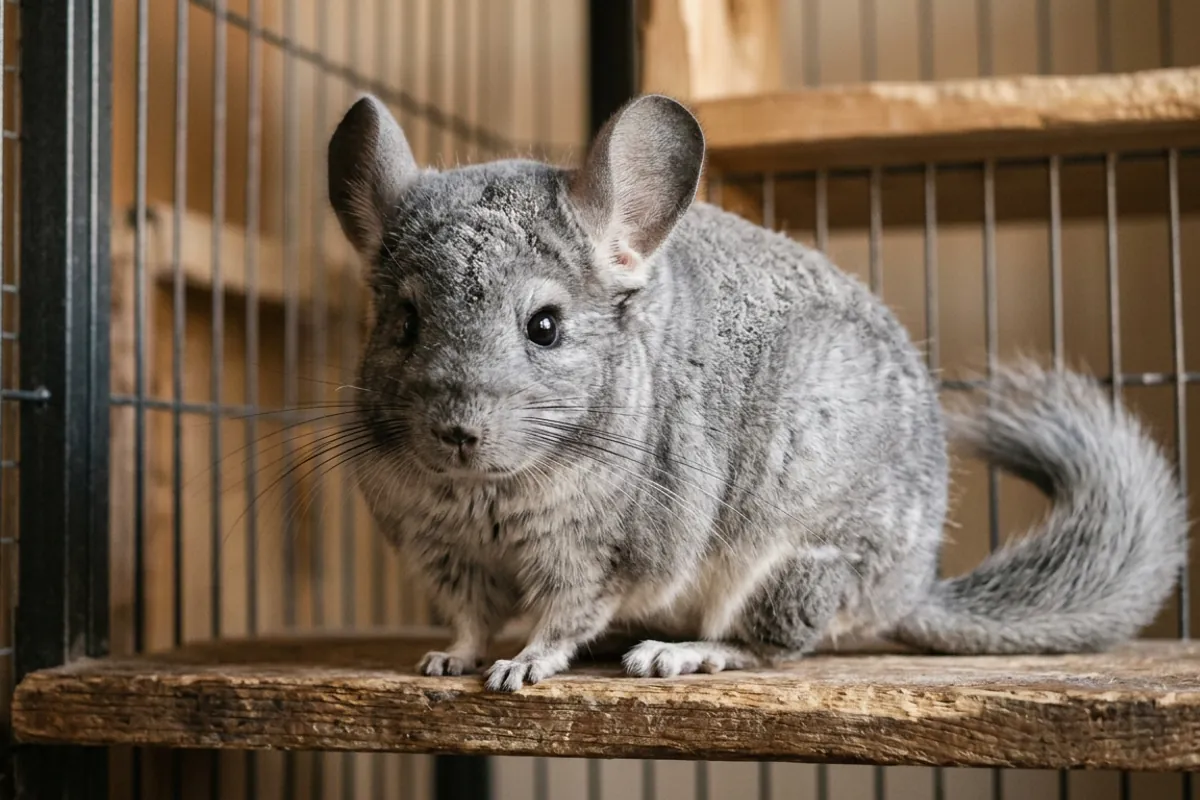
Two things follow from that. Damp skin under dense fur is close to ideal conditions for fungal infection, ringworm in particular. And a wet chinchilla loses body heat fast, which is a serious problem for an animal built to hold heat in. Their thermoregulation is one directional by design, and it is why the heat safety rules on this site are as strict as they are.
If something sticky lands on the coat, the fix is almost always patience: let it dry, offer a dust bath, and let the dust do the lifting. A small mat that will not come out can be trimmed with blunt scissors. If your chinchilla genuinely gets soaked, blot the coat with dry towels, swap towels as they get damp, keep the room comfortable rather than cold, and do not aim a hot hairdryer at the animal. If the chinchilla is shivering, quiet, unwilling to move, or was fully submerged, that is an exotics vet call and not something to sit on overnight.
Dust, sand, and the labels that mislead
Sand is the classic mistake. Sand is made of visible grains with hard edges. Those grains do not wick oil, they sit in the coat, they abrade the guard hairs, and they can scratch a cornea. Reptile calcium sand and children's play sand are both entirely wrong for a chinchilla, no matter what the shelf tag next to them says.
The complication is language. In several countries the correct product is sold under a name that translates as sand, and plenty of perfectly good bags are labelled chinchilla sand or badesand. So do not judge by the word on the front. Judge by the material listed on the back and by how it feels in your fingers. Finely milled pumice sold as sand is fine. Actual sand sold as dust is not.
The list of things that are never a substitute is longer than people expect. Baby powder is out: talc, cornstarch, and added fragrance are all wrong for an animal that inhales the cloud it is rolling in. Flour and baking soda are out. Diatomaceous earth is out, because its particles are sharp at a microscopic level and it is a known respiratory irritant. Anything sold as scented, deodorising, or odour eliminating is out. Your chinchilla does not need perfume, and a scented dust means additives sitting against the skin and going into the lungs of an animal with a small, sensitive respiratory system.
If the bag makes a claim that has nothing to do with cleaning fur, be suspicious of what got added to make that claim true.
How to pick a bag worth buying
Read the ingredients, not the marketing. A good bag lists ground volcanic pumice, or ground volcanic ash, and nothing else. No fragrance, no antibacterial additive, no colour, no clumping agent. Short ingredient lists win.
Check the colour and texture when you open it. It should be pale, somewhere between off white and light grey, uniform, and powder soft. If a brand new bag has hard lumps in it, it picked up moisture in storage, and damp dust is both less effective and more likely to sit in the coat as grit.
Buy the large bag if you have the storage for it. Dust is one of the genuinely cheap parts of chinchilla ownership, and the per bath cost of a big bag is small enough that it barely registers next to hay, vet savings, and the cage itself. If you are still working out what this animal costs to keep, I have gone through the real numbers in what a chinchilla actually costs.
One product category deserves a caution. Some keepers add an antifungal powder to the dust when they are dealing with a ringworm outbreak or a quarantined newcomer. That is a treatment decision, not a routine one, and it belongs to your exotics vet. Dosing a powder into a bath house because a forum post said so is how healthy skin gets stripped for no reason.
The bath house, the depth, and the schedule
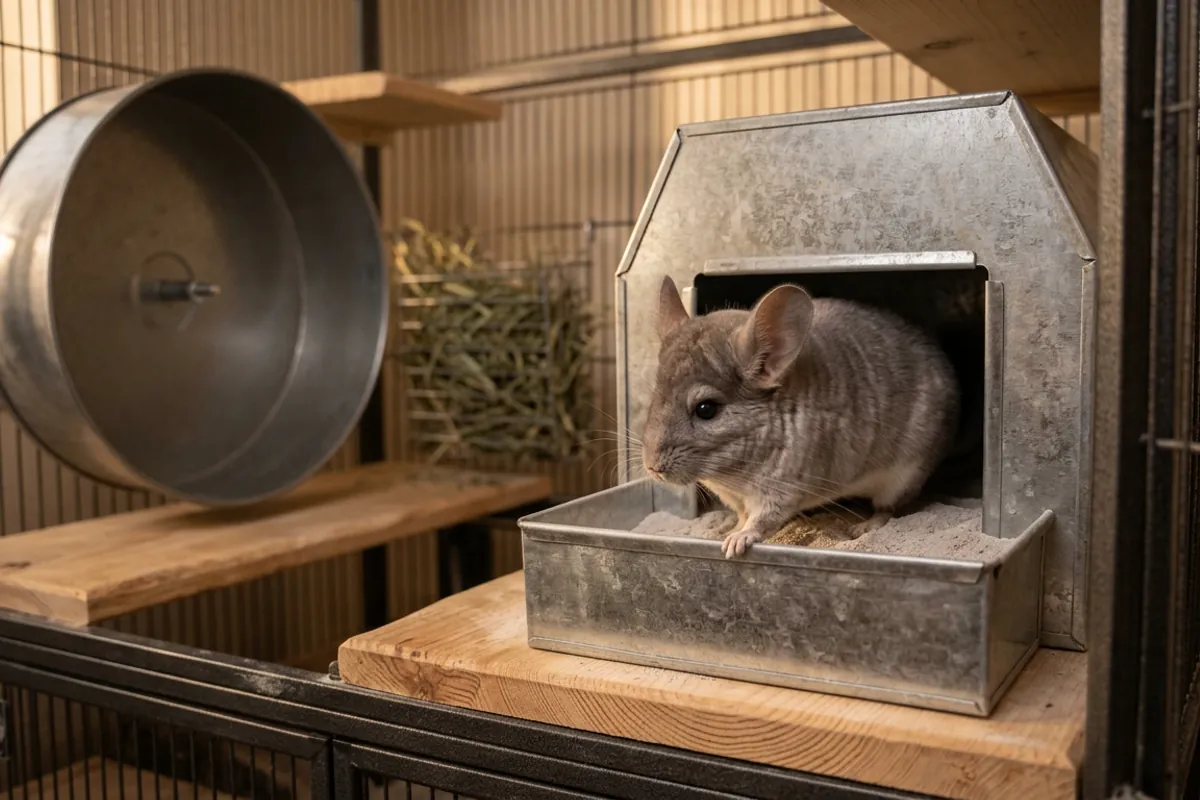
The container matters more than people think. It needs to be heavy enough not to tip, wide enough that the chinchilla can turn a full roll without hitting the sides, and ideally enclosed, because an open bowl throws dust across the whole room. Metal, glass, and heavy ceramic all work. Avoid plastic on principle: chinchillas chew what they sit in, and plastic in a chinchilla's gut is a problem you do not want to have. A dedicated enclosed bath house is the tidiest solution and the one I use.
Lixit Blue Beauty chinchilla dust, 3 lb As an Amazon Associate I earn from qualifying purchases.
Fill it with roughly one to two inches of dust, about three to five centimetres. That is enough for a proper roll without wasting a cup of powder every session. Offer the bath two to three times a week for most chinchillas in most homes. Drier air means you can go a little more often, humid air means you should watch the coat and adjust. Leave it in for ten to fifteen minutes, then take it out.
That last part is not optional. A bath house left in the cage full time gets used as a toilet, and it also lets a chinchilla overbathe until its skin goes dry and flaky. Ten to fifteen minutes, then out.
Time it for the evening, when chinchillas are naturally active, and pay attention to the room. An enclosed bath house is a warm box with a rolling animal inside it, so if the room is above 75°F (24°C), skip the bath and wait for the cool part of the day. At 80°F (27°C) and up you have an emergency on your hands and a dust bath is nowhere on the list of priorities. Pebble came to me out of an overheated attic and gave me a night at the emergency vet during her first summer, and I have never once been casual about room temperature since. Keep the cage room at 60 to 70°F (15 to 21°C), keep a thermometer and hygrometer on the cage rather than trusting how the room feels to you.
digital thermometer and humidity gauge with remote probes As an Amazon Associate I earn from qualifying purchases.
Humidity matters here too. In damp air the coat holds moisture, the dust clumps instead of flowing, and the bath does less. If you are unsure how your temperature and humidity combine, the heat danger calculator will tell you where you stand.
Keeping the dust clean, and when to throw it out
Chinchillas poop while they bathe. That is normal and not a crisis, because the pellets are dry and sit on the surface. Keep a small fine mesh sieve next to the dust container and sift after every bath. Thirty seconds of work and the dust stays usable.
I get about three or four baths out of a batch, roughly a week, before I tip it out and start fresh. Replace it sooner than that if any of these show up: urine has gone into it, it smells at all, it has gone grey and dull compared to the fresh bag, or it clumps when you stir it. Topping up old dust with a scoop of new dust is a habit worth breaking, because it just dilutes something that should have been binned.
Sharing one bath house between several chinchillas is fine when everyone is healthy. It stops being fine the moment one animal has a skin problem, a suspected fungal infection, or is a newcomer still in quarantine. Then that chinchilla gets its own container and its own dust, and the dust goes in the bin after each use.
Wash the container itself with hot water every time you change the dust, and let it dry completely before refilling. Store the bag or tub somewhere dry and airtight. A bathroom shelf is the worst place in the house for it.
Eyes, lungs, and the chinchilla who bathes too much
A bit of blinking and face washing after a bath is normal. What is not normal is an eye that stays squeezed shut, weeps for hours, produces discharge, or has the chinchilla pawing at its face. That is an exotics vet visit, and it is not one to postpone, because a scratched cornea gets worse quickly. Do not put human eye drops in a chinchilla's eye on your own initiative.
For lungs, on both sides of the cage: bathe in a ventilated room, use an enclosed house rather than an open bowl, and give the cloud a minute to settle before you lean over it. If you have asthma, a mask during bath time is a sensible precaution. If your chinchilla has a diagnosed respiratory condition, shorter and less frequent baths are the usual approach, but let your vet set that, not a stranger on the internet.
Watch the skin for the two failure modes. Too much bathing shows up as dry, flaky skin and a chinchilla scratching more than usual, and the fix is simply fewer baths. Too little shows up as fur that looks greasy or separates into damp looking clumps, most often behind the ears and along the flanks. Circular patches of hair loss, especially around the nose, eyes, or feet, with crusty or reddened skin, point toward a fungal infection. That is a vet case, and ringworm can pass to people, so handle it properly rather than hoping.
The mistakes I see most often
The bath left in the cage permanently, which turns a grooming tool into a litter box. Sand instead of dust. Topping up old dust rather than replacing it. Scented anything. Plastic bath houses that get chewed into fragments. Bathing on a hot afternoon because it is the day on the schedule, when the schedule should always lose to the thermometer.
There is one more, and it is subtler. People treat a good dust routine as if it covers the whole animal. It does not. Dust looks after the coat and the skin, full stop. It does nothing for teeth, which need unlimited grass hay and real variety in chews to stay worn down. My rescue Juniper has dental disease I manage every single day, and I watch up close what happens when teeth do not get the work they need. No amount of pumice touches that. If you want the rest of the picture, start with chinchilla care and the dust bath routine in full, and keep an eye on teeth and health alongside it.
Get the material right, keep it clean, keep it short, and keep the room cool. That is really all bathing dust asks of you, and in return it does a job no other product on the shelf can do.