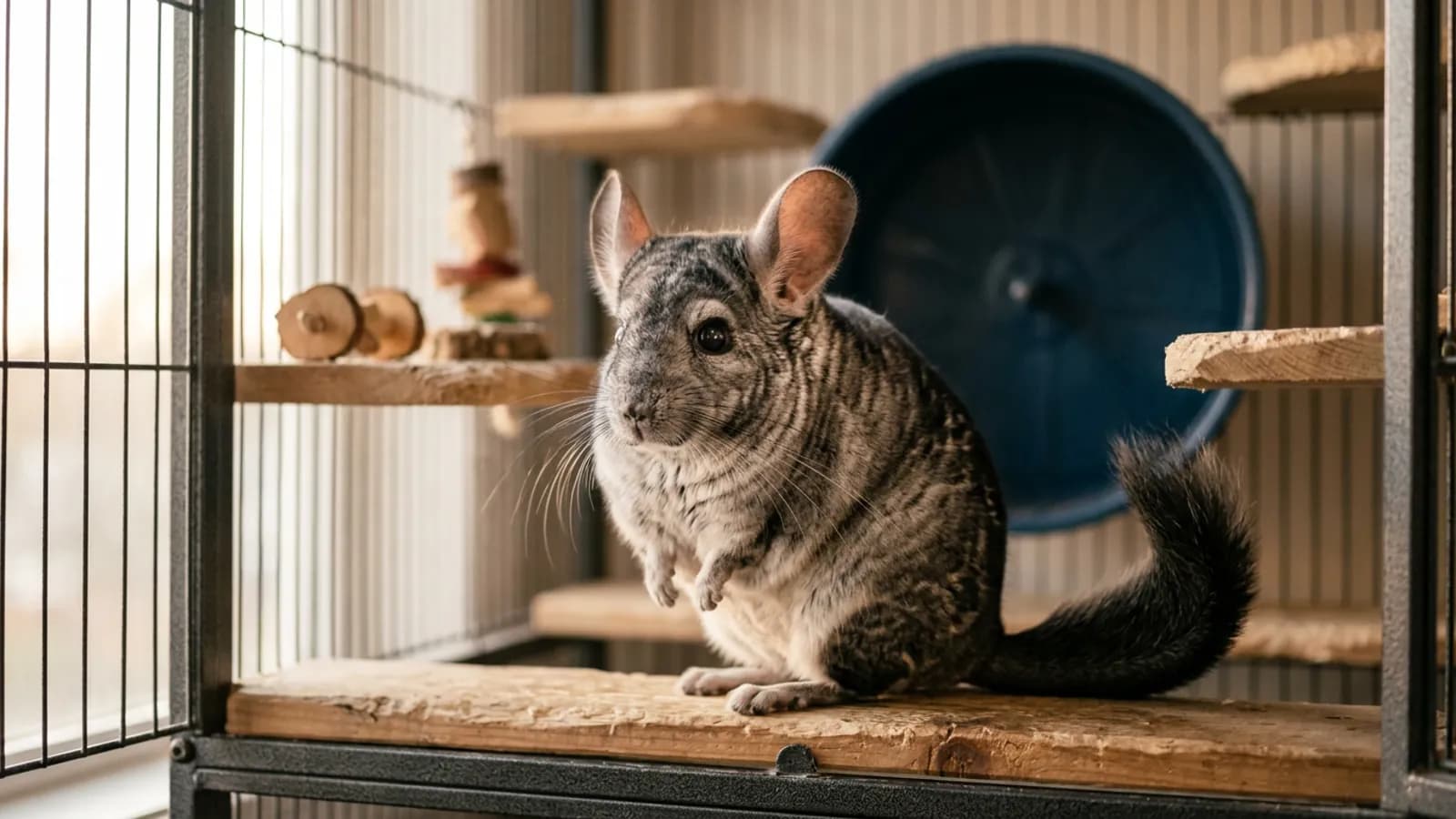
If you searched chinchilla persian expecting the small gray rodent I keep, the photos probably threw you, because almost all of them are cats. Long silvery coats, flat little faces, wide green eyes rimmed in black. That is because a chinchilla persian is not a chinchilla at all. It is a color variety of the Persian cat, named after the way my chinchillas' fur catches the light, and the two animals could not be more different to actually live with. I keep the rodent, not the cat, so I am not going to pretend to be a Persian breeder. What I can do is tell you plainly where the name came from, what the cat really is, what dollface means, and how to end up with the animal you actually meant to bring home.
What a chinchilla persian actually is
A chinchilla persian is a Persian cat that carries a particular silver coat pattern. It is not a separate species, not a hybrid, and it has nothing to do with the rodent beyond its looks. The coat sits on a white or very pale undercoat, and only the extreme tips of the outer guard hairs carry dark pigment. Cat people call that tipping, and on a chinchilla silver it covers only about an eighth of each hair. From a distance the cat looks pale silver with a faint sparkle, as if someone dusted the coat with soot and then brushed most of it off. The eyes are usually green or blue-green and outlined in black, and the nose is a brick red also rimmed in black.
Beyond the color, it is a Persian like any other: a heavy, long-haired, famously placid cat that would rather lie on a cushion than climb your curtains, and one whose long dense coat needs daily grooming to stay out of painful mats. That grooming is not a nice-to-have. Skip it and the coat punishes both of you. Registries do not fully agree on how to file the cat. Some treat it as a color division within the Persian breed, others have used names like Chinchilla Longhair, and I am a rodent keeper rather than a cat registrar, so I will flag that disagreement rather than pick a winner. The one thing everyone agrees on is the origin of the word, and that part is mine to explain.
Where the name really came from
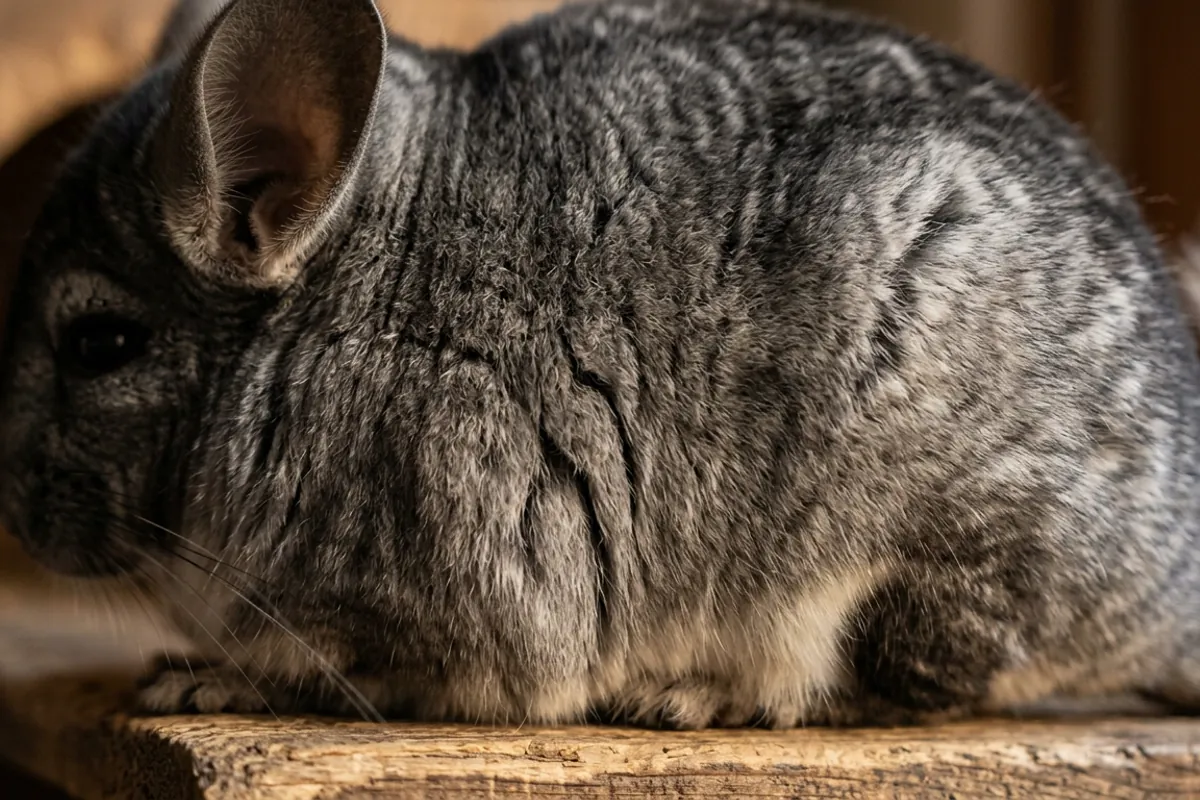
The name was borrowed from my animals. A wild-type chinchilla, the rodent, wears a dense gray coat where each individual hair is banded, dark at the base, a paler band in the middle, and a dark tip. Stack that banding across an incredibly dense coat, the often-cited figure is more than fifty hairs growing from a single follicle, and you get that soft, smoky, silver-over-gray look that no cat or rabbit coat quite matches. Nineteenth century breeders wanted a cat that shimmered like that, and when they got close enough they reached for the obvious word.
The same borrowing happened in shorthairs, which is why there is a British chinchilla cat, and in rabbits too. It is one of those names that spread far past the original animal. If you want the full story of the creature that started it all, I wrote it up in what a chinchilla really is, and the broader tangle of cat colors that stole the name lives in chinchilla cats. None of these cats are rodents. They just wear the rodent's name.
The dollface chinchilla persian, and what dollface means
You will see the phrase dollface chinchilla persian thrown around, and it is worth understanding before you pay anyone. Dollface is not a color and not a bloodline. It describes the shape of the face. Modern show Persians have been bred toward an extremely flat, pushed-in muzzle, sometimes called peke-faced after the Pekingese dog. The dollface, sometimes called the traditional or old-fashioned Persian, keeps a more natural muzzle with the nose set lower on the face, closer to how Persians looked before the flat face became fashionable. Persians did not always have that squashed profile you see on cat food packaging; it was selected for over decades of show breeding, and the dollface is essentially the older blueprint. So a dollface chinchilla persian is simply a chinchilla-silver Persian with that more moderate face.
Why does it matter? Because the extreme flat face is not just a look. It is widely documented to bring breathing trouble, crowded and misaligned teeth, and blocked tear ducts that leave the eyes weeping and stained. The dollface structure tends to spare a cat the worst of that. I am not a vet, and I am certainly not a cat vet, so I will not hand you a diagnosis. But the welfare logic is the same one I apply to my own animals: a face an animal has to fight to breathe through is not a feature. If you are choosing between kittens, a functional face beats a fashionable one, and anything abnormal about a cat's breathing or eyes is a conversation for a feline or exotics vet, not a forum.
The chinchilla colours inside a Persian coat
Chinchilla is not one flat shade in Persians, and the labels trip people up. The palest is the chinchilla silver I already described, tipping on only the very ends of the hairs. Add more tipping, roughly a third of each hair, and the cat reads as darker and is usually called a shaded silver instead. Swap the white undercoat for a warm cream or apricot one and keep the dark tips, and you get the golden chinchilla, which looks like antique gold brushed with shadow. Golden ones are rarer and priced accordingly, which is worth remembering the next time a listing leans on the word rare to justify a number.
They are all the same underlying idea: a pale base with dark only at the tips, borrowed straight from the rodent's banded fur. If you find the color naming fascinating, the rodent side of that rabbit hole is in rare chinchilla colors, where I make the same point I am about to make here about cats.
What the coat colour never changes
Here is the line I repeat on every color article, and it holds whether we are talking about a cat or the rodent on my shelf. Color is cosmetic. A chinchilla silver Persian is not calmer, healthier, or longer-lived than a black one because of its coat, and a rare-sounding label is mostly a pricing tool. With the cat, what actually determines the life you will share is the face structure I mentioned, the breeder's health testing, and the daily grooming a long dense coat demands, which is real work. With my rodents, the equivalent truth is that a sapphire, a violet, or a standard gray all need the exact same care, and none of it is optional.
So do not let a color word do your thinking for you. Ask about health, temperament, and what the animal actually needs every single day. The pretty coat is the last thing that should sway you, not the first, and any seller who leads with it is telling you where their priorities sit.
If you actually wanted the chinchilla, the rodent
Plenty of people land on chinchilla persian while shopping for the rodent and get whiplash. If that is you, let me point you back to the right animal, because a chinchilla is a serious commitment and the care is specific.
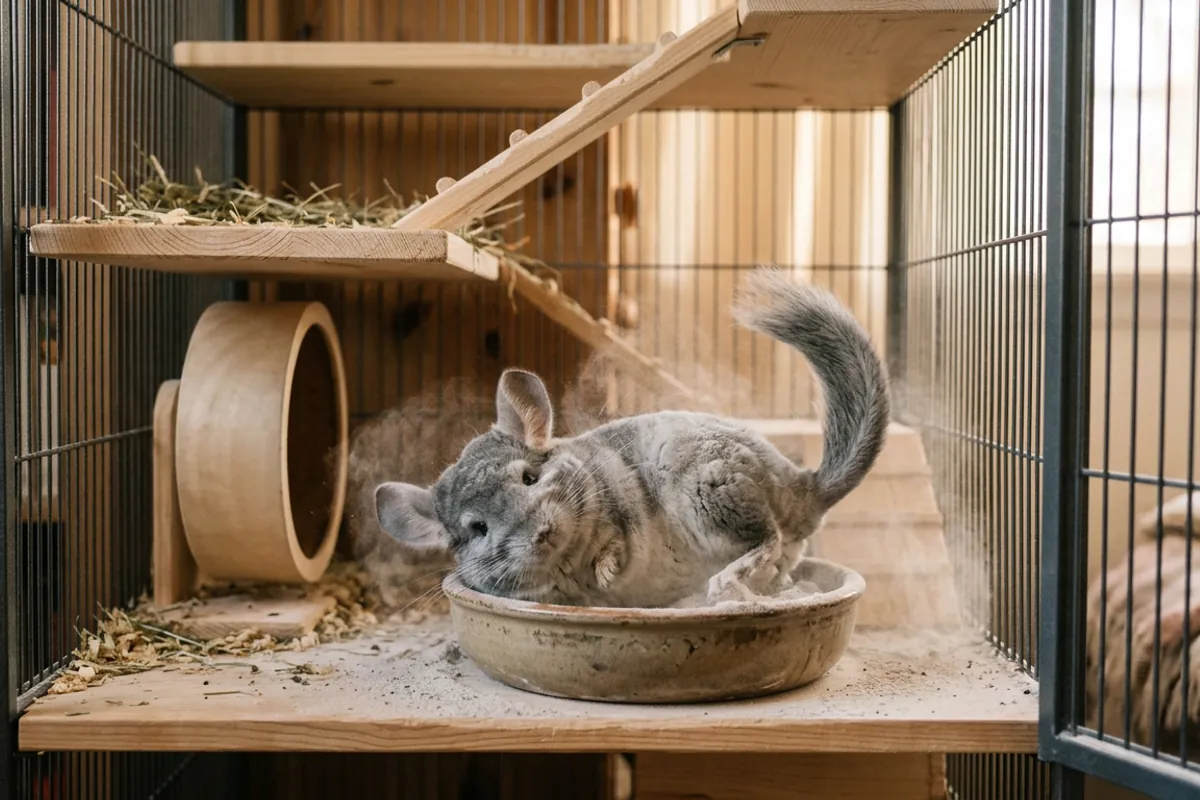
They eat grass hay, unlimited, all day, as the whole base of the diet. A good timothy is the standard. Oxbow Western Timothy Hay, 40 oz bag As an Amazon Associate I earn from qualifying purchases. Pellets are a small measured supplement on top, not the meal, and the whole diet argument lives in chinchilla diet, food, and hay. They never bathe in water. A wet chinchilla coat does not dry properly and can rot down to the skin, so they roll in fine volcanic dust instead, a few times a week. Lixit Blue Beauty chinchilla dust, 3 lb As an Amazon Associate I earn from qualifying purchases. The how and how-often of that is in the chinchilla dust bath. They need a tall metal and wood cage, never plastic, because they chew everything and plastic kills them when it reaches the gut. Critter Nation double unit small animal cage As an Amazon Associate I earn from qualifying purchases. If they run on a wheel it has to be a solid running surface, never wire rungs that can catch and snap a leg. 15 inch Chin Spin solid surface chinchilla wheel As an Amazon Associate I earn from qualifying purchases.
The part that ended my complacency years ago is heat. Chinchillas are built for a cold, dry mountain climate, and they cannot shed heat well. Comfortable is 60 to 70°F (15 to 21°C). Above 75°F (24°C) is getting risky, and 80°F (27°C) and up is an emergency, faster in humid air. My Pebble came to me from an overheated attic and gave me one terrifying night at the emergency vet in her first summer, and every heat rule on this site is that scare turned into numbers. Keep a thermometer where the cage sits so you are reacting to a reading, not a guess. digital thermometer and humidity gauge with remote probes As an Amazon Associate I earn from qualifying purchases. If you want to sanity-check your room, the chinchilla heat danger calculator does the math, and the full playbook is in chinchilla heat safety. For everything else, chinchilla care is the honest owner-to-owner version.
Buying a chinchilla persian without getting burned
If it really is the cat you want, treat the color as the least important thing on your list. Ask the breeder for health testing, meet the kitten's parents if you can, and lean toward the dollface structure for the welfare reasons above. Registered kittens from someone who breeds for a functional face and stable temperament are worth waiting for, and worth what they cost. A suspiciously cheap chinchilla silver from someone who cannot answer a health question is the opposite of a bargain. Ask what the parents were tested for, ask to see where the kittens are raised, and walk away from anyone who treats those questions as an insult. I have written more specifically about the cat listings and the tricks buried in them over in chinchilla persian for sale and chinchilla persian cats for sale, because that market has its own traps.
And if the search was a mix-up and you wanted the rodent all along, the buying advice is different but the caution is the same: see the animal in person, ask about age and health, and never buy on impulse from a tank at the back of a shop.
What I would actually tell you
A chinchilla persian is a cat, a silver Persian named after the fur on the animal I have kept for about ten years. The dollface version is the one bred for a more natural, functional face, and that is the detail I would weigh hardest if I were choosing a kitten, well ahead of the exact shade of silver. If you came for the cat, go in asking about faces and health, not coats. If you came for the rodent by accident, I am glad the wrong search brought you here, because the little gray original is the better story anyway, and the care pages on this site will get you ready for it. Either way, do not let a color word make the decision for you.