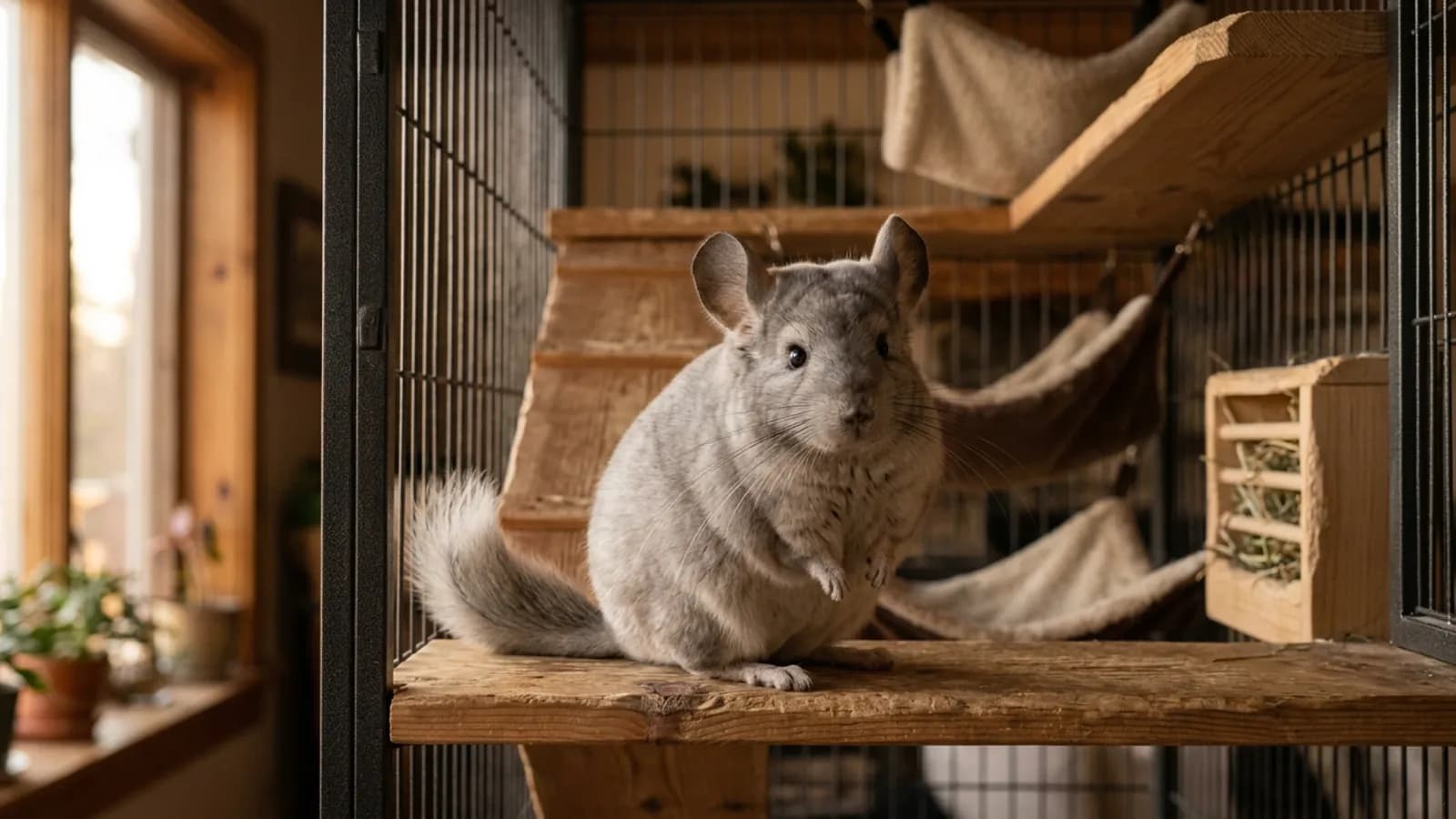
If you typed chinchilla persian cats for sale into a search bar and ended up on a site run by someone who keeps the actual rodent, you have already met the trap that sends a lot of buyers sideways. The word chinchilla is doing two jobs at once. In one, it names a small South American rodent with the densest fur of any land mammal. In the other, it names a coat color in longhaired cats. They are not related animals, they cost different money, and they need opposite care. I keep chinchillas, not cats, and I have kept them for about ten years, so I will be straight with you about where my knowledge ends. But I can at least stop you from buying the wrong animal by accident, and I can tell you exactly what the rodent costs if that is who you actually wanted.
Why a Persian cat ends up with a chinchilla's name
The chinchilla rodent has a coat that looks gray from a distance but is not gray at all up close. Each hair is banded: dark at the tip, pale below, with a slate base. That banding is why the fur reads as a soft, shifting silver rather than a flat color. When Persian cat breeders produced a cat whose white hairs carried only a fine dusting of color on the very tips, someone decided it looked like the rodent's coat, and the name stuck. So a chinchilla Persian is a cat with tipped fur, named after a rodent it will never meet.
That is the whole origin of the confusion. It is not a marketing trick, it is just an old borrowed word doing too much work. But it means every search for chinchilla cats for sale is pulling in two completely separate markets, and the listings do not always make it obvious which one you are looking at. A photo settles it fast: if the animal in the picture has whiskers, a flat face, and weighs more than a bag of sugar, you are looking at a cat. If it has large rounded ears, a bushy tail, and sits in your palm, that is the rodent this whole site is about, and you can read what a chinchilla really is to see how different it is under the fur.
What the listing words actually mean
Once you know the collision exists, the phrases in the listings start to make sense.
Silver chinchilla persian for sale means a longhaired cat, usually white or very pale, with black tipping on the ends of the hairs and often green eyes rimmed in dark. Silver is the classic version and the one most people picture. There is also a golden variant, where the undercoat is warm cream and the tipping is brown instead of black. Both are the same idea: color painted only on the hair tips over a light base.
Royal persian angora chinchilla for sale is where I get more careful, because that is a seller's phrase, not a single recognized breed standard. It stacks together a color word, a coat-length idea, and a grand-sounding label. When a listing reaches for that much decoration, slow down and ask what the animal actually is, what its parents were, and what health screening was done, rather than buying the adjectives. Fancy naming is not proof of anything.
Dearheart chinchilla persian for sale points at a specific cattery name. People who search that way are usually trying to reach one particular breeder they have heard of somewhere. I do not know that cattery and will not vouch for anyone I have not dealt with myself, so I will only say what holds for any breeder of anything: judge them by what they let you see in person, not by the name in the search box.
If you came here wanting the rodent instead
Some of you meant the cat. Some of you typed the wrong thing, or saw a fluffy silver animal somewhere and were not sure what it was called. If it is the rodent you actually want, good, because that is the animal I can genuinely help you buy.
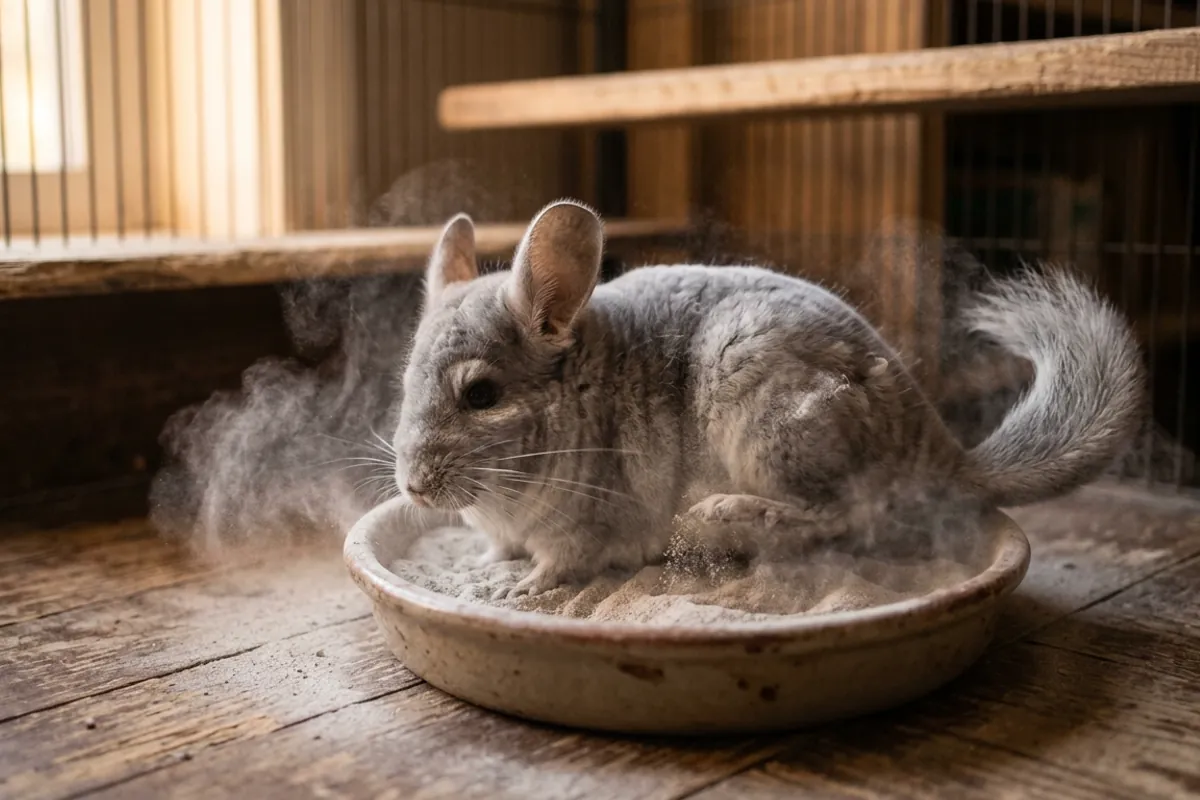
A chinchilla is a nocturnal rodent that lives, kept well, into its late teens and sometimes past twenty. It never gets wet: it cleans its coat by rolling in fine volcanic dust, not water, and a water bath can chill it dangerously because that dense fur holds moisture against the skin and will not dry. It eats grass hay first and most, all day, with a measured amount of plain pellets on the side. And it cannot shed heat the way most pets can, which is the single fact that has shaped everything I believe about keeping them. If you want the honest overview before anything else, chinchilla as pets, the honest version is where I would start.
None of that is optional, and almost none of it overlaps with what a Persian cat needs. So the buying decision really is a fork in the road, not a preference between two similar pets. Pick the wrong branch and you will spend years fighting an animal's basic biology.
What the real chinchilla costs, tag and after
The buying-cost cluster on this site exists because the sticker price is the smallest number in the whole exercise, for either animal. A chinchilla from a rescue or a decent breeder usually runs somewhere in the low hundreds, more for a rare color, and I have broken the full arithmetic down in what a chinchilla really costs and what a chinchilla price actually tells you. The part that catches people out is everything the tag does not include, and it is a longer list than most first-time owners expect.
The cage is the big one, and it is where I watch new owners lose money twice. Chinchillas need height to jump and a wire-free running surface, which means a tall metal-and-wood enclosure, not the plastic-bottomed box sold for hamsters. Buy the right one first. A solid metal-and-wood cage Critter Nation double unit small animal cage As an Amazon Associate I earn from qualifying purchases. outlasts two or three cheap ones, and how to choose a chinchilla cage lays out the reasoning if you want it. Inside it, the exercise wheel has to be a solid running surface 15 inch Chin Spin solid surface chinchilla wheel As an Amazon Associate I earn from qualifying purchases. because a wire wheel catches toes and legs and does real damage.
Then the running costs. Unlimited grass hay is the base of the whole diet, so you buy it in bulk and you never run out; a big box of timothy Oxbow Western Timothy Hay, 9 lb box As an Amazon Associate I earn from qualifying purchases. works out cheaper per pound than the little bags and means the animal is never rationed. Fine volcanic dust for bathing Lixit Blue Beauty chinchilla dust, 3 lb As an Amazon Associate I earn from qualifying purchases. gets used a couple of times a week. Safe wood chews keep the ever-growing teeth worn down, so an apple wood variety pack emours apple wood chew sticks, 40 count As an Amazon Associate I earn from qualifying purchases. is dental care rather than a toy. Plain pellets and a real vet fund for an exotics vet round it out. That last line is not optional either, because a chinchilla in trouble does not wait for payday.
How to buy either animal without getting hurt
Whichever animal you settled on, the way people get burned is the same, so the defenses are the same too.
See the animal before money moves. A seller who will only send photos, wants a deposit to hold a pet you have not met, or keeps moving the meeting point is telling you something, and it is not good. I go through this in detail for the rodent in how to buy a chinchilla for sale without getting hurt or ripped off and how to find a chinchilla near me, and the principle carries straight over to cats.
Ask what you are really being sold. With cats, that means health screening for the flat-faced breathing and tear-duct problems Persians are prone to, and proof of the parents. With chinchillas, it means age, sex, and whether the animal has ever been kept too hot, because heat damage does not always show on day one. Be wary of the bundle listing, where a tired cage is thrown in to make an old setup look like a deal; I pulled that one apart in what a chinchilla and cage for sale listing is really selling you.
And treat chinchilla persian cats for adoption exactly the way you would a purchase. Adoption is often the kinder route and can cost less up front, but a rehome still comes with a history, and you are allowed to ask about all of it. A good rescue, cat or chinchilla, wants you asking questions, not signing quietly.
Where care splits: cat versus chinchilla
This is the part where choosing the wrong animal actually hurts, so it is worth being blunt.
A Persian cat is a warm-room, groom-it-daily, flat-faced animal that tolerates the temperature you already live in and needs its long coat combed so it does not mat. A chinchilla is the opposite on almost every axis. It needs a cool room, because it cannot sweat and it cannot pant efficiently, and the fur that makes it beautiful is the same fur that cooks it. My comfortable range is 60 to 70°F, which is 15 to 21°C. Above 75°F, meaning 24°C, I am already watching the animal closely. At 80°F, or 27°C, and hotter it is an emergency, and humid air makes all of that arrive faster.
I am relentless about this because of Pebble, who came to me out of an overheated attic and gave me a night at the emergency vet in her first summer. That scare is why the heat guidance here reads like law and not a friendly suggestion. If you are weighing a chinchilla, read chinchilla heat safety and learn the warning signs of heat stroke before the animal is home, not after. A cooling stone Kaytee Chinchilla Chiller granite stone As an Amazon Associate I earn from qualifying purchases. and a thermometer with a humidity readout digital thermometer and humidity gauge with remote probes As an Amazon Associate I earn from qualifying purchases. are cheap next to what one emergency visit costs.
The grooming split matters too, and it runs the other way. A Persian needs combing. A chinchilla must never be bathed in water at all; it stays clean by rolling in fine dust a few times a week, which is a real chinchilla dust bath and nothing like a cat's bath. Get water into that coat and you get a chilled, miserable animal, not a clean one.
The last split is teeth. A chinchilla's teeth never stop growing, so it needs unlimited hay and a real variety of wood to chew or the teeth overgrow into something painful and expensive to fix. I manage exactly that with my rescue Juniper, day to day, and I have written up what to watch for in chinchilla teeth problems. A cat's teeth do not do this. So the chinchilla's daily wood and hay are not enrichment, they are dental care, and I will not soften that.
Choosing which animal actually fits your life
Here is the honest sorting. If you want a lap animal that lives in the warm room with you, that you can groom and cuddle in the evening, and you have the budget for the grooming and the flat-faced health care that comes with the breed, then a chinchilla Persian cat is a cat, and you should go find a careful cat breeder or a Persian rescue. Nothing on this site will make that animal easier to keep, because it is not the animal this site is about, and I would rather tell you that plainly than pretend otherwise.
If what pulled you in was the silver, jumping, dust-bathing rodent, then you are in the right corner, and the rest of Chincove is built for you. Start with chinchilla care, get the cage setup right the first time, and go in knowing the ten-plus year commitment and the cool-room requirement before you fall for a face at a pet shop. Either way, the win is the same: you walk away with the animal you actually meant to bring home, with your eyes open, instead of the one a borrowed word talked you into.