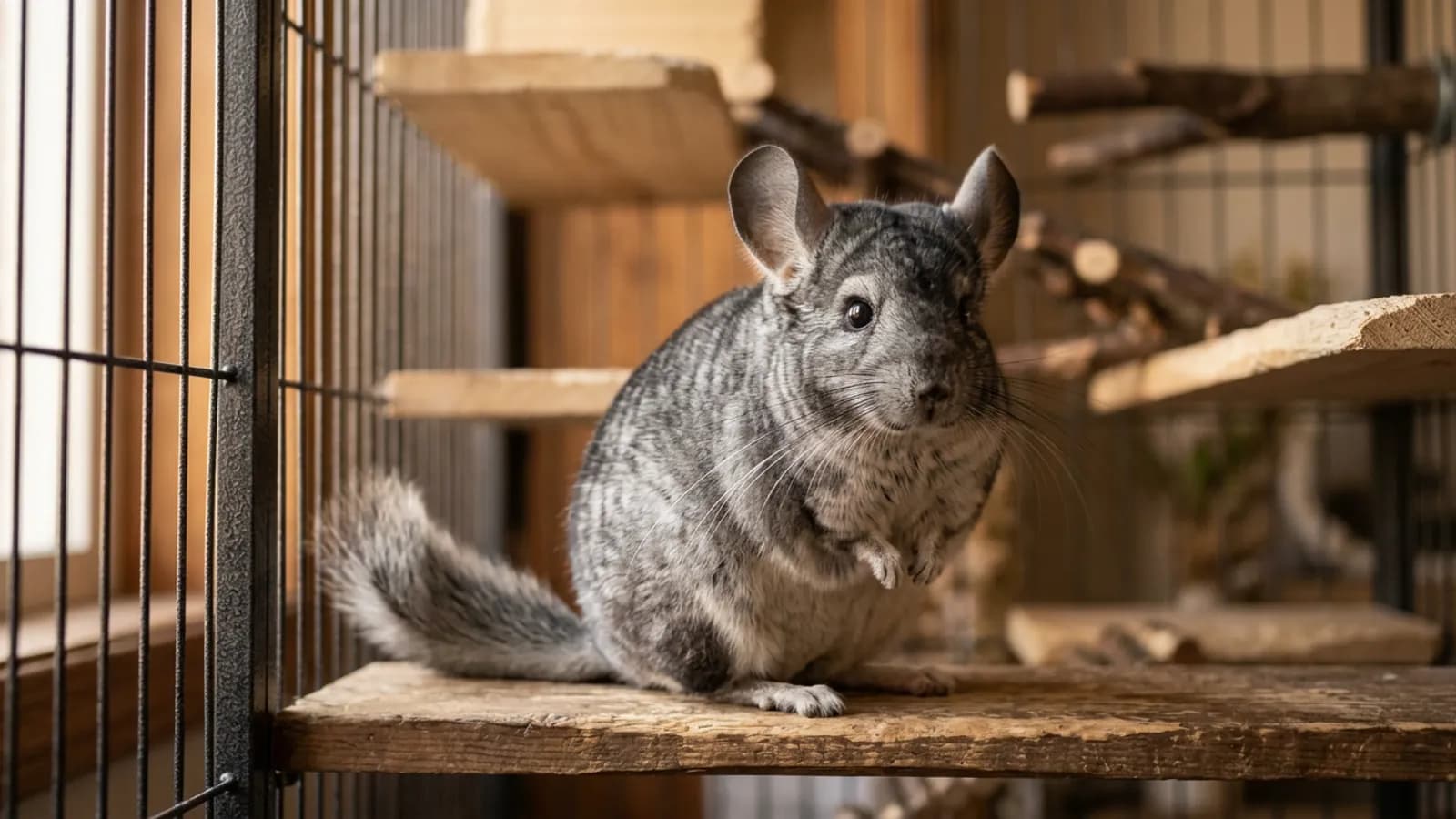
If you searched for british chinchilla cats and ended up on a site about a small silver rodent, you are not lost, and you are not the first. The word chinchilla gets borrowed a lot, and it lands on more than one animal. British chinchilla cats are cats, not the pet I keep. The name describes a coat, a particular way the fur is coloured, and it was borrowed from the animal my whole site is about because somebody thought the two looked alike. I keep the rodent. I have for about ten years. So I can tell you honestly where the name came from, what the cat and the rodent actually share, which is almost nothing that matters for care, and what to do if you actually came here looking for the pet and got the search terms tangled.
What "british chinchilla cats" actually means
When people say british chinchilla cats they are usually pointing at one of two things: a British Shorthair in the chinchilla silver colour, or a Persian in the chinchilla coat, which some sellers also file under British chinchillas when the lines are muddled. In cats, chinchilla is not a breed at all. It is a description of how the coat is coloured. Each hair is pale, almost white, along most of its length, and only the very tip carries colour, usually a fine black or silver-grey shading. The result is a coat that looks like it is dusted with silver rather than painted a solid colour. It shimmers when the cat moves because the tipping catches the light unevenly.
That tipping effect is the whole point. A shaded silver cat has more colour running down the hair; a true chinchilla has the least, just a whisper at the tip, so the animal reads as the palest silvery white with a faint sparkle. Many of these cats also have green or blue-green eyes, often with a dark rim like an eyeliner, and dark paw pads and lips. I am describing the look, not writing a breed standard, because I am not a cat person. If you want the exact registry definitions, the pedigree paperwork, or care advice for a cat, that belongs with a cat breeder or a small-animal vet who works with cats. I would only be guessing, and guessing about an animal's care is exactly what I refuse to do.
Where the name came from: the rodent's fur
Here is the part I can speak to with real authority, because it is my animal. The cat coat was named after the chinchilla rodent's fur, and once you understand how our fur is built, the borrowing makes sense.
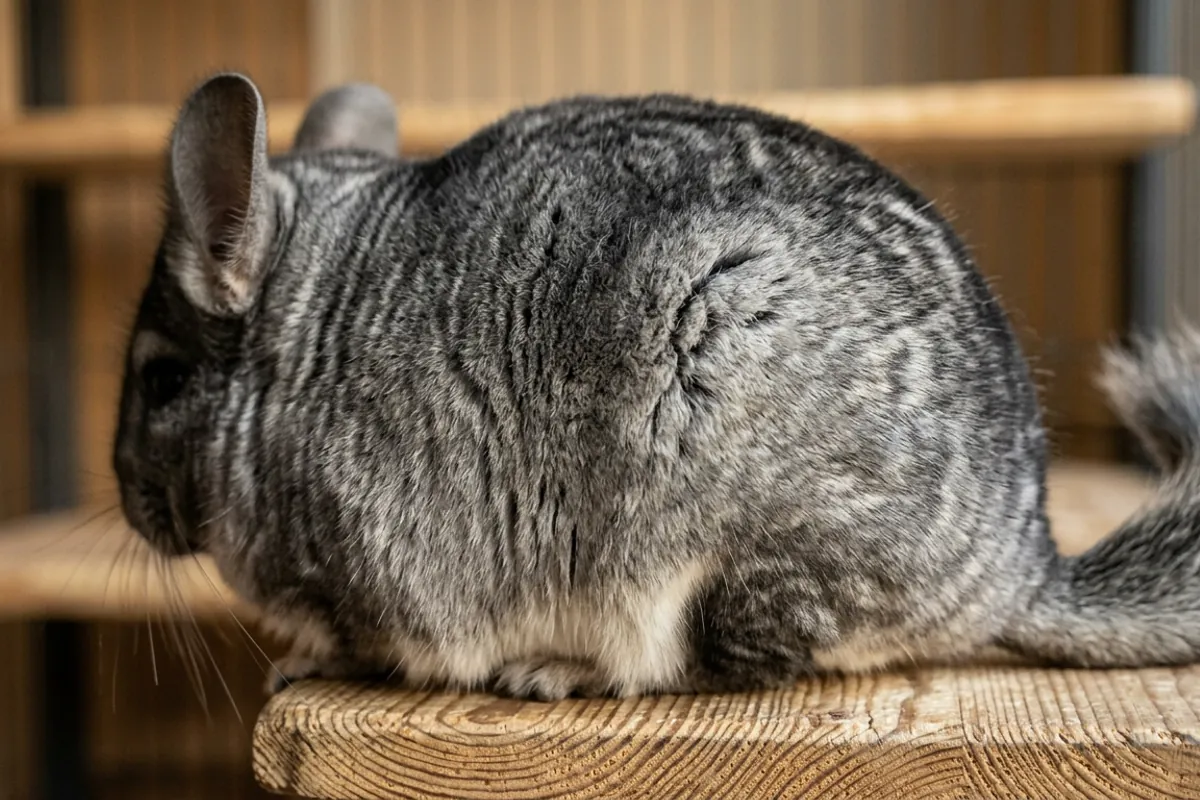
A chinchilla's coat is the densest of any land mammal. Where a cat or a dog grows one or two hairs from a follicle, a chinchilla grows fifty or more from a single point. Pack that many fine hairs into a small animal and you get a coat so thick that parasites cannot really live in it and water cannot easily reach the skin. That density is also why a chinchilla never bathes in water and only ever bathes in fine dust; the coat holds moisture against the skin instead of shedding it, and a damp chinchilla is a sick chinchilla waiting to happen.
The colour comes from banding. In the standard grey chinchilla, each individual hair is not one flat colour. It is dark grey at the base, then a paler band, then a darker tip. Multiply that across an impossibly dense coat and the animal looks silver-grey, shifting lighter on the belly, with the tips giving the whole thing a soft frosted quality. That tipped, frosted, silver look is precisely what the cat fanciers were reaching for when they called a pale silver-tipped cat a chinchilla. They saw the rodent, saw the sparkle, and took the word. If you want to see how the same silver base plays out across the mutations we actually breed in the pet rodent, I have written up the standard grey and the colour mutations and specific ones like the white chinchilla and the brown chinchilla, where the colour changes and the care does not.
What the cat and the rodent do not share
The name is the only real thing they share. Everything about how you keep them alive runs in opposite directions, and this is where the confusion stops being charming and starts being dangerous, because someone could read cat advice and apply it to a rodent.
A cat is a predator. A chinchilla is prey, a small crepuscular rodent from the cold, dry, high Andes. A cat can be bathed in water when it truly needs it; a chinchilla must never touch water and takes its bath in dust. A cat eats meat; a chinchilla is a strict herbivore whose gut is built to grind fibrous grass all day. A cat is comfortable in a warm living room; a chinchilla can die in that same warm room. A cat's teeth stop growing; a chinchilla's teeth never stop, for its entire life. If you take one thing from this article, take that: these two animals could not be more different to care for, and the shared word means nothing once the cat leaves the room.
This is a recurring trap with the word chinchilla, and it is worth knowing so you can spot it. The Soviet Chinchilla is a rabbit, not my animal at all, named for the same silver fur. And chinchilla Persian cats for sale is the same story as this one, a cat coat wearing a rodent's name. Whenever you see chinchilla attached to a listing, the first question is always: is this the actual animal, or is it a colour word doing double duty?
If you actually came here for the pet
Maybe the cat coat is exactly what you wanted, in which case go find a good cat breeder and I wish you well. But if the search terms crossed and you actually want the little silver rodent, or you are weighing whether one belongs in your home, let me give you the honest short version, because that is what this site is for.
A chinchilla is a fifteen to twenty year commitment when kept well, not a couple of years. That surprises people who assume a small rodent is a short, cheap pet. It is neither. It needs a tall metal-and-wood cage, unlimited grass hay, a specific narrow temperature range, dust baths a few times a week, and daily out-of-cage time in a chinchilla-proofed space. It is nocturnal to crepuscular, so it is liveliest in the evening, and it does not love being cuddled the way a cat might tolerate. It is a watch-and-marvel animal more than a hold-and-squeeze one. I have laid out the whole honest picture in chinchilla as pets, and the running chinchilla care hub collects the rest.
If any of that is a dealbreaker, better to learn it now, from a page, than a month in with an animal already in your house.
Heat is the rule that keeps a real chinchilla alive
I am relentless about temperature, and there is a reason with a name. Pebble, my signature chinchilla, came to me out of an overheated attic, and her first summer with me brought a heatwave near-miss and a night at the emergency vet. That scare is why the heat guidance on this whole site reads the way it does. It is not caution for its own sake. It is a rule written in a bad night I do not want you to have.
A chinchilla is built for a cold, dry mountain climate, wearing that impossibly dense coat all year. It cannot pant well and it cannot sweat, so it cannot shed heat the way a cat can. The comfortable range is 60 to 70°F, which is 15 to 21°C. Above 75°F, about 24°C, you are into risky territory. At 80°F, roughly 27°C, and up, you are in an emergency, and it comes on faster in humid air because damp air steals the little cooling ability the animal has. Those are not numbers I am flexible on.
That means you keep a real thermometer where the cage is, not a guess about how the room feels to you. A combined cage thermometer and hygrometer tells you both the temperature and the humidity, which matter together. digital thermometer and humidity gauge with remote probes As an Amazon Associate I earn from qualifying purchases. For the hot months a chilled solid stone the chinchilla can lie against gives it a way to dump heat. Kaytee Chinchilla Chiller granite stone As an Amazon Associate I earn from qualifying purchases. Neither of those replaces air conditioning on a genuinely hot day; they buy margin, not miracles. If your chinchilla is lying flat, breathing fast, with red hot ears, that is heat stroke and it is a vet emergency, not something to sleep on. I walk through the warning signs of heat stroke in detail, and there is a heat danger calculator that reads temperature and humidity together, because on a muggy day the thermometer alone flatters you.
Teeth and hay: the other thing that never stops
My other chinchilla, Juniper, came to me as a neglected rescue, and I manage her dental disease day to day. That is why I am uncompromising about hay and about chews, and I watch, up close, what happens when teeth do not get worn down.
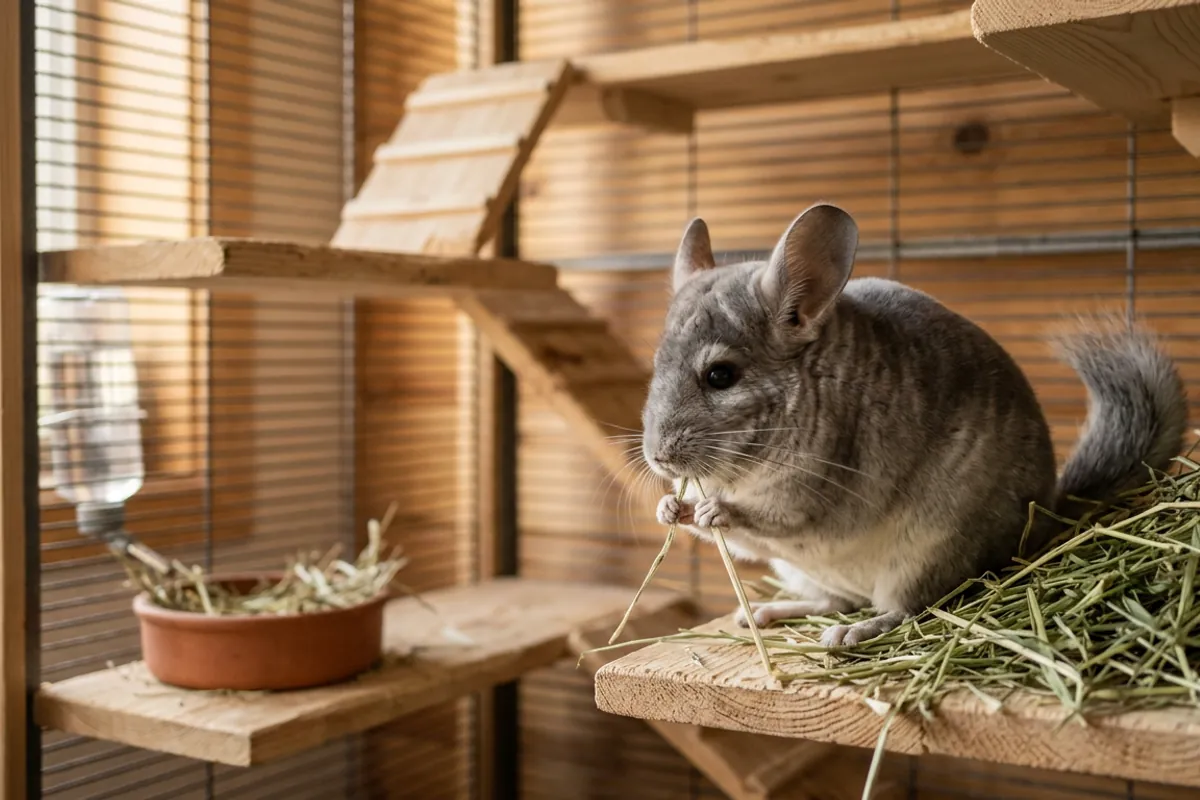
A chinchilla's teeth grow continuously for its whole life. The only thing that keeps them the right length and correctly aligned is grinding, hours of it, on coarse fibrous food. That is why grass hay is not a side dish, it is the diet. A chinchilla should have unlimited grass hay, usually timothy, in front of it at all times, and the constant side-to-side chewing is what files the teeth as they grow. Pellets are a small measured supplement, a topping, never the base. Get the hay right and you are doing the single most important thing for the animal's long-term health.
I keep hay in a dust-controlled box so it stays clean and dry. Oxbow Western Timothy Hay, 40 oz bag As an Amazon Associate I earn from qualifying purchases. For buying it, ordering timothy in bulk is far cheaper than pet-store bags and it keeps well if stored dry. Oxbow Western Timothy Hay, 9 lb box As an Amazon Associate I earn from qualifying purchases. Alongside the hay, safe wood to gnaw gives the teeth a second job and the chinchilla something to do. A variety pack of apple wood and other safe woods keeps it interesting; boredom with one chew is a chew that gets ignored. emours apple wood chew sticks, 40 count As an Amazon Associate I earn from qualifying purchases. None of that is decoration. It is dental care, and I say more about it in chinchilla chew toys. When teeth go wrong, and with Juniper they did, you cannot fix it at home. Drooling, weight loss, dropping food, wet chin, a paw pawing at the mouth: those send you to an exotics vet, because malocclusion is diagnosed and managed medically, not with a better chew. I keep an honest account of chinchilla teeth problems so you know what to watch for before it turns serious.
The rest of the setup, honestly
If the pet is what you want, the setup is not optional and it is not cheap, so it is worth getting right once. The cage should be tall, made of metal and wood, with wooden ledges at different heights so the chinchilla can climb and jump, which it does constantly. Plastic has no place in it; a chinchilla will chew plastic and can swallow pieces, and a wire wheel or a plastic wheel can catch a foot or a tail. A metal-and-wood cage built for the animal is the foundation. Critter Nation double unit small animal cage As an Amazon Associate I earn from qualifying purchases. If it runs on a wheel, and most love to, it has to be a solid running surface, never wire rungs, because open rungs snag and break legs. 15 inch Chin Spin solid surface chinchilla wheel As an Amazon Associate I earn from qualifying purchases.
Then there is the dust bath, which loops us right back to why the cat borrowed the name. Because the coat is so dense that water cannot safely reach the skin, a chinchilla cleans itself by rolling in fine volcanic dust, not sand, not dirt, an actual chinchilla bathing dust made for the purpose. Lixit Blue Beauty chinchilla dust, 3 lb As an Amazon Associate I earn from qualifying purchases. A few baths a week, a few minutes each, keeps that famous frosted silver coat, the very look the cat fanciers copied, clean and oil-free. Leave the dust in too long and the chinchilla will overbathe and dry its skin, so it goes in and comes back out. I cover the how and the how-often in bathing dust for chinchillas, and the full cage setup walks through building the whole thing so you buy it once.
So: british chinchilla cats are cats, wearing a silver coat named after the rodent I keep. The word travels; the care does not. If it was the cat you wanted, a cat breeder is your next stop. If it was the little silver climber, the one with fur too dense for water and teeth that never stop growing, then you are in the right corner after all, and the rest of this site is here for you.