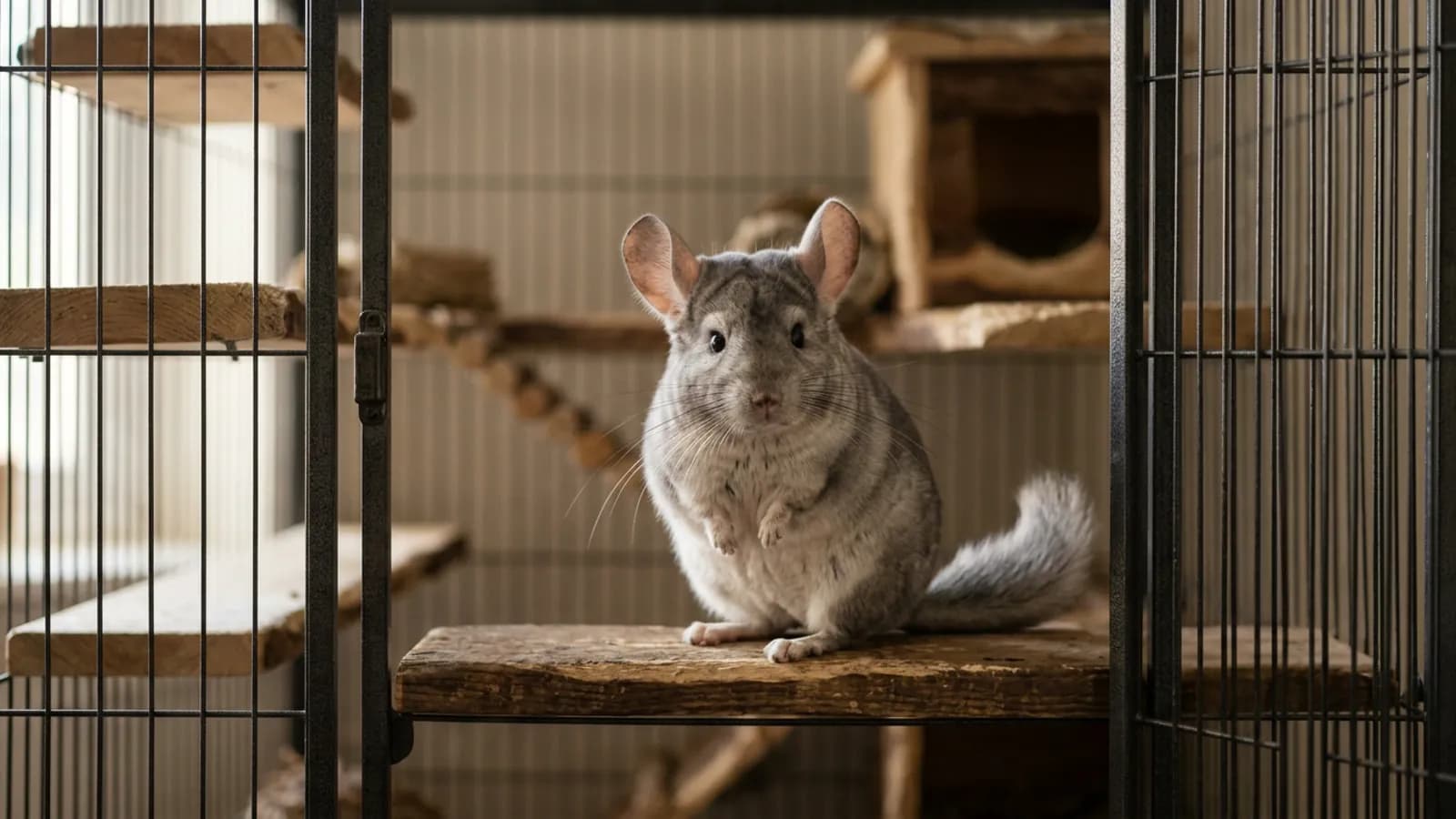
I have kept chinchillas for about ten years, and I will tell you plainly that a chinchilla pet is one of the most rewarding animals you can share a home with and one of the easiest to get badly wrong. They are not starter pets, they are not cuddly on command, and they do not forgive the two mistakes that hurt them most, which are a warm room and the wrong food. But go in knowing what a chinchilla actually is, a small dusk-and-dawn rodent from the cold high Andes wearing a coat so dense it cannot shed heat, and you get a curious, acrobatic companion that can live well into its late teens. This is the honest version of what that commitment looks like, drawn from years with Pebble and Juniper and most of the mistakes I made early.
What a chinchilla pet is actually like to live with
The first thing to understand is that a chinchilla is not awake when you are. They are crepuscular, which means they come alive at dusk and again around dawn, doze through the middle of the day, and expect a genuinely dark, quiet space to sleep. If your plan is a cage in a bright living room with the television on until midnight, you and the animal are going to be on a collision course. Mine live in a room that stays cool and calm, and I do most of my interacting in the evening when they are naturally up and bouncing off the walls.
And they do bounce. A healthy chinchilla is an acrobat, launching itself between ledges, wall to wall, in a way that looks reckless until you realise this is exactly how they move across rock faces in the wild. That single fact drives most of the cage decisions later on. It also means a bored chinchilla in a small box is a miserable animal, and boredom in a chinchilla shows up as bar-chewing, fur-chewing, and stress you could have designed out from the start.
They are prey animals, and that shapes everything about how they relate to you. A chinchilla does not want to be scooped up and squeezed. Trust is earned slowly, on their terms, and even a well-bonded chinchilla is usually happier sitting near you than being held. If you want a pet that will sit in your lap and be stroked for an hour, a chinchilla is the wrong animal, and it is kinder to know that before you bring one home. I go into this honestly in is a chinchilla a good pet, honestly, because the mismatch between what people expect and what a chinchilla is causes a lot of rehoming.
The flip side is that they are long-lived and genuinely characterful. A chinchilla pet can reach fifteen to twenty years with good care, which is a dog-length commitment in a palm-sized body. Pebble has opinions, preferences, and a very clear sense of when I am late with the evening routine. That longevity is a gift and a responsibility in equal measure, and it is the reason none of the shortcuts are worth taking.
The heat rule that comes before everything else
If you take one thing from this whole article, take this. A chinchilla's coat is so dense, with dozens of hairs growing from every follicle, that it cannot cool itself the way most animals can. Heat is the single most dangerous thing in a chinchilla's life, and it kills quickly.
The comfortable range is 60 to 70°F (15 to 21°C). Above 75°F (24°C) you are into risky territory, and 80°F (27°C) and up is a genuine emergency, faster still if the air is humid, because a chinchilla sheds heat by radiating it from the ears and cannot do that into warm, wet air. I am relentless about this for a reason. Pebble came to me from a rehome out of an overheated attic, and her first summer brought a heatwave near-miss and a night at the emergency vet. Everything I say about temperature is that night turned into rules.
So before you buy the cage or the wheel or anything else, work out how you will keep the room reliably below 70°F (21°C) on the hottest day of your year. In many homes that means air conditioning, not a fan, because a fan just moves warm air over an animal that cannot sweat. I keep a combined thermometer and humidity gauge on the wall by the cage so I am reading the real number, not guessing. digital thermometer and humidity gauge with remote probes As an Amazon Associate I earn from qualifying purchases. A cooling stone gives them somewhere to lie and dump heat on a warm afternoon, and it is a cheap, genuinely useful thing to have. Kaytee Chinchilla Chiller granite stone As an Amazon Associate I earn from qualifying purchases. Neither of those replaces a cool room. They are backup, not the plan. If you want the full picture, I keep it in one place at chinchilla heat safety, and there is a chinchilla heat danger calculator that turns your temperature and humidity into a plain risk read. Learn the warning signs of heat stroke before summer, not during it.
Feeding a chinchilla pet starts and ends with hay
A chinchilla's gut is built to process one thing in large quantities: fibrous grass. That means unlimited grass hay, available every hour of every day, is not a part of the diet, it is the diet. Timothy hay is the everyday staple I reach for, and it should never run out. Oxbow Western Timothy Hay, 40 oz bag As an Amazon Associate I earn from qualifying purchases. If you keep more than one, or you simply do not want to reorder constantly, buying it in bulk works out cheaper and means you are never caught short. Oxbow Western Timothy Hay, 9 lb box As an Amazon Associate I earn from qualifying purchases. Hay does two jobs at once. It keeps the digestive system moving, and it grinds down teeth that never stop growing. That second job is why I will not compromise on it. Juniper came to me as a neglected rescue with dental disease, and I manage her worn, uneven teeth day to day. Watching up close what happens when teeth do not get worn down is what made me uncompromising about unlimited hay and a real variety of chews. A chinchilla whose teeth overgrow stops eating, and a chinchilla that stops eating is a medical emergency that needs an exotics vet, not a wait-and-see.
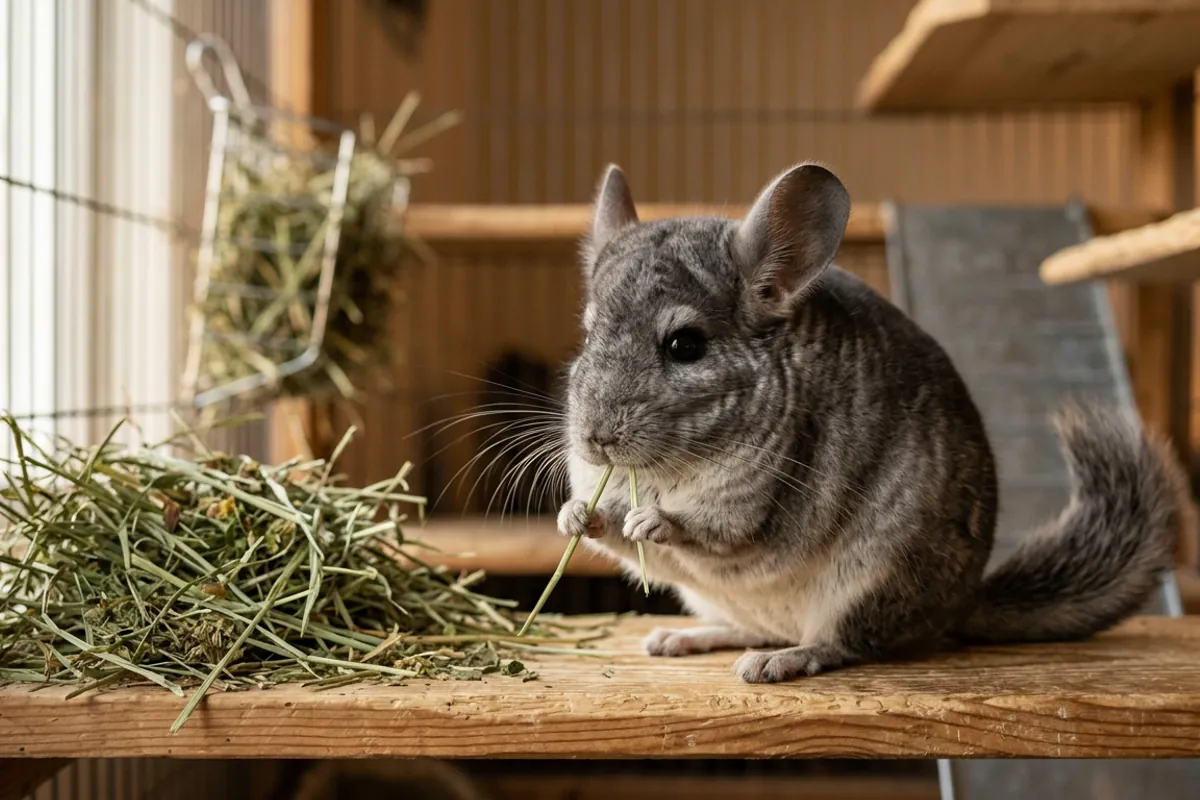
On top of hay, a measured amount of plain, high-fibre chinchilla pellets gives them the vitamins and minerals hay alone can miss. Measured is the key word: a tablespoon or two a day for an adult, not a full bowl they graze on instead of hay. Skip the colourful mixes with seeds, dried fruit, and corn bits, because a chinchilla will pick out the sweet pieces and leave the good stuff.
Treats are where good intentions do the most damage. A chinchilla's system does not handle sugar or fat, so no yoghurt drops, no nuts, no fresh fruit as a daily habit. My treats are a single plain rose hip or a small piece of plain dried herb, a couple of times a week at most. Fresh, clean water from a bottle rounds it out, and I go into what to feed and what to keep out of the bowl in more detail in the chinchilla diet.
The cage a chinchilla pet actually needs
Remember that this is an animal that moves vertically. A good chinchilla cage is tall before it is wide, made of metal bars and solid wood, with wooden ledges set at different heights so they can climb and leap the way they are built to. Plastic has no place in it, because a chinchilla will chew any plastic it can reach, and plastic in the gut is dangerous. A cage that is all metal frame with wooden shelves is what I keep mine in. Critter Nation double unit small animal cage As an Amazon Associate I earn from qualifying purchases. Floor space matters less than height and levels, which is why I would always take a tall cage over a sprawling flat one. I lay out the reasoning in why a multi level chinchilla cage is built for how they move and, if you want the whole build, how to build a chinchilla cage setup that keeps the animal healthy.
An exercise wheel earns its place, but only the right kind. It must be a solid running surface, large enough that the back is not arched, because a wire-runged wheel catches toes and tails and causes real injuries. I have seen the damage a wire wheel does, and I will name it plainly as the wrong buy every time. 15 inch Chin Spin solid surface chinchilla wheel As an Amazon Associate I earn from qualifying purchases. Fill the rest of the cage with things they can safely destroy. Chinchilla teeth need constant work, so a rotating variety of untreated apple, willow, or other safe wood chews is dental care, not decoration. emours apple wood chew sticks, 40 count As an Amazon Associate I earn from qualifying purchases. Wooden ledges, a hidey house, and a few hanging chews give a chinchilla a reason to be the busy, springy animal it is, and they keep the boredom problems from ever starting.
Dust, never water
This is the line that surprises new owners the most: a chinchilla must never be bathed in water. That incredibly dense coat holds water against the skin, takes a very long time to dry, and can grow fungus or chill the animal before it does. They stay clean by rolling in fine dust, which is really finely milled volcanic pumice, not sand and not dirt. The dust slips between the hairs and carries away oil and moisture, and a chinchilla rolling in it is one of the genuine joys of keeping them.
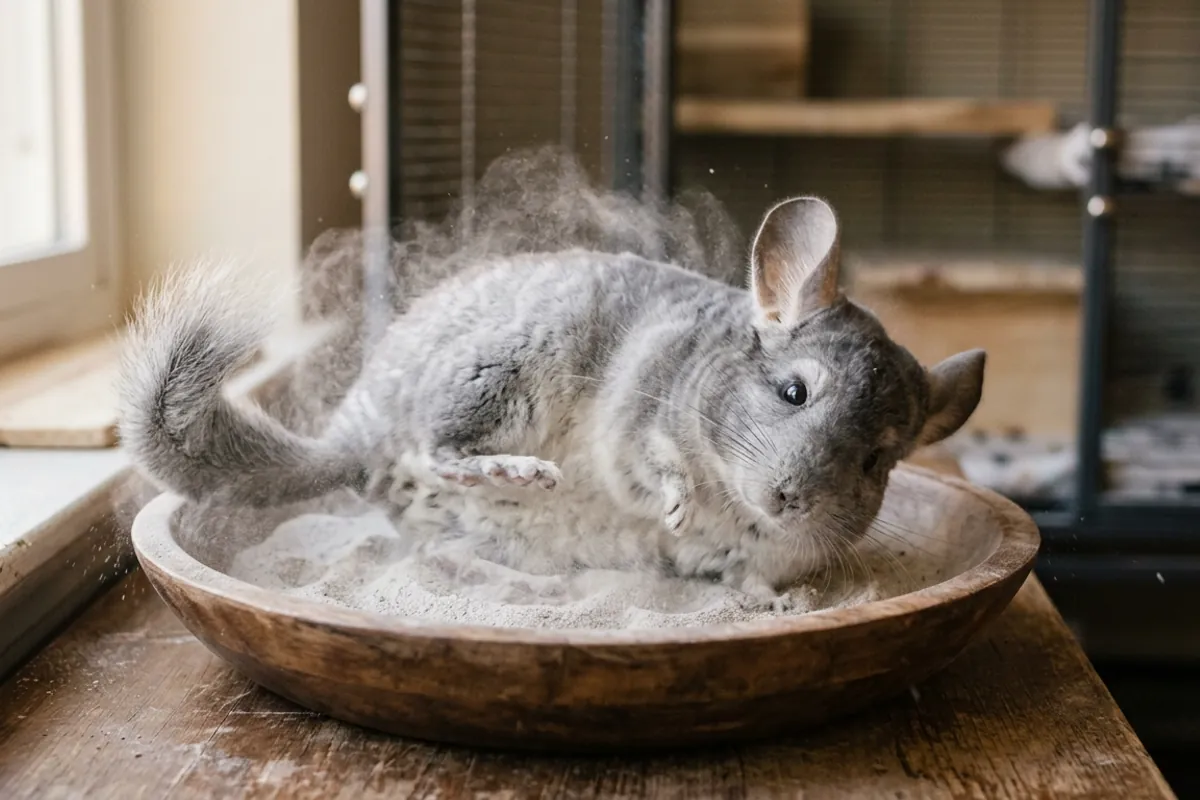
I offer a dust bath two or three times a week, for ten to fifteen minutes, then take it out so they do not sit in soiled dust or overdo it and dry out their skin. In a humid spell I offer it a little more often, and in a dry one a little less, watching the coat and skin rather than the calendar. A solid house or bowl that contains the dust saves you a lot of cleanup and gives them somewhere they can really flip over in. Lixit Blue Beauty chinchilla dust, 3 lb As an Amazon Associate I earn from qualifying purchases. Use proper chinchilla dust, not builder's sand, which is too coarse and can irritate the skin and eyes. I cover the how and how-often in the chinchilla dust bath, done right.
Handling, bonding, and the limits of a chinchilla pet
Bonding with a chinchilla is a patience game. In the first week I mostly leave a new arrival alone to settle, then sit by the cage and talk, then offer a bit of hay from my fingers. Hand-taming happens on the chinchilla's clock, and pushing it sets you backwards fast. Once they trust you, supervised time outside the cage in a chinchilla-proofed room is the best enrichment there is, but the room has to be genuinely safe: no cables to chew, no gaps behind furniture, no other pets loose.
That last point matters. A chinchilla and a dog or cat is a relationship you supervise every second, because to a predator a small fast rodent is prey, and to a chinchilla a big animal is a threat that raises stress even when nothing bad happens. I keep them separated and only ever in the same room under close watch.
Children are the other honest conversation. A chinchilla is fast, fragile, and does not want to be gripped, which makes it a poor match for young kids who want to hold and cuddle. If a child squeezes a startled chinchilla, someone gets bitten and the animal loses trust it took weeks to build. This is a pet for a household that can respect its pace. None of this makes a chinchilla a bad pet. It makes it a specific one, and a wonderful pet for the right person who meets it where it is.
What a chinchilla pet costs before you commit
The purchase price of a chinchilla is the smallest number in the whole equation, and letting it drive the decision is how people end up underprepared. The cage, done properly, costs more than the animal. Then there is ongoing hay, dust, pellets, and safe chews, none of it expensive month to month but constant for fifteen to twenty years.
Two costs people forget are the ones that keep the animal alive. The first is cooling: if your home gets warm in summer, budget for whatever it takes to hold the room below 70°F (21°C), because that is not optional. The second is veterinary care, and specifically an exotics vet. A regular cat-and-dog clinic often cannot treat a chinchilla well, and the two things most likely to need one, dental disease and heat stress, do not wait. I say it plainly: find your exotics vet before you need one, and keep a fund set aside, because a dental exam under anaesthetic is not cheap and an emergency at night is worse.
If you have read all of this and still want a chinchilla pet, that is a good sign, because you are choosing it for what it is rather than what you hoped it would be. Ten years in, I would not keep any other animal. But I keep them with my eyes open, the room cool, the hay endless, and an exotics vet on speed dial, and that combination is what a chinchilla actually needs to thrive.