If you have typed "chinchilla rabbit mix" into a search bar, you were probably after one of three very different things, and it helps to know which one before you spend a cent. Some people mean a cross between a chinchilla and a rabbit, an animal they picture in their head. Some mean the Chinchilla rabbit, which is a genuine rabbit breed named for its coat. And a great many people mean a bag of food labelled as a chinchilla mix or a forage mix, the muesli-style blends stacked on pet-shop shelves. I keep two chinchillas, Pebble and Juniper, and I have something to say about all three, because getting them wrong runs the whole range from a harmless mix-up to something that grinds an animal's teeth into trouble or lets it go hungry next to a full bowl.
A chinchilla and a rabbit cannot be crossed
Let me put the first idea down cleanly, because it turns up more than you would expect. There is no such thing as a chinchilla and rabbit mix as a living animal, and there never will be. Chinchillas are rodents, in the order Rodentia. They are hystricomorph rodents from the high Andes, closer kin to guinea pigs than to anything with long ears. Rabbits sit in an entirely different order, Lagomorpha, which people used to lump in with rodents until the anatomy said otherwise. Two separate orders is a wider gap than the one between a dog and a fox, and dogs and foxes already cannot produce young together.
The plumbing simply does not line up. The two species carry different chromosome numbers, and their reproduction runs on different clocks: a chinchilla is pregnant for around 111 days and delivers fully furred, open-eyed kits, while a rabbit is pregnant for about 31 days and delivers naked, blind ones. Nothing about those two systems meets in the middle. So if a breeder or a listing ever hints at a hybrid, that is your signal to walk away, because either they do not understand the animals they are selling or they are counting on you not to. What people are usually looking at, when they think they have seen a "mix," is one of the next two things.
The Chinchilla rabbit is a rabbit, not the animal I keep
There is one animal that legitimately carries the name, and it is a rabbit. The Chinchilla rabbit breed was developed for a coat that mimics the banded, silvery agouti pattern of a real chinchilla's fur, and the resemblance is close enough that the name stuck across several breeds. You will meet it in three sizes: the Standard Chinchilla, the American Chinchilla, and the Giant Chinchilla, the last of which can weigh five or six kilograms, which is roughly ten times what my Pebble weighs. The name is about fur colour and nothing else. There is no chinchilla in the rabbit and no rabbit in my chinchillas.
The same story sits behind a couple of other names people run into. The Soviet Chinchilla is another rabbit breed entirely, bred in the former USSR for meat and pelt, borrowing the coat name the same way. If you have been reading about the chinchilla rabbit breed and wondering why the care advice sounded so unlike everything else on this site, that is why: you were reading about a rabbit. I wrote a whole piece pulling the two apart, bunny chinchilla, because the confusion is common and the two animals need almost opposite care. It is worth reading before you commit to either, since the label on the cage card at the shop tells you very little about what is actually inside it.
Why you should never house the two together
Because you cannot crossbreed them, the next question I get is whether a chinchilla and a rabbit can at least live together, share a hutch, keep each other company. The answer is no, and I mean that plainly. They have opposite needs and a real capacity to hurt each other, and I would not put them in the same enclosure even under supervision.
Start with disease. Rabbits commonly carry bacteria such as Bordetella bronchiseptica that they may shrug off but that can cause serious respiratory illness in a chinchilla. Housing a prey animal next to a species that quietly sheds pathogens it is immune to is how you end up at the exotics vet with a sick chinchilla and no obvious cause. Then there is sheer size and strength. A startled rabbit kicks with powerful back legs, and a single kick can break the spine of an animal that weighs a fraction of what it does. Chinchillas are quick and fragile, and they are not built to absorb that.
The care needs pull in different directions too. Rabbits tolerate warmth far better than chinchillas do, and they need very different food. A chinchilla lives in a tall metal cage, bathes only in dust, and starts to struggle in heat that a rabbit would find comfortable. My whole approach to keeping mine safe in summer is built around the fact that they overheat where other pets are fine, which you can read in the chinchilla care guidance. Two animals with requirements that far apart do not belong in one space. Keep them in separate rooms if you keep both at all.
The food "mix" is where the real harm hides
Now the bag of food, and this is the version of "mix" that actually injures animals, so I want to spend real time on it. Walk into most pet shops and you will find blends sold under names like a chinchilla forage mix or a charlie chinchilla tasty mix: muesli-style food, full of colourful flakes, dried peas, seeds, puffed grains, and the odd bit of dried fruit. They look generous. They photograph well. They are, for a chinchilla, one of the worse things you can buy.
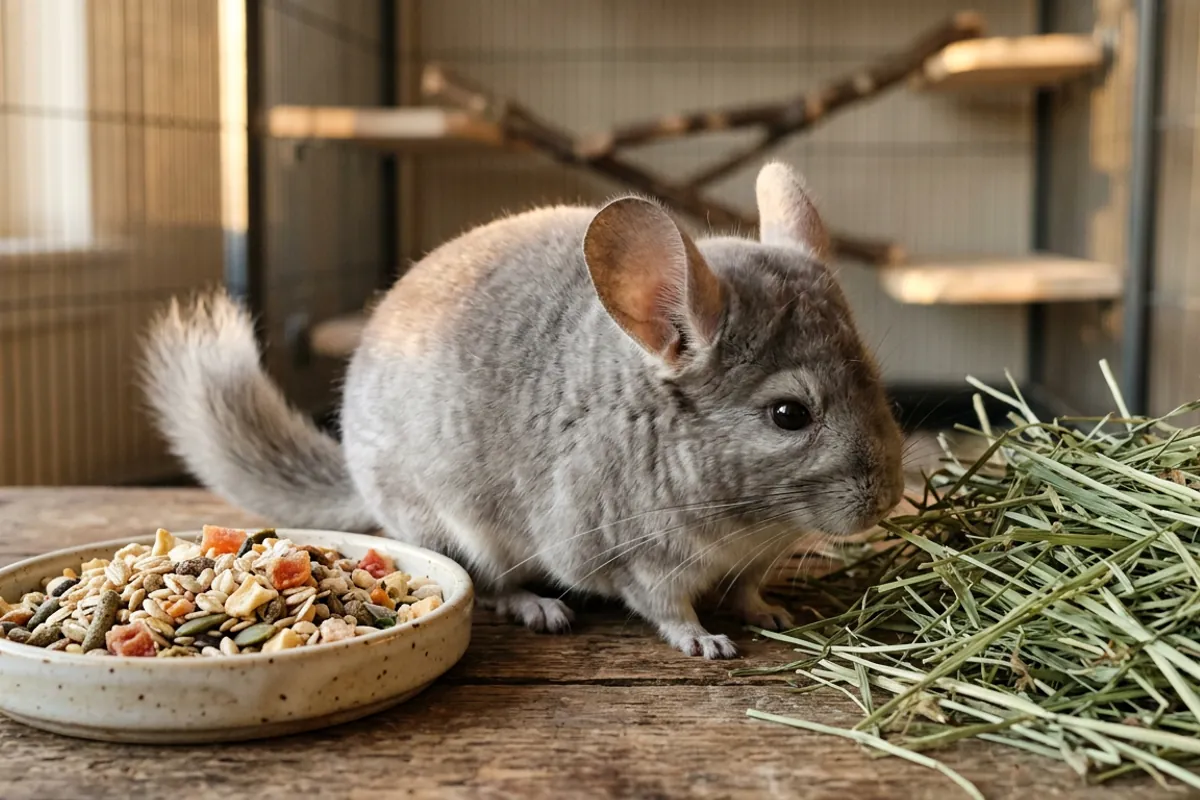
The problem is selective feeding, and it is not a small effect. Given a bowl of mixed pieces, a chinchilla does exactly what you or I would do at a buffet: it picks out the sweet, soft, high-calorie bits and leaves the plain fibrous ones behind. The parts it eats are the parts it needs least. The parts it ignores are the fibre that its gut and its teeth depend on. So you end up with an animal that is eating a lot of sugar and starch, getting fat, and at the same time not wearing its teeth down or keeping its digestion moving the way constant fibrous chewing does.
I watch this problem up close every day, because my Juniper came to me as a neglected rescue with dental disease, and I manage her teeth constantly. A chinchilla's molars grow for its entire life, and the only thing that keeps them the right length is grinding through coarse, fibrous food for hours. When a muesli mix lets an animal skip the fibre, the teeth keep growing without wearing, and you march toward overgrown molars, painful spurs, and an animal that stops eating. That is a vet problem by the time you see it, and often a lifelong one. A uniform food, where every piece is identical so nothing can be picked out, removes the whole trap. That is the entire case against the tasty mix: it sells convenience and colour and hands you a dental and weight problem in return.
What replaces the mix: hay first, then plain pellets
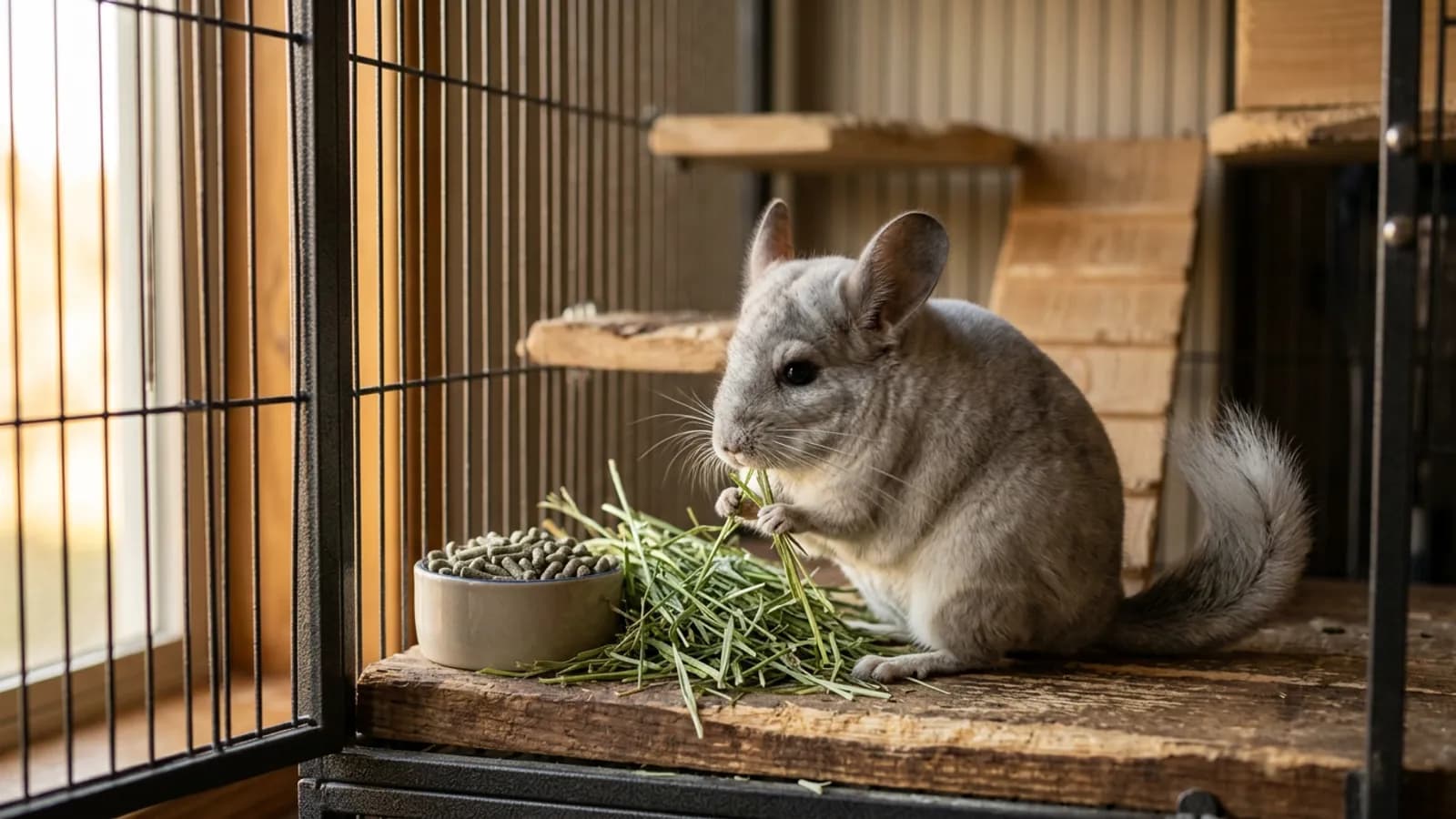
Here is what a chinchilla actually eats, and it is boring on purpose. The foundation, the thing that should make up the large majority of what goes into the cage, is unlimited grass hay. Timothy is the standard, and it should be in front of your chinchilla all day, every day, in quantities it can never quite finish. This is the fibre that wears the teeth and runs the gut, and there is no shortcut around it. I buy it in a way that keeps it dry and green rather than dusty, either a boxed supply for a single chinchilla Oxbow Western Timothy Hay, 40 oz bag As an Amazon Associate I earn from qualifying purchases. or in bulk if you keep more than one and go through it fast. Oxbow Western Timothy Hay, 9 lb box As an Amazon Associate I earn from qualifying purchases.
On top of the hay, a chinchilla gets a measured amount of plain pellets, and the word plain is doing the work in that sentence. You want a uniform, single-type pellet, not a mix, so there is nothing to sort and nothing to leave behind. The usual amount is roughly one to two tablespoons a day, offered as a supplement to the hay and not as the main event. I have written the detail out in the chinchilla diet guide, and it is the same message every time: hay is the meal, pellets are the top-up. For the teeth themselves, alongside all that hay, give safe wood to gnaw. A rotation of untreated apple, willow, or similar hardwood keeps a chinchilla chewing at something all day. emours apple wood chew sticks, 40 count As an Amazon Associate I earn from qualifying purchases. Juniper is the reason I am uncompromising about both the unlimited hay and the variety of chews. When teeth do not get worn down, I have seen exactly what happens.
Forage mix salad and treats, kept honest
There is a gentler cousin of the tasty mix worth addressing on its own, because the marketing blurs the line. A chinchilla forage mix salad is usually a blend of dried herbs, edible flowers, and leaves: dandelion leaf, rose petal, marigold, chamomile, that sort of thing. Unlike a muesli of grains and dried fruit, these are not automatically harmful, and a pinch can be a genuinely nice thing to hand your chinchilla. The catch is portion and honesty about what it is.
A forage mix is a treat, not a food group. A small pinch a few times a week, scattered so your chinchilla has to hunt for it, is enrichment, and I do offer mine dried herbs and rose that way. A daily handful is not, because even wholesome dried plants add up, and because anything your chinchilla fills up on is hay it did not eat. Where these mixes go wrong is when a bag with pretty botanicals gets treated as a meal. Keep it small, keep it occasional, and read the ingredient list: dried herbs and flowers are fine in a pinch, but seeds, nuts, and dried fruit do not belong anywhere near a chinchilla, whatever the front of the packet claims. I have laid out the safe and unsafe lists in what can a chinchilla eat and in chinchilla treats, and the short version is that most of what gets sold as a chinchilla treat is best left on the shelf. When in doubt, more hay is always the right answer.
Getting the rest of the care right
Food is where the "mix" question does the most damage, but if you have landed here while deciding whether a chinchilla is for you, a few other non-negotiables deserve a mention so the whole picture is honest. Housing is a tall metal cage with wooden ledges, never plastic, because a chinchilla will chew plastic and can suffer a fatal blockage from it. A metal wire and wood cage is the standard, and I have written up how to fit one out properly. Critter Nation double unit small animal cage As an Amazon Associate I earn from qualifying purchases.
A chinchilla never bathes in water. It bathes in fine volcanic dust, rolling in it to keep that dense coat clean and dry, and a soaked coat is a real health risk rather than a cute moment. Use proper bathing dust in a heavy dish a few times a week. Lixit Blue Beauty chinchilla dust, 3 lb As an Amazon Associate I earn from qualifying purchases. The detail is in the chinchilla dust bath guide if you want it.
Finally, and this is the one I will never soften, temperature. Chinchillas are built for cold Andean nights and they overheat easily. The comfortable range is 60 to 70°F, which is 15 to 21°C. Above 75°F, around 24°C, you are into risky territory, and 80°F, about 27°C, is an emergency, sooner still in humid air. My relentlessness about this comes from Pebble's first summer, a heatwave near-miss, and a night at the emergency vet, and it is why the heat guidance on this site reads like rules rather than suggestions. Keep a thermometer where the cage actually sits digital thermometer and humidity gauge with remote probes As an Amazon Associate I earn from qualifying purchases. and read the chinchilla heat safety page before your first warm spell, not during it. A chinchilla is a wonderful animal to live with, but it is a specialist, and the whole point of untangling the "mix" question is to start it off on the food and the care it genuinely needs.