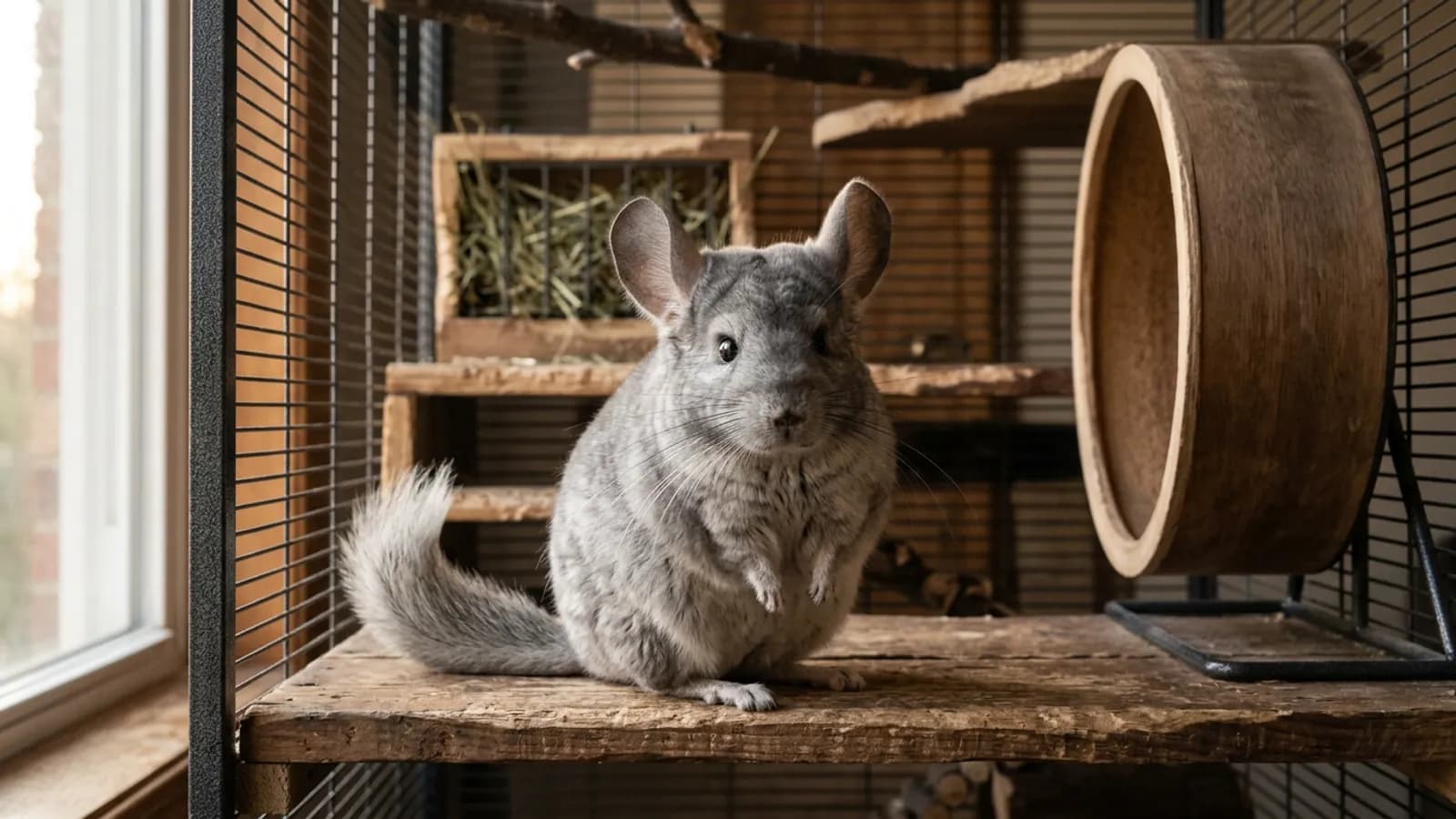
When people ask me for chinchilla interesting facts, they usually want a party trick: the densest fur, the six-foot jumps, the animal that never touches water. I get it. But after about ten years of keeping chinchillas, I have learned that almost every genuinely interesting thing about them is also a care instruction wearing a costume. The fur that makes them famous is the same fur that can cook them in a warm room. The teeth that grow forever are the reason hay is the whole meal, not a snack. So here are the facts I find most interesting, and underneath each one, the thing it quietly tells you about keeping the animal alive and comfortable.
The fur is the densest of any land mammal
A human follicle grows a single hair. A chinchilla follicle grows a bundle, and the commonly cited figure is more than 50 hairs from one follicle, which packs the coat to something like 20,000 hairs per square centimeter. That is denser than a seal, denser than an otter, denser than anything else that lives on land. When you first sink your fingers into that coat it does not feel like fur at all. It feels like warm smoke.
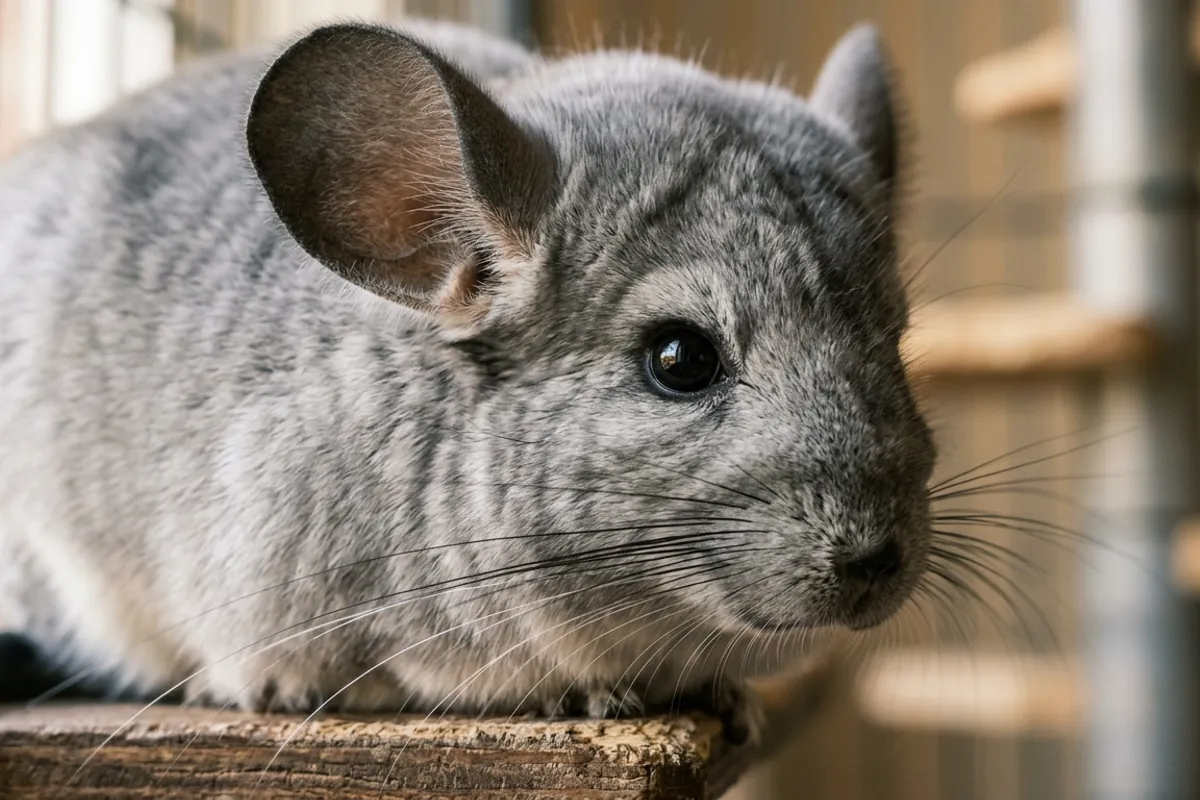
That density is the single most important fact about the animal, because it explains two rules new owners always want to bend. The first is why chinchillas never bathe in water. A coat that dense does not dry. Water soaks all the way to the skin, stays there, and turns into fungal infections and worse. The second is heat. That fur is a survival coat built for a cold mountain night, and it traps body heat as well as it traps everything else. A chinchilla cannot open a window in its coat.
There is a third fact hidden in the fur, and it surprises people. If a predator grabs a chinchilla, or a person grabs one too hard, the animal can release a clean patch of fur and bolt, leaving the attacker holding a tuft. It is called fur slip, and it is a real defense mechanism, not a health problem, though the bald patch it leaves can take months to fill back in. I wrote about fur slip on its own page because people panic when they see it. The short version: handle gently and you will rarely trigger it.
They are high mountain animals, and that sets the thermostat
Chinchillas come from the Andes of South America, from cold, dry, rocky slopes at high elevation. Everything about their body is built for that climate, and nothing about it is built for a warm living room. This is the fact I am most relentless about, because it is the one that nearly cost me a chinchilla.
Pebble came to me from a rehome out of an overheated attic, and her first summer brought a heatwave and a night at the emergency vet. That scare is why the heat guidance on this site reads like a rulebook. A chinchilla barely sweats. It sheds heat mostly through those big ears, and when the air gets too warm the ears are not enough. The comfortable range is 60 to 70°F (15 to 21°C). Above 75°F (24°C) you are in risky territory. At 80°F (27°C) and up you are in an emergency, and humidity makes all of it worse and faster.
Do not guess at the number. Put a thermometer on the cage and read it, because the warmest corner of the room is usually where the cage ends up. digital thermometer and humidity gauge with remote probes As an Amazon Associate I earn from qualifying purchases. A cage-mounted thermometer and hygrometer costs almost nothing and tells you the truth. A chilled stone the animal can lie against helps on a warm afternoon. Kaytee Chinchilla Chiller granite stone As an Amazon Associate I earn from qualifying purchases. That stone is comfort, though, not a cure. Air conditioning is the only real answer to a hot room. If you want to see how fast the danger climbs, the heat calculator does the math, and the warning signs of heat stroke are worth memorizing before summer arrives.
Their teeth never stop growing
Here is a fact that sounds like trivia and is actually the reason your chinchilla's diet is shaped the way it is. All 20 of a chinchilla's teeth, the four incisors at the front and the cheek teeth in the back, are open-rooted. They grow continuously, for the animal's entire life. Estimates vary, but the incisors are often said to grow on the order of 2 to 3 inches a year. The teeth only stay the right length because the animal grinds them down against tough, fibrous food.
That is why hay is not a side dish here, it is the meal. Chinchillas need unlimited grass hay in front of them at all times, and the long sideways chewing of hay is what keeps the cheek teeth worn flat and even. Plain pellets are a small measured supplement, not the main course, and treats are smaller still.
Juniper, my second chinchilla, is why I will not budge on this. She came to me as a neglected rescue with dental disease, and I manage her teeth day to day. When the back teeth do not wear evenly they form sharp points and spurs that cut into the cheek and tongue, and a chinchilla in that state slowly stops eating. So I keep good grass hay in unlimited supply. Oxbow Western Timothy Hay, 40 oz bag As an Amazon Associate I earn from qualifying purchases. And I keep a rotating set of safe wooden chews in the cage so there is always something worth gnawing. emours apple wood chew sticks, 40 count As an Amazon Associate I earn from qualifying purchases. The teeth page covers what healthy looks like and when drooling and dropped food mean it is time for an exotics vet, because malocclusion is not something you fix at home.
They bathe in dust, and only in dust
In the wild, a chinchilla keeps that impossible coat clean by rolling in fine volcanic ash and pumice dust. The dust works its way down to the skin, lifts away oil and moisture, and the animal shakes it out. It is one of the most charming things they do. A chinchilla in a dust bath flips and spins like it has lost its mind, and it is pure maintenance.
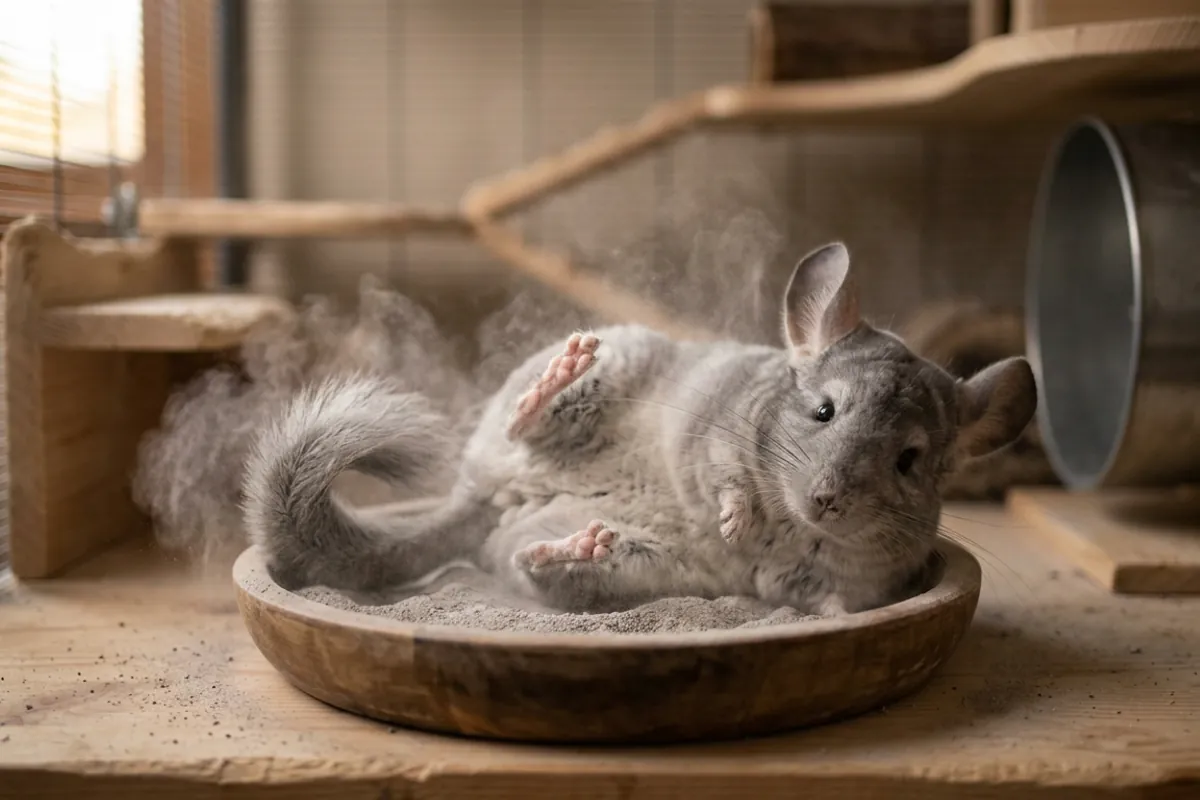
At home you recreate it with a fine bathing dust, not sand and never water. The dust bath done right is a short routine: a dish or enclosed house with an inch or so of dust, a few minutes a few times a week, then take it out again so the cage does not turn into a dust storm and so the animal does not sit in a soiled bath. Lixit Blue Beauty chinchilla dust, 3 lb As an Amazon Associate I earn from qualifying purchases. Leaving the bath in all the time can dry the skin and, worse, becomes a litter box.
This is the other half of the no-water rule. People see a word like bath and reach for a sink. A chinchilla that gets genuinely wet needs to be dried carefully and completely, because that dense coat holds the damp against the skin for a long time. The dust is not a cute substitute for a real bath. For this animal, the dust is the real bath.
For a rodent, they live and breed like something much larger
Most people expect a small rodent to live a couple of years, the way a hamster or a mouse does. A chinchilla does not. With good care they commonly reach 10 to 20 years, and plenty pass 15. That is a genuine commitment, closer to a dog or a cat than to the pocket pets they get shelved next to in stores. It is the fact I most want a first-time buyer to sit with, because a teenager's impulse can turn into a twenty-year responsibility.
Their reproduction is just as unrodentlike. A chinchilla pregnancy runs about 111 days, which is remarkably long for an animal this size. The trade-off is that the kits are born precocial: fully furred, eyes open, able to move around within hours. Litters are small, usually one to three. Compare that to a mouse, born pink, blind, and helpless in a litter of a dozen, and you start to see how differently these two rodents are wired.
The long life is also why heat and teeth matter so much. A husbandry mistake that a short-lived animal might never live long enough to suffer from, a chinchilla has years to develop into a chronic problem. How long they really live comes down almost entirely to the daily details: temperature, diet, and a cage big enough to actually move in.
Your pet is a survivor of a near extinction
This is the fact that changes how I look at my own animals. Chinchillas were hunted nearly to extinction. Their fur was so prized that through the 1800s and early 1900s they were trapped in enormous numbers, and because a single coat takes more than 100 pelts, the wild population collapsed. Both wild species, the long-tailed and the short-tailed chinchilla, are still listed as endangered today, hanging on in small pockets of the Andes.
Almost every pet chinchilla alive descends from a tiny founding group. In the 1920s an American mining engineer named Mathias Chapman was permitted to bring a small number of chinchillas, around a dozen, out of Chile, and much of the domestic population traces back to those founders. That is worth pausing on. The soft grey animal doing backflips in a dust bath in your living room is only a handful of generations removed from an animal that was nearly wiped off the map.
I find it makes the care feel less like a hobby and more like custodianship. It also explains some of the health quirks keepers run into, because a population built from few founders carries less genetic variety than a wild one. What they are like in the wild still dictates a surprising amount of what they need at home: the cold, the dry air, and the vertical rocky terrain they are built to climb.
The small facts that quietly shape daily care
A pile of the shorter facts now, each with the practical tail that makes it worth knowing.
They are extraordinary jumpers. A chinchilla can launch several feet straight up, and by many accounts up to around 6 feet. This is not a fun aside, it is a cage requirement. It is why height matters more than floor space, and why a good cage is tall with wooden ledges to bounce between. It is also why a solid running surface matters if you offer a wheel, since a wire or rung wheel can catch a foot or a tail. 15 inch Chin Spin solid surface chinchilla wheel As an Amazon Associate I earn from qualifying purchases.
They are crepuscular, most awake and busy at dawn and dusk. If your chinchilla seems sleepy and unsocial in the middle of the afternoon, that is not a sick animal, that is a normal one keeping its own hours. Plan handling and play for the early morning and the evening, and you will meet a very different animal.
Those big rounded ears are not just for hearing, though the hearing is sharp. They are radiators, full of blood vessels near the surface, and they are the main way the animal dumps heat. Once you learn to read the ears, flushed and warm ears on a hot day become an early warning worth acting on before anything worse shows up.
A few more in quick succession. Their whiskers are enormous, long enough to help them feel their way through rock crevices in the dark. They produce small, dry droppings, an adaptation to a bone-dry habitat where water is scarce. And like rabbits, they re-ingest certain soft droppings to pull more nutrition out of their fibrous food, which is normal and healthy, not a vice. Reading the rest of their behavior is the same skill applied everywhere: watch the animal closely, and let it tell you what it needs.