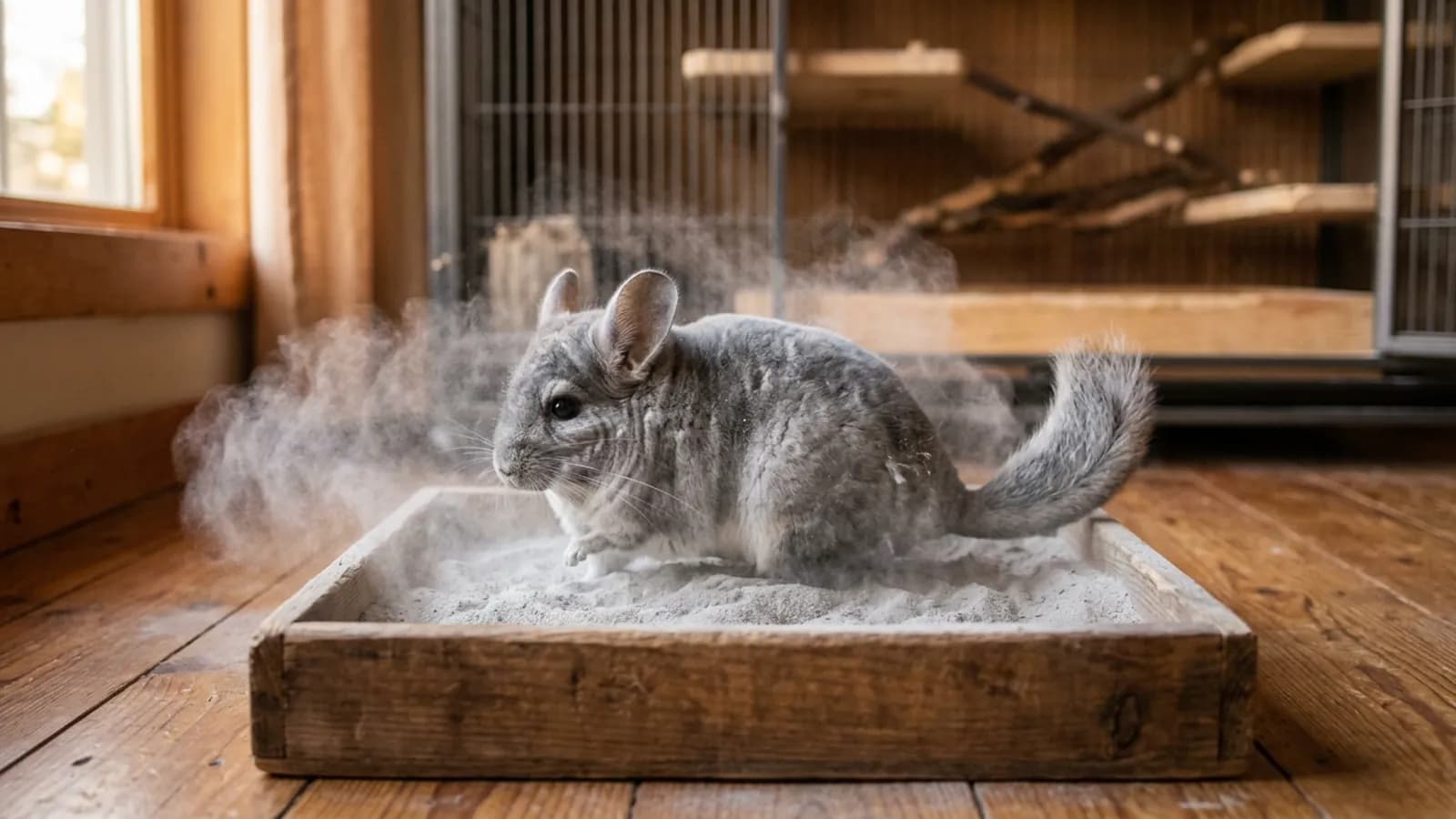
Search for a chinchilla dirt bath and you will find a hundred people doing exactly the right thing under exactly the wrong name. The instinct behind the phrase is correct: chinchillas clean themselves by rolling, not by washing, and they need something dry and powdery to roll in or their coats turn greasy and matted. But the word "dirt" describes the one material you must never put in that bath. Dirt is soil. Soil holds moisture, mold spores, bacteria and grit. What a chinchilla actually needs is fine volcanic dust, closer in feel to talcum powder than to anything you could dig out of a garden. I have kept chinchillas for about ten years, and the gap between those two things is the single most common mistake I see from new owners who otherwise did their homework.
Why the word "dirt" leads people wrong
Wild chinchillas live in the arid, high-altitude parts of the Andes, where the ground is volcanic ash and pumice, wind scoured and bone dry. They roll in it, and the fine particles work down through the coat and lift out excess oil and moisture. That is the behaviour people are describing when they say dirt bath, and it is a real, hardwired need, not a luxury.
The problem is that "dirt" points shoppers at the wrong shelf. I have talked to owners who used play sand from a hardware store, aquarium gravel, potting soil, and once, memorably, sieved garden earth that had been baked in an oven to sterilise it. Sand is the most dangerous of these because it looks plausible. Sand grains are large and sharp-edged compared with proper bathing dust, and instead of sliding between hairs they abrade them. A chinchilla bathed in sand ends up with a coat that looks frayed and dull, and skin that gets scratched raw at the pressure points.
Soil is worse in a different way. It carries organic matter and fungal spores, and it holds humidity even when it feels dry to your hand. A chinchilla's coat is astonishingly dense, with something in the region of 50 to 80 hairs growing from each follicle depending on which source you read, and once moisture or debris gets down into that it does not come out on its own. That is the mechanism behind most fungal skin infections in pet chinchillas. So keep the instinct and drop the noun. If you want the longer version of the material science, I wrote it up in what bathing dust for chinchillas really is, and how to use it.
What actually belongs in the bath
Proper chinchilla bathing dust is a fine, pale grey powder, usually milled volcanic pumice, sometimes blended with or replaced by sepiolite, a magnesium silicate clay. Both work by the same principle: particles small and smooth enough to travel deep into the coat, absorb oil, and fall back out when the animal shakes.
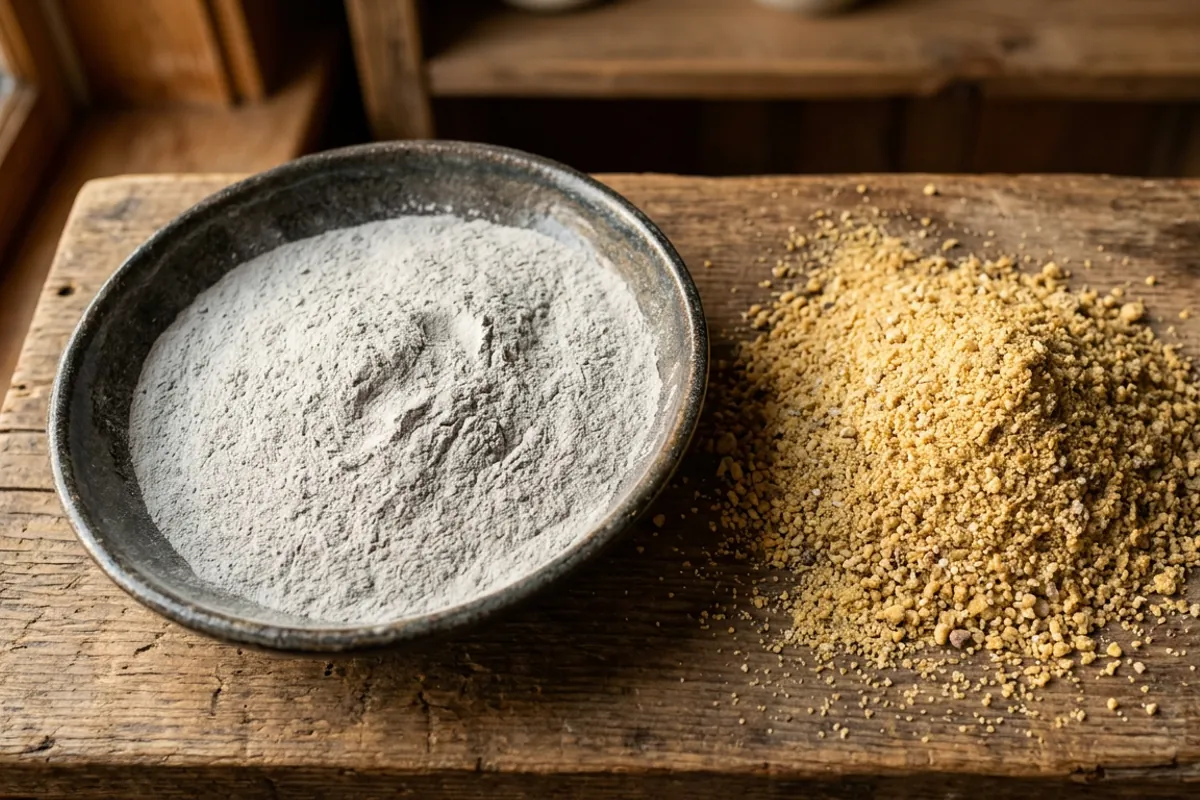
The test I use is my fingers. Rub a pinch between thumb and forefinger. It should feel like flour or fine chalk, with no perceptible grain at all. If you can feel individual particles rolling, that is sand, whatever the bag says on the front. Labelling is genuinely inconsistent here, and I have seen products sold as "chinchilla sand" that were fine dust, and products sold as "bath dust" that were unmistakably gritty. Trust your fingers over the marketing.
A few things to rule out flatly. Scented dust is a no. Chinchillas have sensitive airways and there is no version of added fragrance that helps them. Coloured or glitter-added dust, which exists, is a novelty product and not a care product. Cornstarch, baby powder and baking soda are sometimes suggested online as emergency substitutes, and I would not use them: they cake in a dense coat rather than shaking free, and talc-based powders raise respiratory concerns that pumice does not. Antifungal powder mixed into dust is a real veterinary treatment, but it is a treatment, prescribed for a diagnosed infection, not something to add preventively because you read about it.
The container, and how deep to fill it
The bath house matters more than people expect. Chinchillas roll hard and fast, and a light or shallow container simply gets flipped, which turns a bath into a dust cloud on your floor. What works is something heavy or enclosed, with sides high enough that the dust stays put, and an opening wide enough that an adult chinchilla can turn a full circle inside.
Enclosed plastic bath houses are the standard commercial option and they do contain the mess well. I use one, with an eye on it, because plastic in a chinchilla's world is generally something I avoid and a bath house is the one exception I make: it goes in for ten minutes and comes straight back out, so there is no meaningful chewing window. If your chinchilla treats it as a chew toy rather than a bathroom, switch to a heavy ceramic or glass vessel instead and accept the extra sweeping.
Lixit Blue Beauty chinchilla dust, 3 lb As an Amazon Associate I earn from qualifying purchases.
Fill depth should be roughly 2 to 3 inches, about 5 to 8 cm. That is enough for the animal to get down into and flip through. Less than that and the dust just skids around the bottom. Much more is not harmful, it is just wasteful, since you will be discarding it before it gets used.
The traditional alternative, a large glass cookie jar or fishbowl laid on its side, works beautifully and is easy to clean, but it is heavy, breakable, and it rolls. If you use one, wedge it against something solid. I have had a jar roll across a floor with a chinchilla in it, and while nobody was hurt, nobody enjoyed it either.
How often, and for how long
The honest answer is that frequency depends on your climate, and anyone giving you a single universal number is guessing. In a normal indoor environment, two to three baths a week, at 10 to 15 minutes each, suits most chinchillas. In a humid summer or a damp house, some keepers go to four or even daily short sessions because the coat picks up moisture faster. In a very dry winter home with the heating running, twice a week can be plenty and more than that starts to dry the skin out.
What you should not do is leave the bath in the cage permanently. This is the most common well-intentioned error after the sand problem. Given constant access, most chinchillas will over-bathe, and a few will start using the dust as a litter box, which means they are then rolling in their own waste. Over-bathing shows up as flaky skin, especially around the ears and nose, dull-looking fur, and increased scratching. Under-bathing shows up in the opposite direction: fur that clumps or parts in greasy-looking sections, most visibly along the back and at the base of the tail, and a coat that feels slightly tacky instead of squeaking clean.
Read the animal, not the calendar. My two need different schedules in the same room. Pebble is fastidious and would bathe every day if I let her. Juniper, who came to me as a neglected rescue and is a good deal more phlegmatic, is genuinely fine on two.
Between baths, sift the droppings out with a small kitchen sieve. Replace the dust entirely when it stops looking uniform: when it clumps, darkens, or takes on a slightly greasy sheen. How many sessions that takes depends on how much your chinchilla uses it, so I will not pretend there is a fixed number. Mine tends to last around a week to ten days of normal use before it needs replacing.
Where and when to put the bath out
Time it for the evening. Chinchillas are crepuscular, most awake and most inclined to roll around dusk and dawn, and a bath offered at two in the afternoon usually gets ignored by a sleepy animal. Mine come alive around the time I am thinking about dinner, and that is when the dust goes in.
Think about where the dust lands. Even a well-designed enclosed house throws a visible cloud when a chinchilla shakes off, and that fine powder settles on everything within a couple of feet. Ventilate the room, and if anyone in the house has asthma, keep bath sessions out of their space entirely. This applies to your chinchilla too. A bath in a small unventilated cupboard of a room means they breathe the airborne fraction over and over, and chronic respiratory irritation is a real risk. Some chinchillas develop weepy or red eyes from dust exposure; if you see that, cut frequency, improve airflow, and if it persists past a few days, get an exotics vet to look, because conjunctivitis has other causes too.
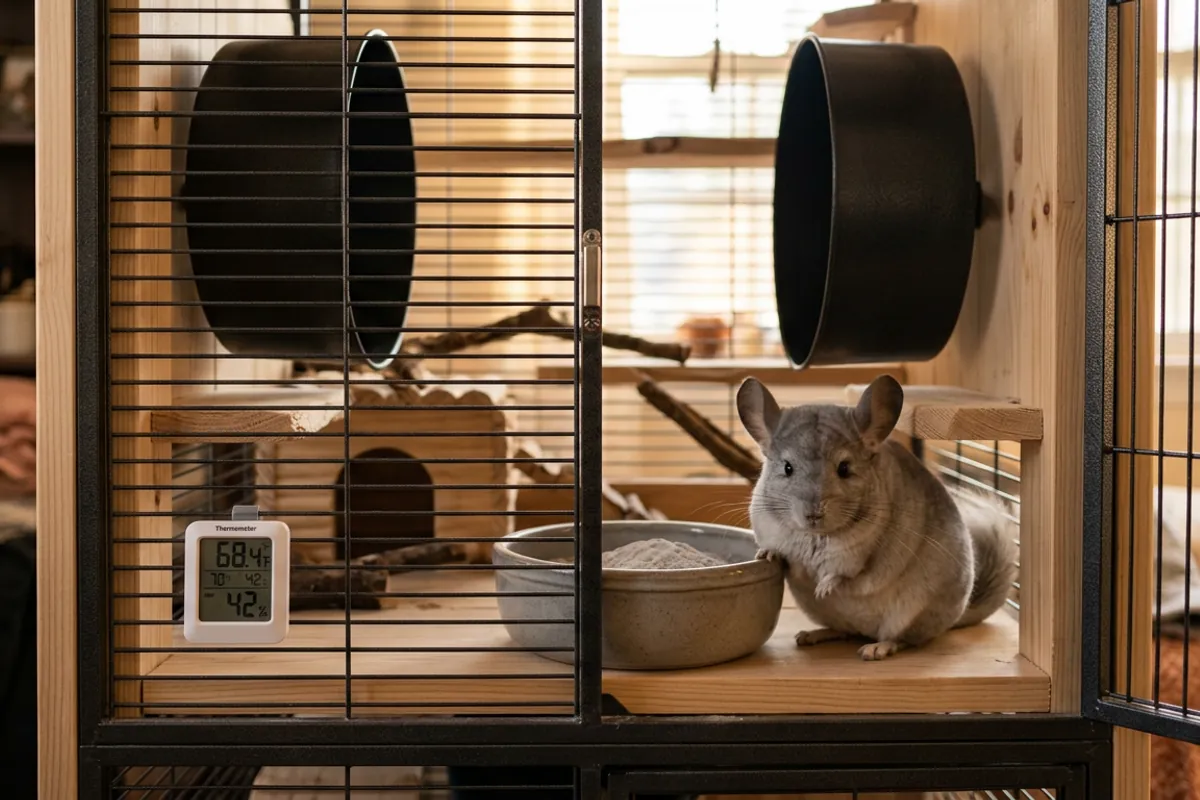
You can offer the bath inside the cage or in a safe enclosed play area. Inside the cage is simpler, and it means the routine survives if you are tired. Either way it comes out again when the session ends. If you are still working out the cage itself, how to choose a chinchilla cage without buying the wrong one twice covers what a bath house has to fit into.
Heat, humidity, and why bathing is not a cooling strategy
Here is the part I am inflexible about, and I am inflexible for a reason. Chinchillas are built for cold, dry mountain air. Their comfortable range is 60 to 70°F, which is 15 to 21°C. Above 75°F, about 24°C, you are into risky territory. At 80°F, roughly 27°C, and above, you are in an emergency, and humid air makes all of that arrive faster because that dense coat cannot shed heat through evaporation the way thinner-furred animals do.
Pebble came to me from a rehome out of an overheated attic, and her first summer with me included a heatwave near-miss and a night at the emergency vet. Everything I say about temperature comes from that night. So: a dust bath does nothing to cool a chinchilla down. Dust is not water and does not evaporate. If your chinchilla is lying flat, breathing fast, with red or hot ears, do not offer a bath. Cool the room, offer a chilled stone to lie against, and get to an exotics vet. The signs are worth memorising in advance, and I laid them out in chinchilla heat stroke: warning signs every owner should know.
Know the actual numbers in the actual room, not the number on your hallway thermostat. A cheap digital thermometer and hygrometer clipped to the cage tells you both temperature and humidity where the animal lives.
digital thermometer and humidity gauge with remote probes As an Amazon Associate I earn from qualifying purchases.
A granite or marble cooling slab gives them somewhere to dump heat by conduction and is a genuinely useful year-round fixture, not just a summer one.
Kaytee Chinchilla Chiller granite stone As an Amazon Associate I earn from qualifying purchases.
Humidity matters for bathing in its own right. In damp air the coat holds moisture, dust works less effectively, and the risk of fungal problems rises. If you can keep the room drier, do. If you want to see how temperature and humidity combine into actual risk, the chinchilla heat danger calculator does that arithmetic, and chinchilla heat safety is the wider guide.
What to do if a chinchilla gets wet
Never bathe a chinchilla in water. Not a rinse, not a quick dip, not a shampoo for a show coat. That coat takes a very long time to dry through to the skin, and while it is damp you have a warm wet environment against skin that never gets one in nature. That is how fungal infections start, and a soaked chinchilla can also chill dangerously.
If it happens by accident, and it does happen, act fast. Wrap them in a dry towel and blot, do not rub, because rubbing mats the fur and can trigger fur slip. Move to fresh dry towels as they get damp. A hair dryer on a cool, low setting held well back can help, but only if the animal tolerates it without panic, and never on heat. Keep them somewhere warm and draught free until the coat is dry right down to the skin, which you check by parting the fur with your fingers, not by feeling the surface. Give it a full day before offering dust again, and watch over the following two weeks for circular bald patches, flaky skin around the nose, eyes or feet, or scabbing. Those point at ringworm, and that is a vet visit, not a home project.
For a spot of something sticky, a barely damp cloth on that spot only, followed by careful drying, is as far as I would ever go without professional advice.
When the problem is not the bath at all
Sometimes an owner tells me their chinchilla's chest fur is always damp and matted, and no amount of dust fixes it. That is usually not a bathing problem. Persistent wet fur under the chin and down the front is drool, and drool in a chinchilla points at the teeth. Their molars grow continuously, and when the wear goes wrong the resulting spurs and points make chewing painful, which shows up as drooling, dropped food, weight loss and a sudden preference for softer pellets over hay.
Juniper is my daily reminder of this. She came in with dental disease already established, and managing it is a permanent part of her care. It is also why I am uncompromising about the two things that keep teeth worn down. Unlimited grass hay, available every hour of every day, with plain pellets as a small measured supplement rather than the main event.
Oxbow Western Timothy Hay, 40 oz bag As an Amazon Associate I earn from qualifying purchases.
And a real variety of safe wood to chew, rotated so it stays interesting, because a chew that gets ignored does no work.
emours apple wood chew sticks, 40 count As an Amazon Associate I earn from qualifying purchases.
If you see drooling, matted chest fur that returns, or a chinchilla that has gone quiet about eating, book an exotics vet with dental experience. I can tell you what to watch for, and chinchilla teeth problems: spotting malocclusion before it turns serious goes through the signs in detail, but I am a keeper and not a vet, and molars need someone who can actually see them.
The rest of it is genuinely simple. Right dust, right container, right frequency, out again when they are done. Get those four things correct and the coat looks after itself, which is exactly the arrangement the species evolved for. If you want the full routine in one place, the chinchilla dust bath, done right from dust to schedule is the companion piece, and chinchilla care covers where bathing fits alongside everything else.