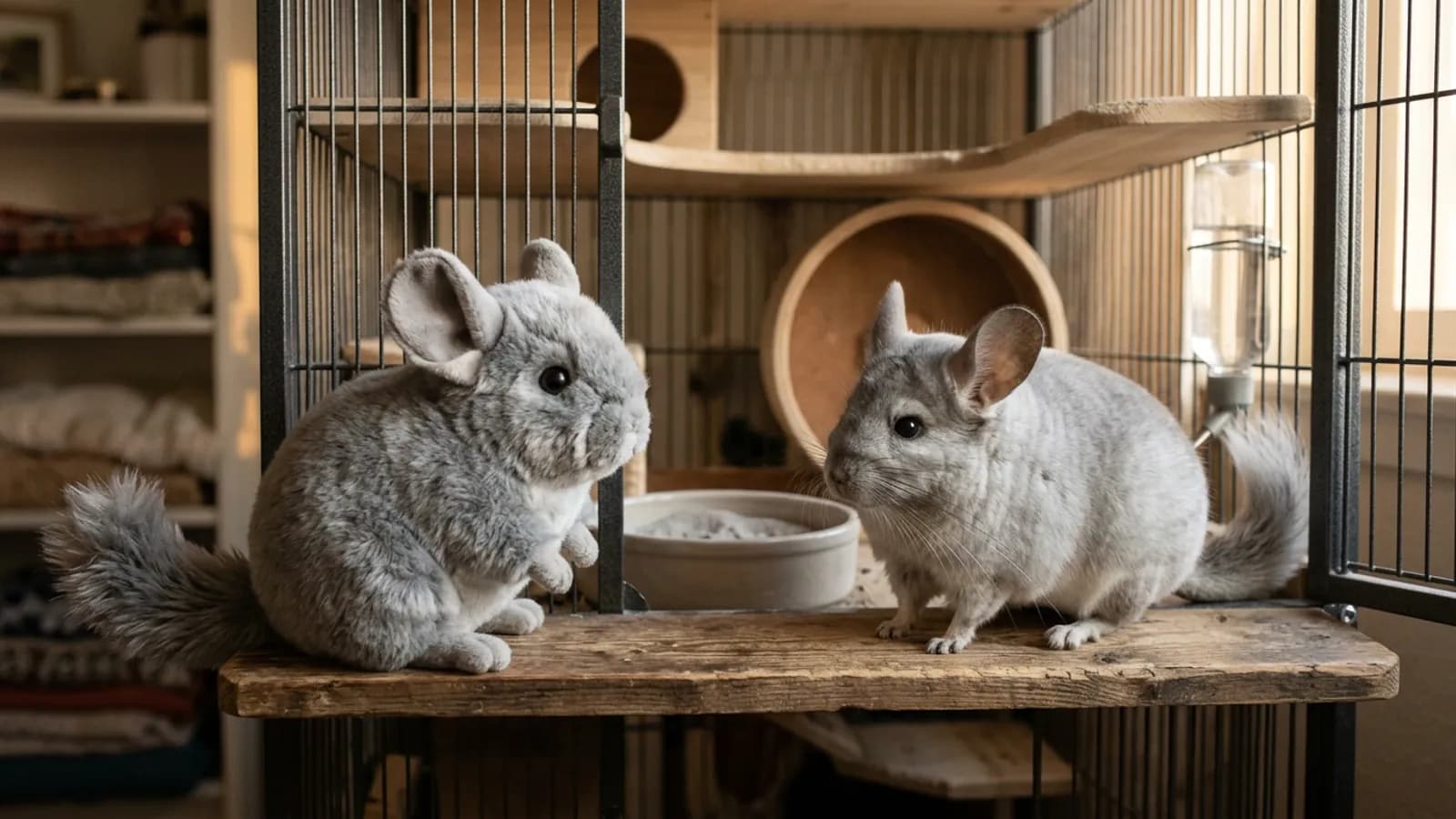
A chinchilla stuffed animal is a toy, and I am going to be honest about that from the first line, because the people who type "chinchilla stuffed animal" into a search box are really two different people wearing the same words. One of you wants a soft grey plush to give a child, or to put on a shelf, or to hold because the real chinchilla you loved is gone. The other one of you is circling. You are half looking at a toy and half wondering whether the living animal behind it belongs in your home. I have kept chinchillas for about ten years, and I can help both of you, but only if we keep the toy and the animal in separate boxes, because the plush is harmless and the real one is a fifteen-year commitment with a body that breaks in ways most people never see coming.
So this is not a review of which brand of stuffed chinchilla is cutest. It is a plainer piece: what a chinchilla stuffed animal is good for, what it quietly gets wrong about the real animal, why you must never hand one to an actual chinchilla, and how to tell whether the pull you feel is toward a toy on a shelf or toward the far harder thing.
Why people search for a chinchilla stuffed animal
There are a handful of honest reasons a stuffed chinchilla ends up in a shopping cart, and none of them are silly.
The first is a gift for a child. A kid saw a chinchilla somewhere, maybe on a screen, maybe at a pet store, and now every drawing has a fat grey animal with enormous ears in it. A plush is the safe answer. It does not chew wires, it does not overheat, it does not need a vet fund, and it survives being loved hard by small hands. I have no argument with that at all.
The second is comfort. People who have lost a chinchilla sometimes want something the right shape to hold. I understand this more than I can put neatly into a paragraph. A realistic chinchilla stuffed animal, the kind with the correct proportions, can be a genuinely kind object to keep on a nightstand.
The third is the circling I mentioned. You are considering the real animal, and the toy is a low-stakes way to bring the idea into the house before you commit. That is smart, honestly, and later in this piece I will tell you exactly what the toy leaves out so the circling is done with open eyes.
And the fourth, quietly, is decoration and collecting. Chinchillas photograph adorably, and a soft grey lump on a shelf is an easy yes. The same instinct feeds the whole toy-chinchilla world, the Littlest Pet Shop figures and the chinchilla lps pieces that a lot of owners first met the species through. A plush is just the plush-sized version of the same appeal.
What a realistic chinchilla stuffed animal gets right, and where it lies
Here is where my ten years get opinionated. A stuffed chinchilla is designed to be bought, not to be accurate, and the two goals pull in opposite directions.
What the good ones get right is the silhouette. Dense round body, oversized rounded ears, a bushy tail, that permanently startled face. The best realistic chinchilla stuffed animals also nail the colour, a soft blue-grey with a paler belly, which is close to what a standard grey chinchilla actually looks like. If a plush has that shape and that colour, it is doing its job.
What almost every one of them lies about is size and density. A real chinchilla is smaller and lighter than the plush suggests, and its fur is unlike anything a toy can reproduce. Chinchilla fur grows more than fifty hairs from a single follicle, which is why it feels like touching a cloud and why the animal cannot get wet and dry normally. No plush conveys that. People pick up a real chinchilla for the first time expecting the heft of the toy and are startled by how little is there under all that fur.
The bigger lie is temperament, and it is not the toy's fault, it just cannot help it. A stuffed chinchilla sits still in your arms. A real one, for most of its life, does not want to. Chinchillas are prey animals built to explode off a ledge, and a lot of them tolerate being held for about as long as it takes to plan an escape. The plush teaches "cuddly lap pet." The animal did not read that script. If you want the honest version of what living with them is actually like, I wrote it out in chinchilla as pets, the honest version, and the gap between that and the toy is the whole point of this section.
No, do not give a plush toy to your real chinchilla
This one is not a preference, it is a safety rule, and I will be blunt because bluntness here keeps an animal alive.
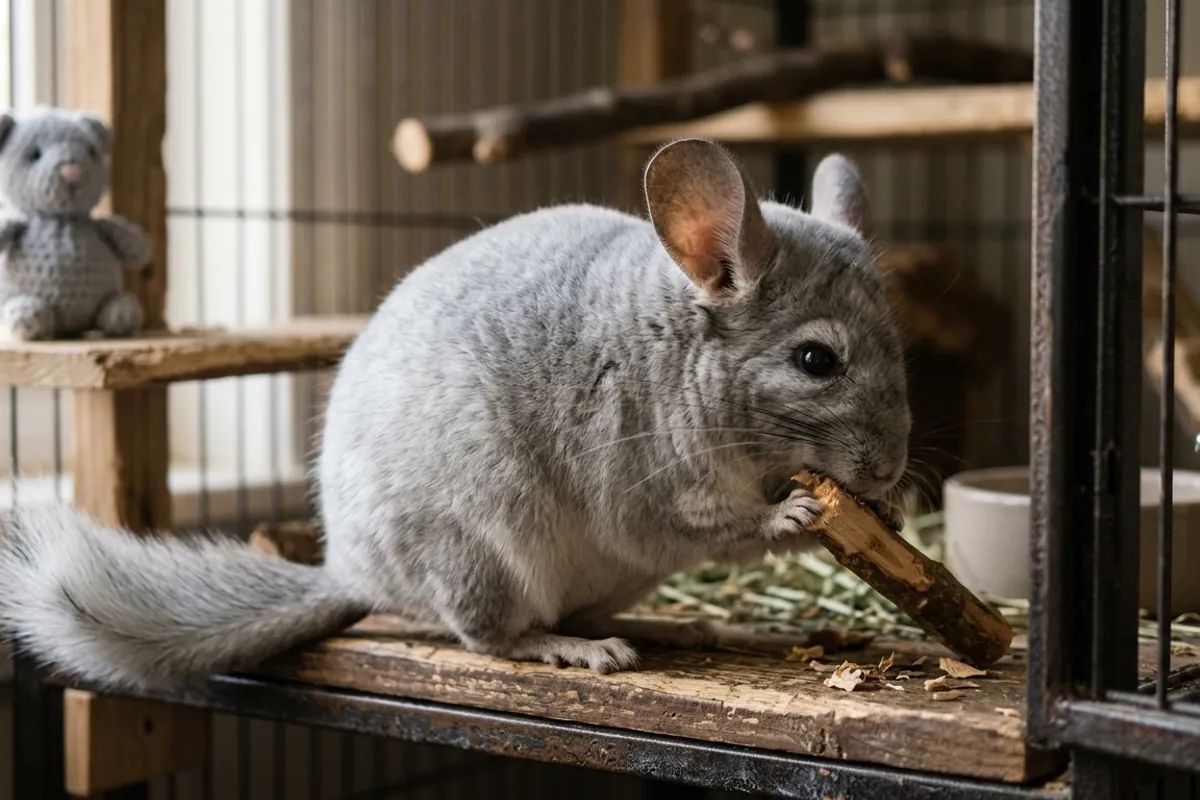
If you already own a chinchilla, do not put a stuffed animal in the cage. Not as a companion, not as a comfort object, not "just to see." A chinchilla's whole relationship with the world is its teeth. Those teeth grow continuously for the animal's entire life, and the chinchilla wears them down by chewing everything it can reach, constantly, whether it needs to or not. A soft toy is not a friend to a chinchilla. It is a thing to be dismantled.
The moment a plush goes in, it starts getting chewed. Fabric threads, polyester stuffing, plastic eyes and noses, the little bead that makes it rattle, all of it. A chinchilla's digestive system is a delicate, hay-driven machine that is not built to pass synthetic fibre or plastic. An intestinal blockage in an animal this small is a genuine emergency, and it is the kind of thing that ends with an exotics vet or ends badly. This is exactly the reasoning behind why chew toys are dental care, not decoration: the only safe things in a chinchilla's mouth are safe by design.
If your chinchilla needs things to chew, and it does, the answer is the boring safe stuff, not a toy pretending to be a friend. Untreated apple, willow, and other safe woods give the teeth what they are looking for without the risk. A variety pack of safe chew woods does more real good in that cage than any plush ever could.
emours apple wood chew sticks, 40 count As an Amazon Associate I earn from qualifying purchases.
The one gentle exception people ask about is bonding: a chinchilla will sometimes accept another chinchilla as a companion, which is a real and good thing to arrange properly, but a stuffed animal is not a substitute for that and should never be treated as one. If loneliness is the worry, the fix is a correctly introduced second chinchilla, not a toy.
What a stuffed chinchilla is actually good for
Cleared of the cage, a plush earns its keep in a few honest ways.
It is a wonderful stand-in for a child who wants a pet the family is not ready to take on. Chinchillas are, frankly, a poor match for young kids, they are crepuscular, they dislike being squeezed, and they need cool rooms and careful handling. A stuffed chinchilla lets a kid love the idea safely while the adults decide, slowly, whether the real animal fits the household. I would rather a family spend a year with the plush and get the real decision right than rush a live animal into a home that was not built for it.
It is a fair memorial object. I said this above and I will not dress it up. If you lost a chinchilla and a soft grey shape on the shelf helps, that is a good reason to own one.
And it is a low-cost reality check for the circling buyer, which is the whole next section.
There is also the plain answer that it is a nice soft thing to own, and not everything needs a justification. A stuffed chinchilla asks nothing of you. That is exactly what makes it a toy and not a pet.
If the toy is making you want the real animal
This is the section for the circling buyer, and I am going to be useful rather than encouraging, because encouragement is cheap and a mismatched adoption is expensive for the animal.
Start with the number that surprises everyone: the real cost is not the animal, it is everything around it. I laid the whole thing out in what a chinchilla really costs, but the short version is that the purchase price is the smallest line on the page. The setup and the ongoing care dwarf it.
The single non-negotiable that no plush prepares you for is temperature. This is where my Pebble comes in. Pebble was a rehome out of an overheated attic, and her first summer with me brought a heatwave that nearly killed her and ended in a night at the emergency vet. That scare is why I am relentless about this. Chinchillas are comfortable between 60 and 70°F (15 to 21°C). Above 75°F (24°C) is genuinely risky, and 80°F (27°C) and up is an emergency, faster still in humid air, because that incredible fur that makes them cloud-soft also makes them unable to shed heat. If you cannot keep a room reliably cool, you cannot keep a chinchilla, full stop. Learn the warning signs in chinchilla heat stroke before, not after. A cooling stone and a proper thermometer are day-one gear, not upgrades.
Kaytee Chinchilla Chiller granite stone As an Amazon Associate I earn from qualifying purchases.
digital thermometer and humidity gauge with remote probes As an Amazon Associate I earn from qualifying purchases.
Then there is the diet, which is not a bag of pellets. A chinchilla eats unlimited grass hay first, all day, every day, with a small measured portion of plain pellets as a supplement and nothing sugary. This is not fussiness. My Juniper is a neglected rescue whose dental disease I manage day to day, and I have watched up close what happens when teeth are not worn down by constant hay. Good timothy hay is the foundation of the whole animal.
Oxbow Western Timothy Hay, 40 oz bag As an Amazon Associate I earn from qualifying purchases.
There is the cage, which must be tall, made of metal and wood with wooden ledges, and never the plastic-floored small thing sold beside the register. There is the wheel, which must have a solid running surface, never wire, because wire wheels catch feet and break legs.
15 inch Chin Spin solid surface chinchilla wheel As an Amazon Associate I earn from qualifying purchases.
And there is the bath, which is dust, never water. A chinchilla bathes by rolling in fine volcanic dust that pulls oil out of that dense coat, and a wet chinchilla is a real problem, not a cute one. If any of this is news to you, read chinchilla how to take care end to end and then decide. If it reads as too much, that is not a failure. That is the plush being the right answer for your life, which is a perfectly good outcome.
Lixit Blue Beauty chinchilla dust, 3 lb As an Amazon Associate I earn from qualifying purchases.
Buying a stuffed chinchilla as a gift
If you have landed firmly on the toy, here is how I would choose one, keeping the same honesty I would want in gear advice.
Go for correct proportions if you want it to actually read as a chinchilla and not a generic grey blob. The tells are the ears, big and rounded and set high, and the tail, which should be bushy, not a thin mouse tail or a fluffy squirrel plume. A realistic chinchilla stuffed animal gets those two details right. Colour matters less than shape, since real chinchillas come in many colours anyway, from standard grey to the paler and darker varieties, so a grey plush is accurate but so is a beige or a near-black one.
Check the safety features if the toy is for a young child, the same way you would any plush: firmly attached eyes, no small parts that pop off, machine washable if it is going to be dragged everywhere. This matters for the kid, not the chinchilla, because the toy is never going near a real one.
Be a little wary of "lifelike" fur that sheds. Some realistic stuffed chinchillas use long synthetic pile to mimic the density of real fur, and the cheap ones shed that fibre. For a shelf piece it is fine. For a toddler who mouths everything, pick a tighter, shorter plush.
And set the expectation that goes with the gift, especially for a child. A stuffed chinchilla is a chinchilla you can hug as hard as you like. A real one is not, and saying so early saves a disappointed kid and, down the line, saves a real animal from being squeezed by someone who learned to love the plush version of holding.
The real animal behind the plush
I will end where I started, because it is the honest place to end. A chinchilla stuffed animal is a good toy and a poor teacher. It gets the silhouette right and the whole animal wrong, because it leaves out the two things that define keeping the real one: the fragility and the heat.
If you came for a soft grey thing to give, to hold, or to keep, buy it without a second thought and enjoy it. If you came circling, use the plush the way it is best used, as the cheapest possible first step, and read the honest pages before the animal, not after. And if you already have a chinchilla, keep the plush on the shelf and out of the cage, give the real one safe wood to chew and a cool room to live in, and let the toy be a toy.
The plush will sit still in your arms for the rest of its life. That is the one thing the real chinchilla will almost never do, and once you understand why, you understand the whole difference between the two of them.