The messages I get about chinchilla allergies arrive in two shapes that have almost nothing to do with each other. In one, a person is streaming, wheezing, or covered in hives an hour after their chinchilla's dust bath, and they want to know whether they can keep the animal at all. In the other, an owner has watched their chinchilla sneeze four times in a row and wants to know whether she has picked up hay fever. Those are different problems with different fixes, and answering one with the other wastes time nobody has.
I have kept chinchillas for about ten years. I am an experienced keeper, not a doctor and not a vet, so every medical call in this article goes where it belongs. What I can give you is an honest inventory of what ends up in the air in a chinchilla room, which parts of it you can change, which parts you cannot change without hurting the animal, and where my knowledge runs out.
The two questions hiding inside one phrase
The first question is whether a human is reacting to something a chinchilla brings into the house. There are four real candidates, and the fur is the least of them: the bathing dust, the hay, the bedding, and the proteins in urine, saliva, and skin flakes. The second question is whether the chinchilla is reacting to something in your house. That one has a shorter answer than most people expect, and I get to it further down.
It also helps to separate a true allergy from plain irritation. An allergy is an immune reaction to a specific protein. It can build over months or years of exposure, and it tends to be reproducible. Irritation is mechanical: fine particles land in your airway and your body tries to get rid of them. Both make you cough, so the labels get used loosely. The difference matters because irritation usually responds well to ventilation and particle control, while a genuine allergy needs a doctor and a plan. If you have never had an allergy symptom in your life and you cough only during a dust bath, irritation is the likelier story. If your eyes swell and stay swollen for hours after handling, take that more seriously.
No, chinchillas are not hypoallergenic
You will see chinchillas sold as hypoallergenic, usually in the same listing that calls a 24 inch cage roomy. No furred mammal is hypoallergenic. The word has no regulatory meaning and no test behind it.
Chinchillas do have a couple of genuine points in their favor, which is probably where the claim started. They have no oily coat and essentially no functional sweat glands, which is also exactly why heat kills them so easily, so they do not carry the greasy skin secretions that drive a lot of dog allergy. A clean cage has almost no smell. And they are never bathed in water, so there is none of the wet animal protein that gets spread around a bathroom. That is a real difference, and it is not nothing. Their fur is remarkable stuff, but it still sheds.
What they do have is shedding fur, flaking skin, saliva groomed into that fur, and urine in the tray. Rodent urinary proteins are one of the best documented occupational allergies anywhere: people who work with laboratory mice and rats develop reactions to them at high rates. Whether chinchilla urine carries an equivalent protein is not something I have seen studied properly, and I am not going to invent an answer. What I can tell you is that plenty of owners react in chinchilla rooms, and the dust bath is almost always the loudest trigger in the room.
The practical version: if you are allergy prone, spend real time near a chinchilla and near an actual dust bath before you buy one. An hour in a breeder's or a rescue's chinchilla room tells you more than any marketing claim ever will.
Being allergic to chinchilla dust
If you are allergic to chinchilla dust, or simply reacting badly to it, this is the part of the problem you have the most control over. It is also the part you must not solve by taking the bath away.
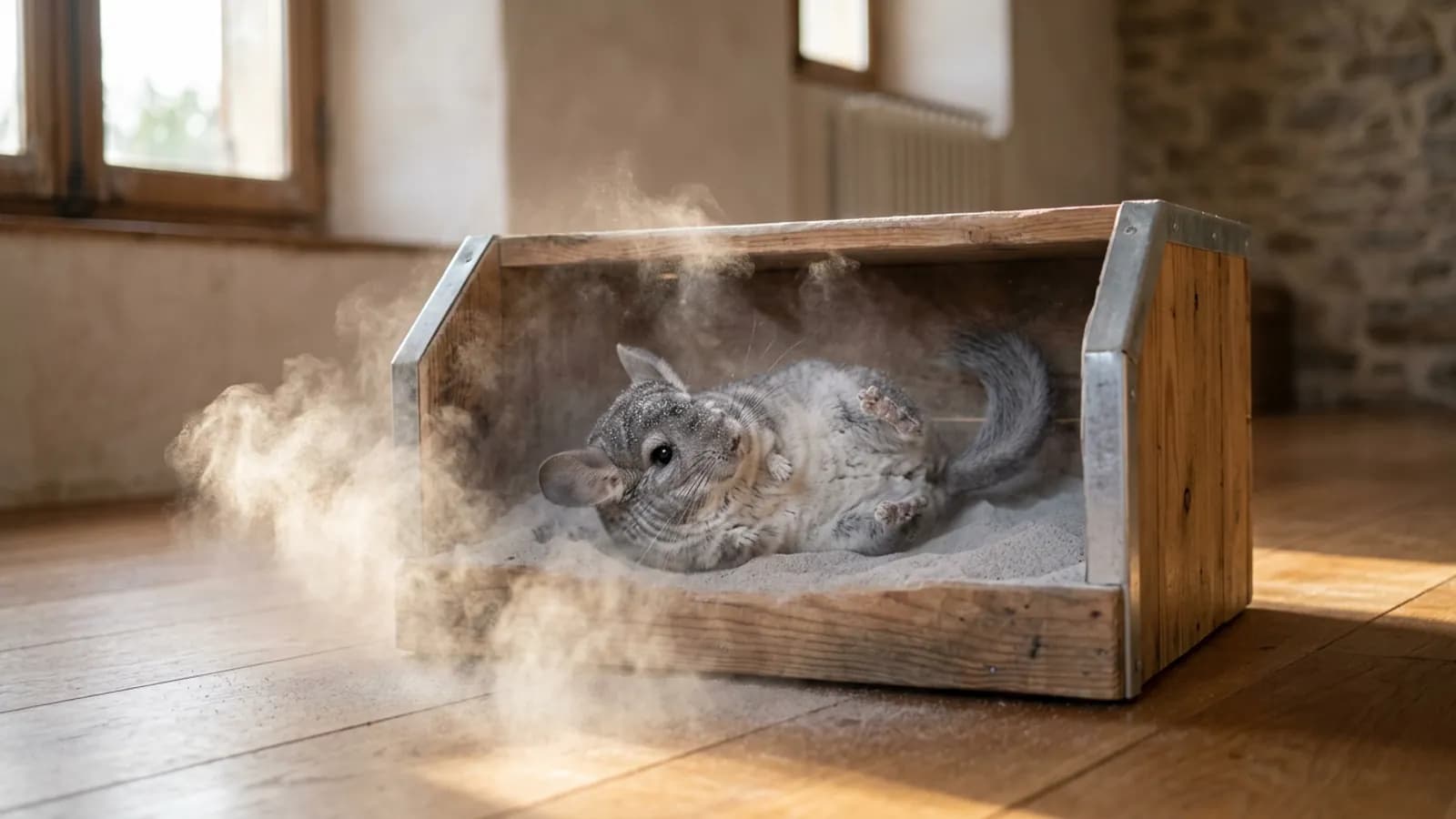
Chinchilla bathing dust is not sand. It is a very fine powder, usually volcanic pumice or a similar ash based mineral, and its entire job is to be light enough to work down through a coat where dozens of hairs grow out of a single follicle and pull the oil and moisture out. Fine enough to do that means fine enough to hang in the air long after the bath is over and to settle on every surface in the room. Watch the cloud come out of a bath house when a chinchilla flips over in there and you will understand why your sinuses know before you do.
So change the how and the where.
- Bathe in an enclosed house with one opening, not an open bowl. It does not stop the cloud, but it cuts it down a lot. Lixit Blue Beauty chinchilla dust, 3 lb As an Amazon Associate I earn from qualifying purchases.
- Bathe in a room you can ventilate, and never in a bedroom.
- Put the bath in, let her roll for 10 to 15 minutes, take it out. A bath house left in the cage all day means constant airborne dust for you and dust in the eyes for her.
- Leave the room during the bath if you react hard, and let the air settle before going back in.
- Wear a fitted respirator, the N95 or FFP2 style, when you sift the dust or refill it. A loose surgical mask does very little against particles this fine.
- Damp wipe surfaces instead of sweeping or dry dusting, which just puts everything back in the air.
- Run a HEPA air purifier in that room continuously, not only at bath time.
Two or three baths a week, 10 to 15 minutes each, is the usual schedule, and humid climates often need more rather than fewer. What you cannot do is drop to one bath a month because you are sneezing. Do not switch to sand either: the grains are too coarse to clean the coat properly and they scratch.
The hay nobody warns you about
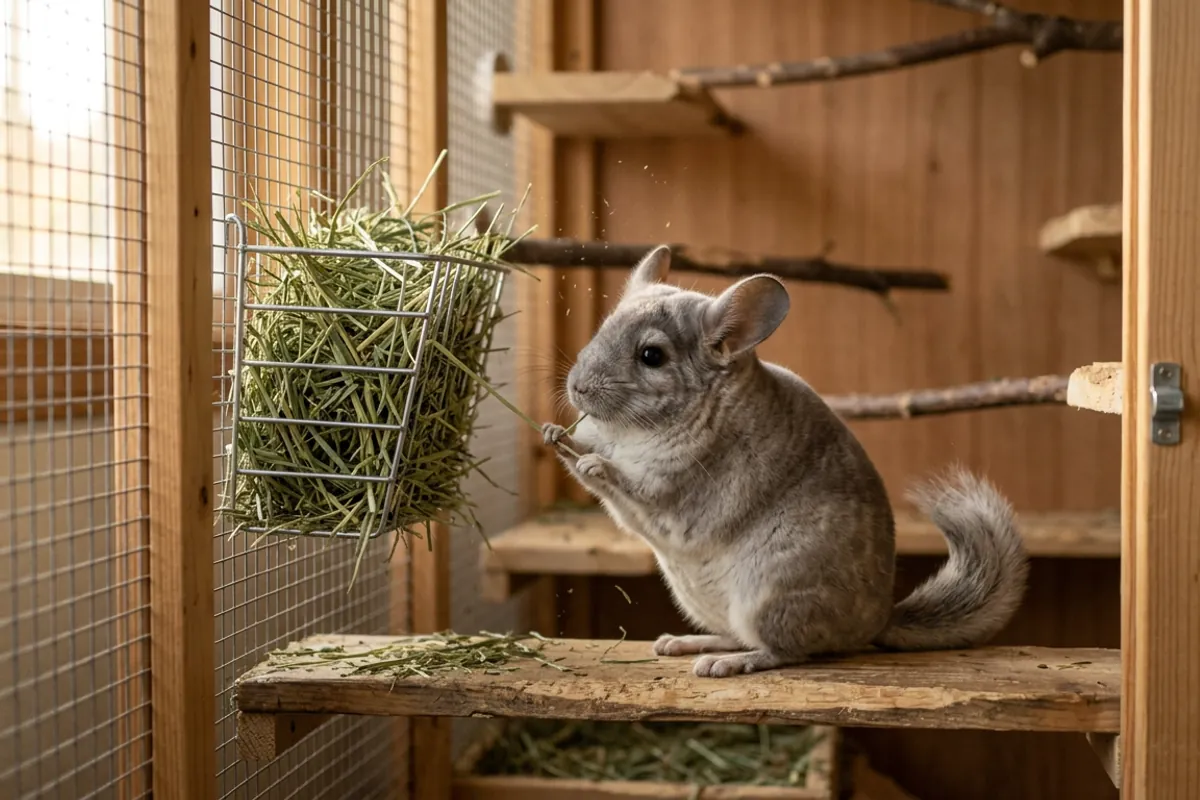
Here is the trigger blamed on the chinchilla more often than any other. Timothy hay is dried grass, and grass pollen is one of the most common human allergens there is. Hay also carries fine plant debris and, if it was ever stored damp, mold spores. If your symptoms spike when you refill the feeder rather than when you hold the animal, the hay is your answer.
You can change how you handle hay without changing what goes in the cage:
- Buy hay that looks green and smells sweet. Brown, musty, or powdery hay is worse for both of you.
- Refill by an open window or outside, wearing that same fitted mask.
- Do not shake or fluff the bag anywhere near your face.
- Store it sealed, dry, and out of the room you live in.
Smaller boxed hay bought more often stays fresher and throws off less fine debris than the bottom third of a huge bale that has been sitting open for two months. Oxbow Western Timothy Hay, 40 oz bag As an Amazon Associate I earn from qualifying purchases.
If you keep more than one chinchilla and go through hay quickly, buying in bulk is cheaper, and it simply means being stricter about sealed storage away from your living space. Oxbow Western Timothy Hay, 9 lb box As an Amazon Associate I earn from qualifying purchases.
What you cannot do is cut the hay. Unlimited grass hay is the whole foundation of the diet and it is what keeps continuously growing teeth worn down. My Juniper came to me as a neglected rescue with dental disease I manage every single day, and I have watched at close range what happens when teeth do not get the wear they need. Pellets are a measured supplement, never a hay substitute. There is no version of this where hay leaves the cage to spare a human's sinuses.
Setting up a room when you react to your own pet
Most owners who get this under control do it with room design rather than willpower.
Keep the cage out of your bedroom. You spend a third of your life in there with your face on a pillow, and allergen settles into soft furnishings and stays. This is the highest value change on the list and it costs nothing.
Pick a room with hard flooring and as little soft furnishing as you can manage. Carpet, curtains, and upholstery are reservoirs. Wood or tile can be damp mopped.
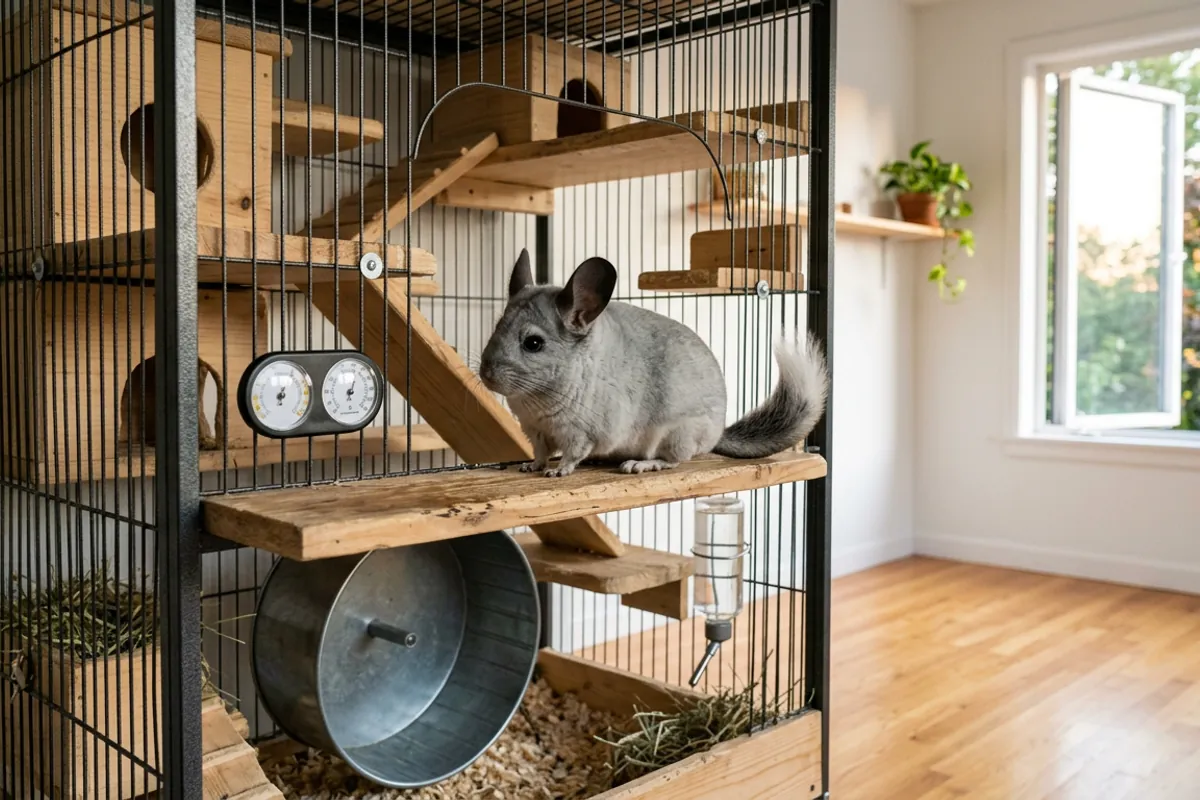
Choose a cage you can actually clean. A tall metal and wood cage with a deep solid tray wipes down properly, and metal does not scuff and hold residue the way plastic does. Plastic has no business in a chinchilla cage in the first place, because they chew it. Critter Nation double unit small animal cage As an Amazon Associate I earn from qualifying purchases.
Get the bedding right. Kiln dried pine and aspen shavings are the standard safe choices, and cedar is out permanently because of its aromatic oils. Very fine or heavily processed paper beddings can add dust of their own. Fleece liners cut airborne bedding dust noticeably, which makes them tempting here, but they need washing often and some chinchillas chew fabric, which is an ingestion risk you have to watch for.
Clean often and gently, in clothes you take off afterward. Spot clean the tray daily so a full strip out is a small job rather than a dust storm, then wash your hands and change your shirt. Fine dust rides fabric straight to the sofa.
Ventilate deliberately. Air exchange is the cheapest allergen control there is, and it has to respect the temperature rules, which is the next section.
What you cannot trade away to breathe easier
Everything above changes the human side of the equation. Here is what I see people try instead, where the cost quietly lands on the animal.
Do not stop or drastically cut dust baths. That coat is far too dense to stay healthy without the dust, and a permanently oily or damp coat invites fungal skin infection. Change the venue and the technique, never the fact of it.
Do not humidify or mist the room to keep dust down. This is the one that makes me raise my voice. Humidity is the multiplier on heat danger. Chinchillas are comfortable at 60 to 70°F (15 to 21°C), above 75°F (24°C) is genuinely risky, and 80°F (27°C) or higher is an emergency, and every one of those numbers turns dangerous sooner in humid air. Pebble came to me from a rehome out of an overheated attic, and her first summer here brought a heatwave near miss and a night at the emergency vet. So I will not soften it: dust control is never worth adding moisture and heat to the room. Keep a thermometer and hygrometer at cage height where the animal actually lives, not on the far wall. digital thermometer and humidity gauge with remote probes As an Amazon Associate I earn from qualifying purchases.
If you want to sanity check your own room, the heat safety guidance and the heat danger calculator will tell you where you stand.
Do not exile the cage to a garage, basement, shed, or conservatory. That solves your symptoms by moving the animal into temperature swings, fumes, and a spot you will check far less often.
Do not bathe a chinchilla in water, for any reason, including allergen control. The coat holds water against the skin and takes a very long time to dry, which is how you get a chilled animal and a fungal infection.
When your chinchilla is the one reacting
Now the other half of the question. Owners describe a chinchilla sneezing in bouts, rubbing her face, squinting, running watery eyes, or carrying flaky skin and a rough coat, and they ask which allergy it is.
The honest answer: diagnosed true allergies in pet chinchillas are not a well established, commonly documented thing, not the way flea allergy in dogs is. That does not mean it never happens. It means that when I see those signs, allergy sits well down my list, and something likelier is usually in plain sight.
What I check, roughly in order:
- Airborne irritants in the room. Cedar shavings, scented bedding, plug in air fresheners, scented candles, incense, aerosol sprays, cleaning products, perfume, cigarette smoke, cooking smoke. A chinchilla has small, sensitive airways and no way to leave the room. Strip all of it out first. It costs nothing and it resolves more cases than anything else here.
- Dust in the eyes. A bath house left in the cage all day, or a coarse sandy product sold as bathing dust, will make eyes water and squint. Ten to fifteen minutes, then out.
- A respiratory infection. This does not clear up when you remove the scents, and chinchilla respiratory illness can get serious quickly. Sneezing that keeps going is a vet case, not a wait and see case.
- Skin problems that look like allergy and are not. Dry flaky skin and fungal infection such as ringworm cause far more itching and coat damage than mites, which are much rarer in chinchillas than the internet suggests.
- Fur chewing. The causes are genuinely debated, with stress, boredom, genetics, and diet all argued for, and I have not seen allergy make a convincing case among them.
Call an exotics vet the same day if you see labored or noisy breathing, breathing with the mouth open, a hunched lethargic posture, appetite falling off, droppings getting smaller or fewer, wet or matted fur around the nose or eyes, or sneezing that carries on beyond a day or two. Chinchillas are prey animals and hide illness until they cannot. By the time it is obvious to you it has usually been building for a while, so find that vet before you need one.
When to see a doctor, and the call I hope you never face
On the human side there is a clear line. Wheezing, chest tightness, shortness of breath, hives, or anything involving your breathing is a doctor's problem, not a forum's. Do not manage asthma with an open window and optimism.
One thing worth knowing before the appointment: there is no standard commercial chinchilla allergen test the way there is for cat or dog. Skin prick panels typically cover cat, dog, horse, mouse, rat, rabbit, guinea pig, grass pollens, and molds. That is still useful, because grass pollen and mold are exactly what a daily hay habit exposes you to, and a positive there often explains the entire picture. Ask what can actually be tested, and mention the dust bath specifically, because most clinicians have never had to think about volcanic pumice powder as a household exposure.
Then the part nobody wants to write. Sometimes management is not enough, particularly with asthma, and particularly with a child in the house. A chinchilla rehomed to a household that runs the baths properly and airs the room is far better off than one kept where the baths get quietly cut short, the window stays closed, and the cage ends up somewhere it should never be. If it comes to that, do it properly, through a rescue or a breeder who takes animals back, and be honest with the next keeper about why.
For most people it does not come to that. The dust goes in an enclosed house in a ventilated room, hay gets refilled by an open window, the cage stays out of the bedroom, a purifier runs day and night, and life with a chinchilla carries on. Make the changes on your side of the glass, not on hers.